
Santa Barbara closed State Street to help businesses. Would SLO shut down Higuera?
READ MORE
Designing Downtown
A Tribune special report looking at the future of downtown San Luis Obispo.
Expand All
Editor’s note: This story is one in The Tribune’s ongoing “Designing Downtown” series examining how San Luis Obispo is coping with economic change and the pandemic while exploring what the city core might look like in the future.
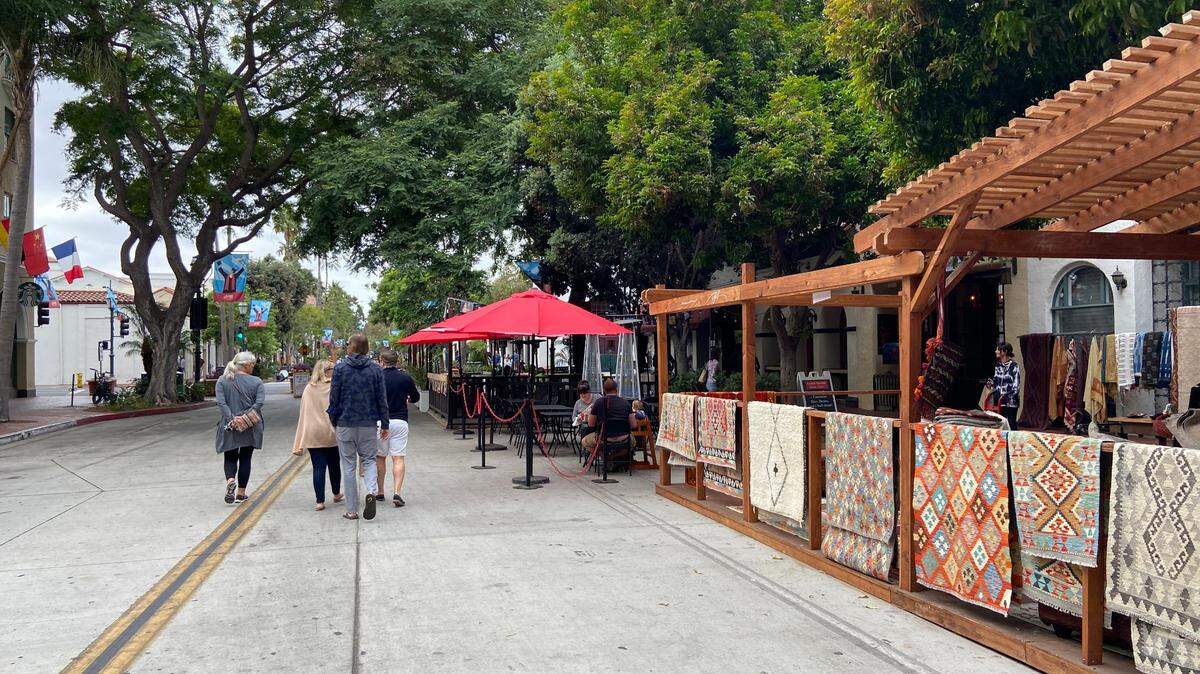
In an effort to save struggling businesses and boost its downtown economy, Santa Barbara shut its main street to vehicle traffic in place of a pedestrian-friendly promenade.
The move, which came near the beginning of the pandemic in May 2020, successfully drew people to the town center and helped businesses, according to city leaders.
Santa Barbara’s experiment have led some to wonder whether something similar could happen here.
Would downtown San Luis Obispo block off Higuera Street 24 hours a day?
Why Santa Barbara closed State Street
Santa Barbara, a popular tourist destination like SLO, closed State Street to traffic 18 months ago along eight city blocks to help boost the downtown economy.
Businesses set up shop in new outdoor parklets, the closure opened up more space for bikers and walkers, and decorative improvements like planters made the area more attractive.
“The resident population just absolutely loved it,” said Jason Harris, Santa Barbara’s economic development director. “People came out in droves.”
The pandemic-driven economic response has evolved into a European-style cafe, restaurant and retail plaza scene — a shift Santa Barbara plans to make permanent as the City Council considers a long-term plan for the area.
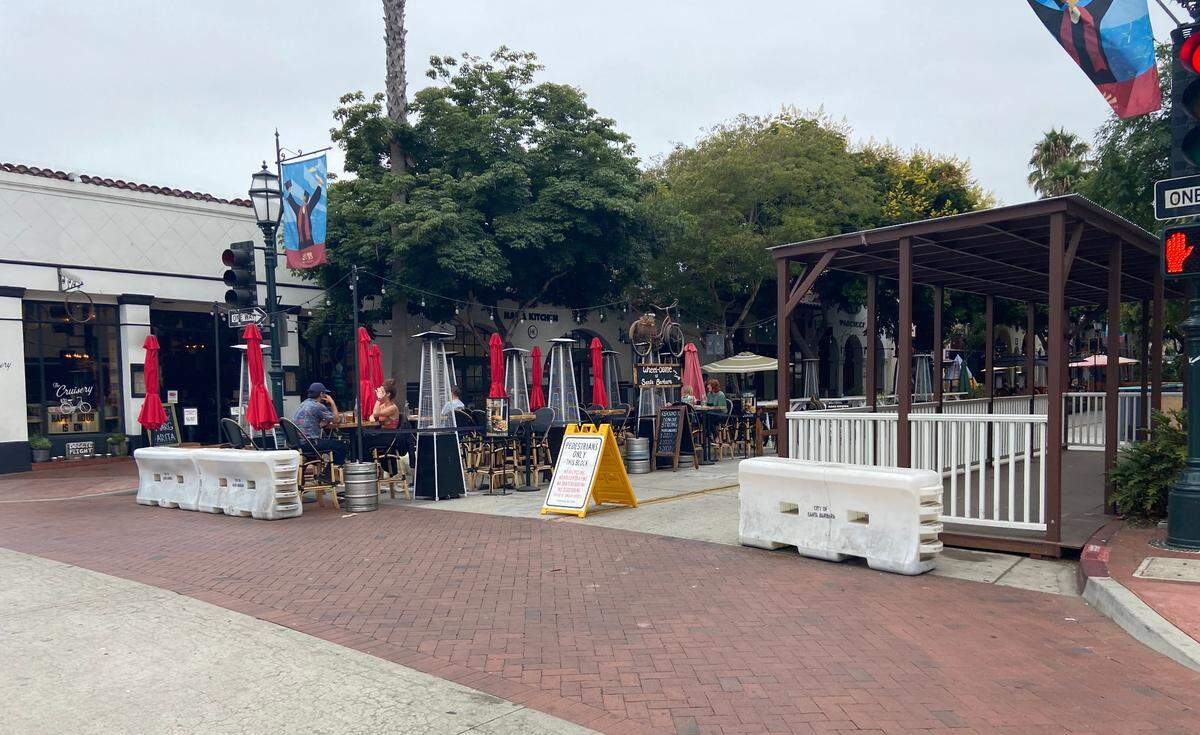
“Closing State Street was a combination of serving businesses in the commercial district and creating a new public space for the public to enjoy,” Harris said. “The very first weekend we closed it, families came out teach their kids to bike because there’s really no other public space like it in the city — a mile-long, open corridor.”
Harris added: “It was very popular and, in due course, business has really started to build out and create both the parklets and outdoor operations.”
SLO experimented with street closures
Would a similar experiment work in downtown San Luis Obispo?
Not likely, SLO leaders say.
“We tried it, and it just didn’t work for the mix of businesses in our downtown,” City Manager Derek Johnson said.
Amid the height of pandemic shutdown in July 2020, San Luis Obispo experimented with limited closures of sections of Higuera between Osos and Nipomo Streets for about a month — retaining side street traffic flows.
Monterey Street also was blocked off to cars between Chorro and Osos streets to serve as an extension of Mission Plaza.
But SLO officials heard from downtown businesses that the pilot program, closing centralized street sections, wasn’t working for them.
“It’s just a much different dynamic down there (in Santa Barbara),” Johnson said. “They had Macy’s close, Nordstrom close, Sak’s Fifth Avenue close. They had blocks where there was basically no one there. We had businesses we still needed to keep alive by having traffic come through.”
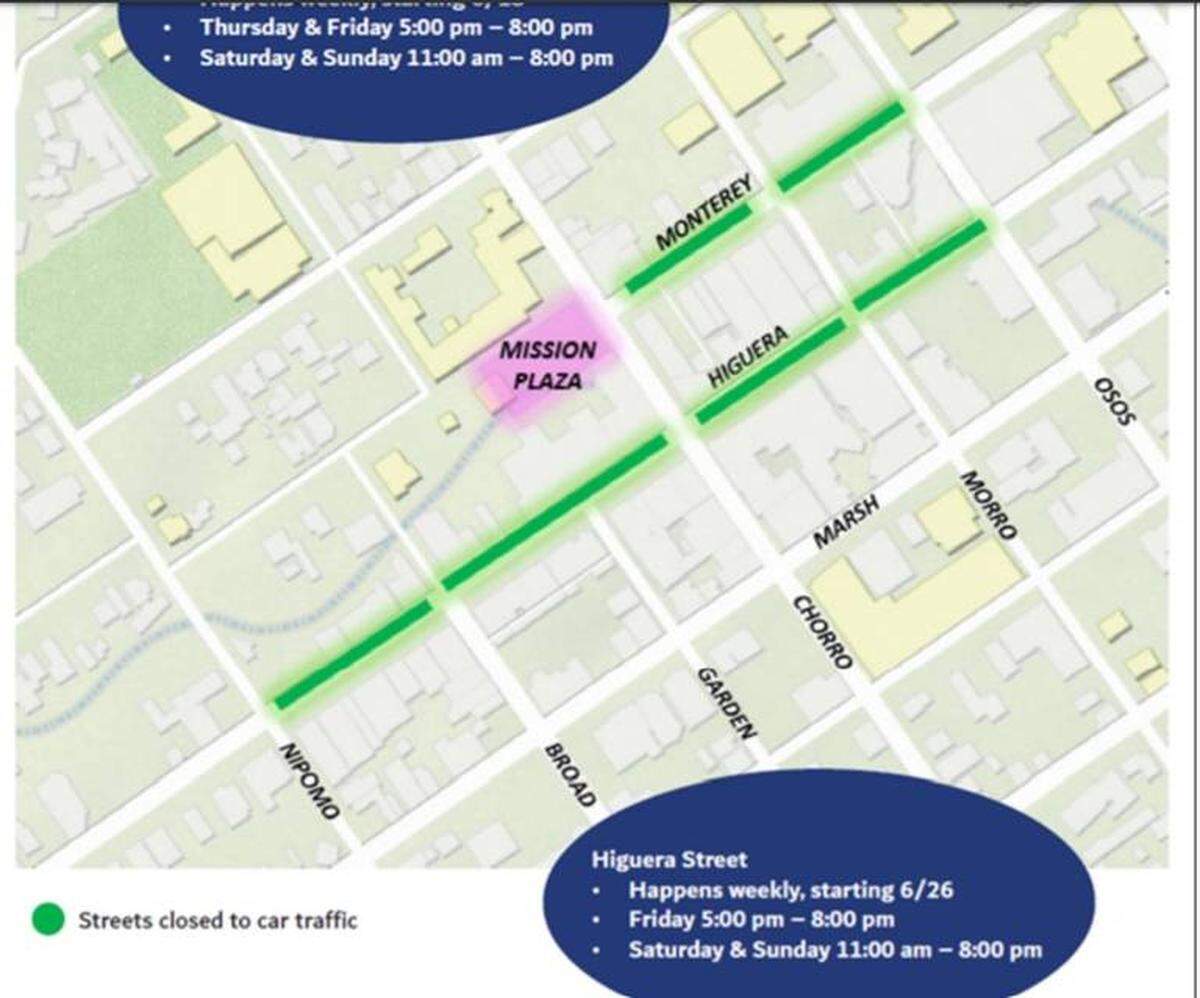
The city ultimately decided to close only one Monterey Street lane near the Mission, which remains a blocked space for a parklet and pedestrian zone.
SLO’s economic development manager Lee Johnson said many of the Santa Barbara businesses lining State Street are restaurants or vacant tenant spaces.
That pushed Santa Barbara to make the switch, because restaurants can benefit from outdoor dining more so than retail shops, Johnson said.
“Retail stores don’t benefit as much from closed streets because of the parking,” Johnson said. “If you look at Higuera, the mix is way higher retail. The anecdotal feedback we have is businesses were extremely happy with the outcome of the parklets, and that’s the path we’ve said is the right one.”
BEHIND THE STORY
MOREIntroducing: Designing Downtown
Downtown San Luis Obispo is facing a pivotal moment — and you can be a part of its future.
Why we did this story
Downtowns across the United States are at a turning point: The rise of online shopping forced a decline in brick-and-mortar storefronts at the same time that a housing crisis and growing environmental awareness are pushing cities to reexamine these traditionally retail-driven corridors.
Meanwhile, the coronavirus pandemic sped up the retail shutdown, leaving vacant downtown storefronts with very little unified discussion over what should fill them.
We at The Tribune believe this presents an opportunity for dialogue with the community: What should the downtown of the future look like?
Through an ongoing series called Designing Downtown, we are exploring the many potential ways that downtown San Luis Obispo (and other shopping corridors throughout San Luis Obispo County) can best serve their communities.
We’ll explore the various visions for what a downtown should be, and what it could be. We’ll talk with business owners about what they need. We’ll talk with city officials about what they hope for. And we’ll talk with you, the public, about what you want.
Together, we can shape the future of downtowns in San Luis Obispo County.
How you can help us
The Tribune is eager to engage with the public as we embark on this project — we want to hear from you about what you want in your downtowns.
To do this, you can fill out our Google Form here.
You can also send your thoughts and comments to reporters Nick Wilson (nwilson@thetribunenews.com) and Kaytlyn Leslie (kleslie@thetribunenews.com).
Business owners weigh in
For their part, SLO business owners say that closing a street would need to address delivery and traffic concerns, though at least one city business owner who has a shop in Santa Barbara as well is all for it.
Levent Derdiyok, who opened Lokum in September, said he has seen the benefit of street closure in Santa Barbara, where he first opened his Turkish delight business.
“I definitely think SLO should do it,” Derdiyok said. “I’m moving forward with planning a parklet now and talking with the city, which is going to be good, but it’s still going to be better if they shut down the streets. When there are no cars, it’s going to bring more people for sure.”
Cherisse Sweeney, owner of Basalt Interiors, said that she could envision some weekend street closures perhaps one day, but “until we have a better plan for delivering goods and services (to retail stores), then it it would be challenging” to have any 24-hour closures, Sweeney said.
Her store, which supplies home decor, furniture, bath and bedding and more, only has delivery access from Higuera Street.
Sweeney added: “I think the most important thing is to not confuse people even more with the flow of traffic. People get frustrated, and it’s hard to get them back.”
Sweeney added homelessness and safety issues with downtown vagrancy remain her highest concerns.
“My employees don’t feel safe,” Sweeney said. “It means we have to double up on staff and pay extra for parking so they don’t have to walk to the structures. It’s challenging, that’s for sure.”
Breanne McLaughlin, owner of SeaBreeze Cupcakes & Sweet Treats in the Creamery, said that she has “mixed feelings about closing off streets.”
McLaughlin said it has been great for restaurants in particular to be offered street space for parklets and the pandemic made it necessary to “think outside the box.”
“I love Santa Monica’s pedestrian walk, but I feel like their downtown is bigger than SLO’s and logistically speaking blocking a main street like Higuera might make things little more difficult for business delivering and unloading of supplies and limit exposure for those who might just drive through,” said McLaughlin. “And parking has always been challenging in SLO. I know some folks will avoid downtown because it’s not convenient to park and shop with your car nearby.”
Downtown SLO CEO compares cities
Downtown SLO CEO Bettina Swigger pointed out differences between San Luis Obispo and Santa Barbara, explaining why a closure was appropriate there as opposed to here.
“Santa Barbara has a larger population,” Swigger said. “It’s a much closer distance to a major metropolitan area. And it also has proximity to the beach on the oceanfront in a way that we just don’t. I love Santa Barbara. But I don’t see it as a comparable downtown.”
National chains like The Gap and Express shuttered in SLO in recent years, but not to the extent of Santa Barbara’s big brand departures, she said.
“It’s important to have a healthy mix of both locally owned businesses and those national kind of anchor stores,” Swigger said. “I think we’re really lucky in San Luis Obispo to have an Apple store, for example. That’s a big draw to our downtown.”
Swigger added: “Unfortunately when a national chain store closes, it can feel personal to San Luis Obispo. And it’s seldom based more on than how a spreadsheet was getting analyzed in whatever corporate office they may be.”
Swigger also said that community members in SLO were used to seeing Higuera closed for the Thursday Night Farmers Market. The concept wasn’t novel and likely more “exciting to other communities that hadn’t had that type of activation before,” Swigger said.
Swigger said business owners also quickly realized in closing streets, the “lack of parking wasn’t being solved.”
“It didn’t work here,” Swigger said. “And I think it’s really because people expected it to be Farmers Market and they were disappointed when it wasn’t. That’s when more parklets and downtown dining started getting deployed. That was a more popular program.”
SLO Chamber CEO weighs in
San Luis Obispo’s Chamber of Commerce CEO said that Santa Barbara had a “lot less to lose” by closing its main thoroughfare.
“They had to make a drastic shift,” Jim Dantona said. “And if we were in that same place, we might have closed Monterey. But not having to make the drastic shift and getting people used to things in a slower fashion, to see that it works, was better for SLO.”
Dantona added: “I think you’ll see a much more phased, systematic approach to looking at different and new ideas that make our downtown feel like a place you want to hang out.”
Dantona said activities that took place over the Christmas holidays like a movie screening projected on the Ah Louis store building and holiday displays helped draw people to town and bring vibrancy.
“They wouldn’t have done that (the movie screening) but for the pandemic, and then once it happened, everybody went, ‘Oh my gosh, that’s amazing,” Dantona said.
Building a Better SLO series
While a closure of Higuera may not be in the offing now, the idea of converting more downtown space from vehicle to pedestrian use remains attractive.
As part of the recently launched “Building a Better SLO” series, which held its first speaker event in October, international urban designer Blaine Merker cited examples of cities around the world, such as Copenhagen and New York (Times Square), where creating public spaces such as plazas and promenades have led to positive change.
Cities that have transitioned busy hubs from traffic or parking to visually appealing parklets, walkways and public lounge areas have found that the change helped reduced crime, improved retail business by bringing more foot traffic, and encouraged community interactions among people of different social classes, Merker said.
“People making less than $50,000 are likely to make connections in public spaces,” said Merker, managing director of the firm Gehl, which is based in San Francisco. “People also are much more likely to frequent businesses because they’re not just passing through. Data has shown the stickiness rate (people staying in an area versus passing through) goes way up.”
Flipping design patterns to encourage pedestrian use of streets versus vehicle traffic use also helps reduce climate change, attract tourism, and support local economies, he said.
“We’re missing an opportunity if we don’t rethink and reprogram how we tend to traditionally use streets, which is to store metal (cars),” Merker said.
The organizing team involved with the Building a Better SLO is made up of a group of local leaders and industry experts seeking to “benefit our economy, culture and environment” through discussions on arts and culture, equity and inclusion, innovative housing, outdoor spaces, and more.
The organizers are Andy Pease, Jim Duffy, Greg Wynn, Molly Kern, Matt Ritter, Will Ruoff, and Beya Makekau.
Coming tomorrow: The pandemic hit Santa Barbara harder than San Luis Obispo. Here’s what the city did to help its businesses.
Correction: This story has been updated to identify the Building a Better SLO organizing team.
This story was originally published November 11, 2021 at 5:00 AM.
%20Cropped.jpg)