
What will downtown SLO look like in the future? Here’s a glimpse at what’s planned
READ MORE
Designing Downtown
A Tribune special report looking at the future of downtown San Luis Obispo.
Expand All
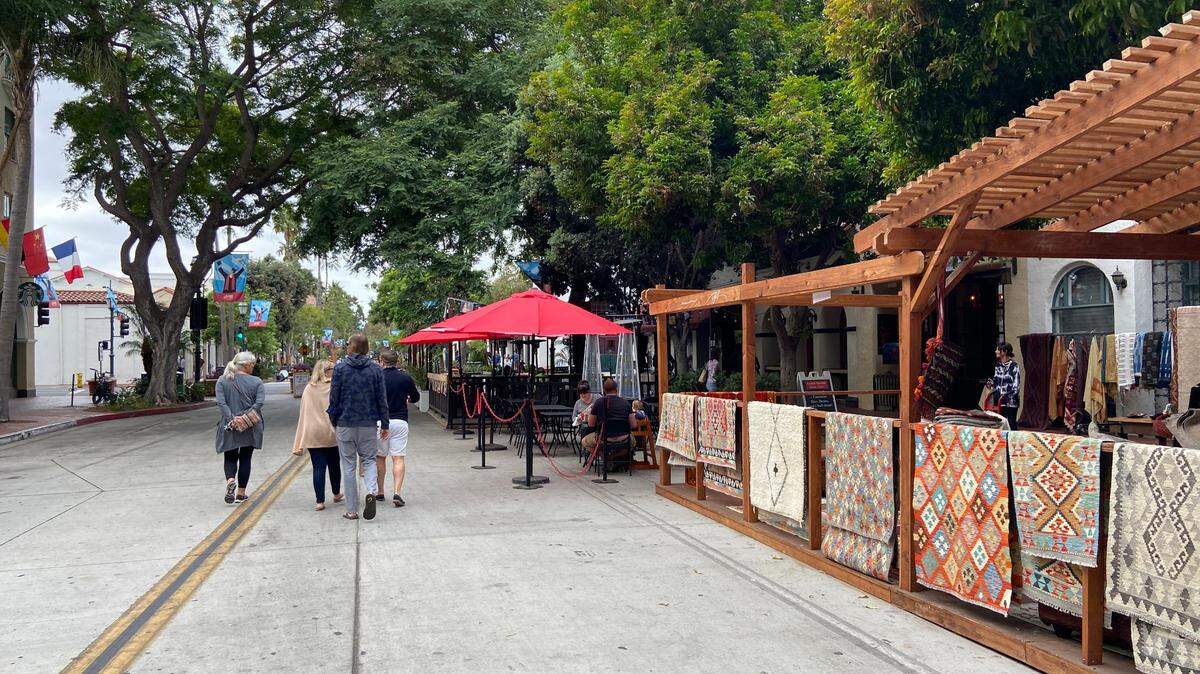
Editor’s note: This story is the first in an ongoing series called “Designing Downtown,” examining how San Luis Obispo is coping with economic change and the pandemic while exploring what the city core might look like in the future.
If you ask people how downtown San Luis Obispo is doing, you’ll get a variety of opinions.
Some complain about parking.
Some lament the loss of longtime family-owned stores which have left gaping vacancies in key spaces on Higuera Street after decades of serving faithful local shoppers.
Others point to a relatively healthy downtown economy that’s adapting to cultural shifts and consumer habits.
A host of new businesses have popped up in recent months, adding fresh retail draws to downtown.
Since its return after pandemic restrictions, SLO’s Farmers Market and Concerts in the Plaza were well attended over the summer, city and community leaders say.
And two new luxury hotels (Hotel SLO and Hotel Cerro) show that private investors believe the city’s central hub remains a place to be.
Despite those trends, most agree that long-term challenges and uncertainties exist in maintaining a healthy retail economy, along with how best to transition in an evolving marketplace.
“It’s hard to say right now exactly how the retail economy will move, but we have a lot of foot traffic downtown and it’s a great place to experience products and to introduce a lot of excitement,” said SLO Community Development Director Michael Codron.
Business vacancies
The past few years have presented new and unique challenges to SLO’s city core.
The most noticeable result has been a pattern of vacancies downtown as new businesses try to establish themselves in a fluctuating retail environment made more tenuous by the COVID-19 pandemic.
Vacancies left by the closures in recent years of Charles Shoes, Beverly’s, Aaron Brothers — and the move of Giuseppe’s to a new location at 849 Monterey St. in 2016 (its old space remains empty five years later) — create commercial dead spots that haven’t been quick to fill and are hard to ignore.
In general, city and local business leaders say downtown visitors are seeking experience-based shopping and cultural offerings over products they can easily find online, city officials say, veering from the large chain store model.
“Obviously those bigger (empty storefront) spaces do create a challenge, especially as we look at the future of retail stores and generally thinking that maybe a smaller footprint is the way to go, giving more of an experience so people can interact with the product,” Codron said.
As a result, boutique shops, product presentations and store activities have been on the rise, as well as gathering spaces for people to spend time as well as money.
“People spend money when they’re on vacation,” said Bettina Swigger, CEO of Downtown, a nonprofit group that works to ensure an economically vibrant downtown. “They’re probably not going to go back to the hotel room and shop on Amazon. But when they walk by a cute shop, they’ll pick something up.
“There’s been a shift toward the experience-driven economy across the board,” Swigger added. “And that’s true in our restaurants and our fine-dining community and our retail in some of the cultural organizations that have been successful downtown.”
City officials said that the number of empty storefronts is trending in a positive direction after peak pandemic impacts, with the addition of a host of new businesses that include Teazer World Tea Market, Anthropologie, Lokum, SLO Delicious Bake Shop, Chinelo restaurant, Buen Dia and Battle Axe, along with 1039 Park, Wetzel’s Pretzels and Rocket Fizz.
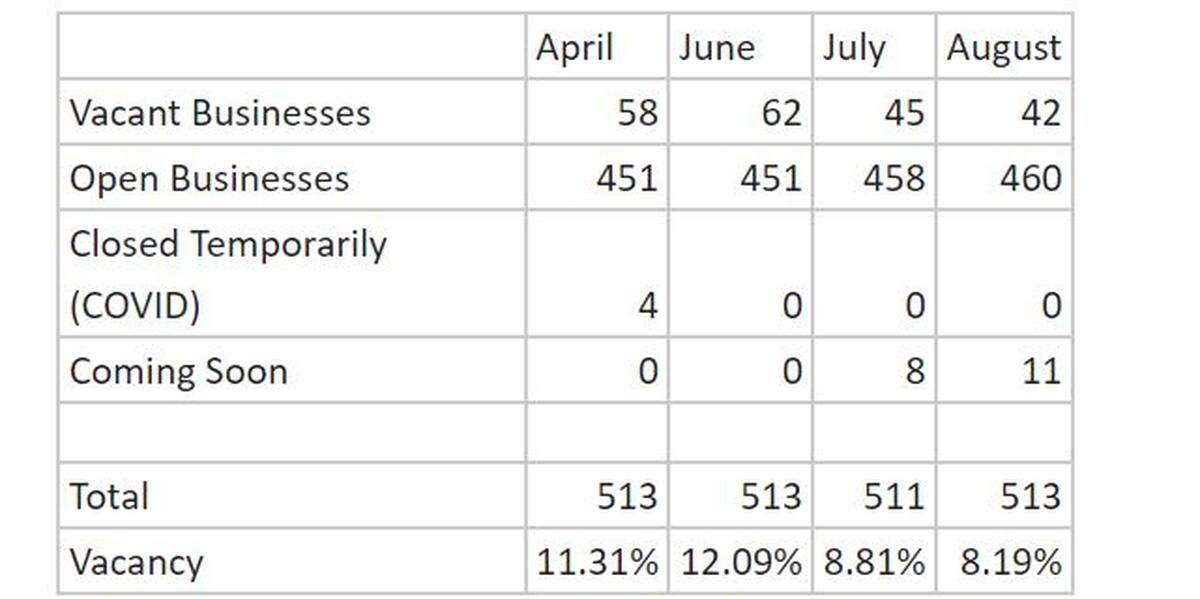
The number of vacant downtown businesses spaces dropped in recent months, from 58 in April to 42 in August, SLO officials say, out of 513 total businesses downtown. That’s an improvement in the vacancy rate from 11.3% to 8.2%.
And SLO officials believe tourism is rebounding sooner than expected as well, according to “Top 3 Takeaways from SLO’s Tourism Annual Report,” including a 10% increase in total transient occupancy tax (TOT) collected in 2020-21 compared to the previous year, which saw a severe drop in travel in spring 2020 due to COVID-19 restrictions.
Attracting new businesses to downtown
As a planning roadmap for decades to come, the city’s visionary Downtown Concept Plan — formed by a group of citizen leaders and adopted by the City Council in 2017 — serves as a block-by-block guide for potential future public and private construction and re-design of the city core.
The plan’s general themes include preserving SLO’s art, culture and history while making it easy to walk, bus and bike — as well as using public spaces in innovative ways, such as parklets.
Mixed-use projects and high-density housing, along with reduction of car travel in favor of pedestrian zones, also are encouraged.
On the retail side, the key question is, can the city bring in new businesses that people want?
Codron said “there’s a lot of excitement” from the community about possibly turning a large empty commercial space into a new marketplace with a collective of multiple smaller tenants, similar to the SLO Public Market concept. But that’s dependent on property owner and investor interest, Codron said.
“We’re sort of limited by the property owner’s imagination,” Codron said. “We need the property owner to initiate the proposal and bring something forward and then we work with them.”
Many of the proposed projects coming in look to blend living space with businesses.
A plan for the block between Higuera and Marsh street where the old Foster’s Freeze site is located has a plan for mixed-use project featuring 51 residential units, three commercial storefronts and hotel.
“It’s now a phased development and currently going through permitting with the city building department,” said project developer Taylor Judkins. “The first phase, which is 28 units and a commercial storefront on Higuera, should be ready to break ground in the first quarter of 2022. The second phase is the Foster Freeze hard corner, and that is also under permitting with the city but will be built second. That is 23 units and up to two commercial storefronts.”
Judkins added: “The third phase is the hotel units. The number of units is still under flux.”
A separate six-story 1144 Chorro St. project calls for housing on the top three floors and retail and offices below.
And another plan to renovate the Network Mall would bring new housing on three floors about restaurant and retail space on the ground floor.
The city is also looking for ways to upgrade its public spaces.
The city’s Mission Plaza improvement — which calls for replacement of the restrooms and the addition of a kiosk — is a public project that fits with the Concept Plan vision.
“We have projects that are coming in that are implementing the project plan, such as the plan for 1144 Chorro and the (Network Mall) replacement,” said City Manager Derek Johnson. “... We know we need to make public investments as well.”
Can the city influence private development?
Community leaders say it’s important to know that city government can’t directly influence a developer to build a certain project or control whether a specific business comes to SLO or stays.
Government planning and development guidelines also don’t have direct power over rent costs, or if a landlord chooses to leave a space vacant for long periods, as has happened with the old Giuseppe’s and Aaron Brothers spots.
“People think government can pitch to a certain business and get them to come in,” said Jim Dantona, the SLO Chamber’s CEO. “Back when I was doing land-use development in Los Angeles (as a political aide to L.A. Council member Nury Martinez), I would get asked, ‘Jim, why can’t we get to Trader Joe’s?’”
Dantona said: “That’s because Trader Joe’s has done a market study, and they know exactly where they want to be. No matter what I tell them, they’ve done their math. If people want a Starbucks or art gallery or whatever, we can’t go in and tell them to build it here.”
Nonetheless, SLO’s leaders say they often meet with corporate representatives who express interest in projects or businesses, and they hear from residents about needs and public comments on building design.
“We talk all the time with people about ‘Hey, this is what we need. This is what would be cool. We’re looking for this type of experience,” said Lee Johnson, the city’s community development director. “The (regulatory) flexibility that we’ve built into downtown is what makes new types of businesses possible. We’ve seen the new Turkish coffee shop, bakeries, a tea shop, galleries, a really diverse mix. But that’s because you can do almost anything down there, and you can have different typologies and different mixes that make the financials work.”
A “healthy vacancy rate” can be an opportunity for “the next great business” to launch, and “no vacancies would present hindrance to entrepreneurship,” Codron said.
The national retail (all retail) vacancy rate has drifted upward since late 2018, acccording to the Federal Reserve Bank of Atlanta, part of the central U.S. banking system.
The Atlanta Fed posted 2021 data on its website: “By the first quarter of 2021, the all retail vacancy rate stood at 5.1 percent. However, recent trends by property subtype vary widely, ranging from a low of 3.2 percent (general retail) to a high of 7.9 percent (neighborhood centers).”
In comparison, SLO’s business vacancy rate was at 8.3% in September.
SLO officials brainstorm about project ideas with developers and business owners, building plans and seeing how they match up with zoning and regulatory requirements, they say.
Of late, the city has worked to provide financial support and fast-track permitting of tenant improvements through its TIPP-FAST program, which offers discounts on tenant improvement fees.
More than 20 permits have been processed for new business improvements since the program launched in fall 2020, normally a one-week turnaround time from application to issuance, said Whitney Szentesi, SLO’s public communications manager.
“Twenty-three projects have received refunds in the amount of $48,596 for costs associated with opening up their doors,” Szentesi told The Tribune in an email on Oct. 8.
What does the future hold for filling vacancies, shaping public infrastructure, and making sure SLO remains economically stable?
BEHIND THE STORY
MOREIntroducing: Designing Downtown
Downtown San Luis Obispo is facing a pivotal moment — and you can be a part of its future.
Why we did this story
Downtowns across the United States are at a turning point: The rise of online shopping forced a decline in brick-and-mortar storefronts at the same time that a housing crisis and growing environmental awareness are pushing cities to reexamine these traditionally retail-driven corridors.
Meanwhile, the coronavirus pandemic sped up the retail shutdown, leaving vacant downtown storefronts with very little unified discussion over what should fill them.
We at The Tribune believe this presents an opportunity for dialogue with the community: What should the downtown of the future look like?
Through an ongoing series called Designing Downtown, we are exploring the many potential ways that downtown San Luis Obispo (and other shopping corridors throughout San Luis Obispo County) can best serve their communities.
We’ll explore the various visions for what a downtown should be, and what it could be. We’ll talk with business owners about what they need. We’ll talk with city officials about what they hope for. And we’ll talk with you, the public, about what you want.
Together, we can shape the future of downtowns in San Luis Obispo County.
How you can help us
The Tribune is eager to engage with the public as we embark on this project — we want to hear from you about what you want in your downtowns.
To do this, you can fill out our Google Form here.
You can also send your thoughts and comments to reporters Nick Wilson (nwilson@thetribunenews.com) and Kaytlyn Leslie (kleslie@thetribunenews.com).
Here are key adoptions of the Downtown Concept Plan so far:
Parklets and rootop patios
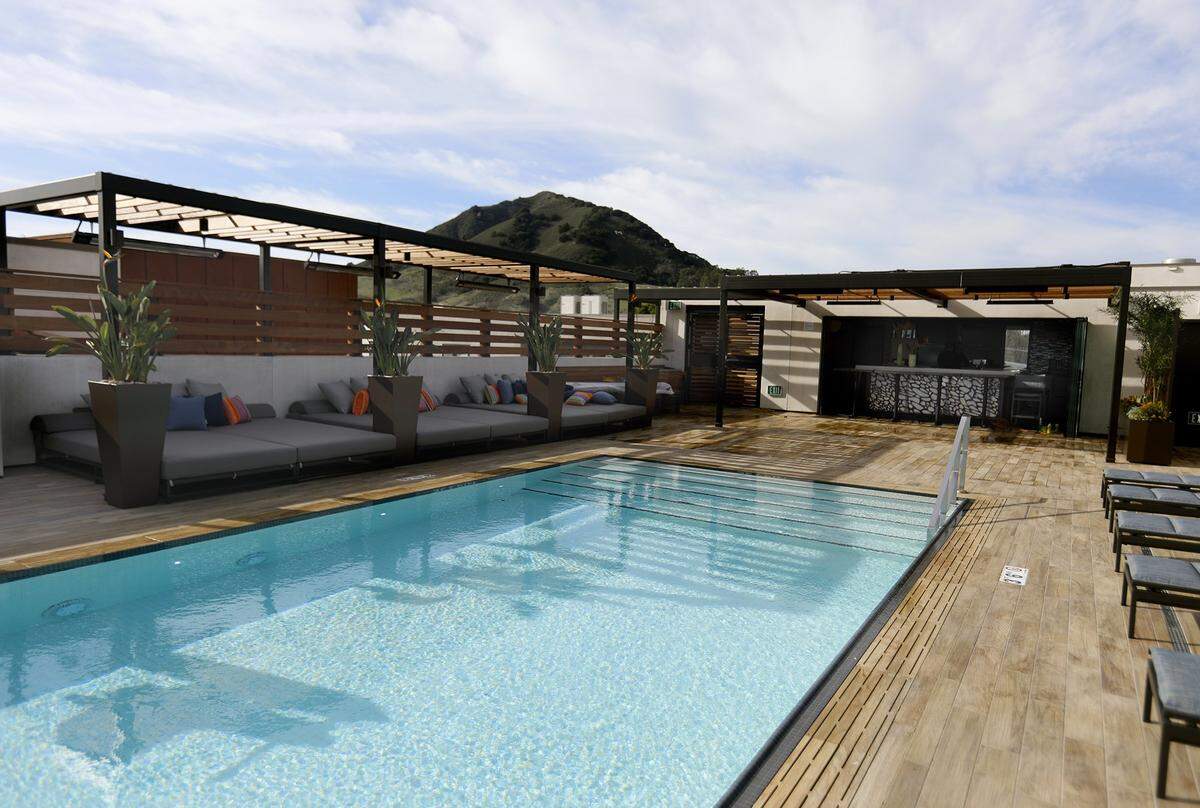
One of the core principles of SLO’s design concept involves incorporating parklets and rooftop public spaces to offer visitors a place to hang out and enjoy the downtown.
Hotel SLO and Hotel Cerro have new rooftop bars with bird’s-eye views of SLO. Rooftop spaces are popular amenities in bigger city bars like Perch in Los Angeles and Charmaine’s in San Francisco.
Before the pandemic, many leaders thought parklets would happen more gradually, but the need to adjust with outdoor dining and shopping forced the city to act quickly.
Now there are around 30 parklets in use citywide, with a permanent program approved by the City Council this year.
“I think the parklets are the most rapid acceleration of what downtown can be conceptually and they’ve provided such a wonderful European sensibility to the downtown,” said Bettina Swigger. “It’s been really fun to see the way the parklets integrate into Farmers Market.”
Existing and new businesses have embraced parklets, from Big Sky Cafe to Novo to Lokum, whose owner plans to build one after opening the store in September.
“The parklets saved Big Sky Cafe,” said owner Greg Holt. “Extra outdoor exposure helps attract customers. We are willing to pay the city to keep the parklet. The outdoor rent is well below market rate by the square foot (for building space).”
Holt said that he seats up to 25 people with five tables outdoors, helping his business stay nimble and weather the economic storm of COVID.
“To use a baseball analogy, before, I was a a power hitter getting fastballs and all of a sudden I had to learn how to hit curveballs,” Hold said. “And it taught me a lot and showed that everything doesn’t have to be exactly the same forever and ever.”
Novo tends to use its parklet Thursday through Saturday night, said its owner Robin Covey.
The business has a bigger footprint and outdoor patio seating in the back of the business already, but on busy nights the Higuera parklet space accommodates the demand.
“I do believe they have been and will be beneficial to the vast majority of SLO restaurants,” said Covey. “I think the parklets have the ability to attract more customers if the restaurants choose to invest in making them inviting and safe. I plan on keeping Novo’s for the long term.”
Swigger wasn’t sure how people would react to the parklets at first, but now, she said, “I can’t imagine what it was like before them, because you have areas where there will be a parklet and the customers are sitting in the park, enjoying their drinks, maybe having a beer, and they’re facing the market.”
Swigger added the setup “is designed to bring people here, help them stay longer, and spend more money.”
Codron, SLO’s community development director, said the parklets have helped build a “better, strong downtown. ... We’re learning a lot in the process.”
Biking and lighting
Adding space for people to more easily bike through downtown, along with improved lighting, are key components of the Downtown Concept Plan as well.
In summer 2020, the city added a green-striped bike lane on Higuera to clearly distinguish the space dedicated to cyclists.
It’s not a separated pathway divided by planters or bollards, as many bicycle advocates hoped and as the Downtown Concept Plan suggests, but it’s a start to gauge the effectiveness of bike improvements.
“There are things that we want to expand and support going forward,” Codron said. “It gives us the ability to evaluate how people use it and what their feelings are about about using that facility. We can see how it functions with parking and pedestrians, then put our plans together in the future for what the ultimate Downtown Concept Plan improvement is going to be.”
As for the zigzag, string lighting that hangs over the main city streets, Swigger said that was a feature that Downtown SLO encouraged for decoration.
“Many years ago, when we did the light up downtown holiday program, we got to keep the zigzag lights and that has been such a value add for all of downtown,” Swigger said. “It just looks so beautiful at night and, not to sound like ‘The Big Lebowski,’ but it really pulls the town together.”
How housing fits into downtown
One major change that’s well in the works calls for integrating more housing into the downtown core.
In fact, it’s such a key element that the city requires every new development project downtown to include housing, and “we’re working on new programs to increase the density of new housing,” Codron said.
Business leaders cite the benefit of housing downtown because full-time residents are especially well located to help support local businesses through dining, shopping and neighborhood vigilance.
“The Downtown Concept Plan encourages a wide variety of housing types to appeal to different demographics, and includes a spectrum of housing options,” the document says. “Residential uses are envisioned to accommodate low-income, workforce, and high-end housing for seniors, families and single professionals.”
Parking districts and parking structures would help accommodate those residents, the plan notes, and car travel could be reduced “by providing services, jobs, and housing in proximity to each other.”
The 1144 Chorro St. property, for example, would bring 50 smaller-sized residences between 318 and 616 square feet on the top three floors of a six-story building, while the Network Mall proposal would add 36 new units of housing on its three upper floors.
Other building ideas in the pipeline could add more downtown residents, city officials say.
“We really see that as setting up the future of downtown for success by embedding residents into a neighborhood where they can be customers and they can be neighbors and they can take advantage of everything downtown has to offer,” Codron said.
Downtown has the most flexible zoning district in the city with the widest range of allowed uses for “development standards in terms of building heights and lot coverage, and the least in the matter of parking requirements, which really contributes to development feasibility, especially with housing,” Codron said.
When will large, empty spaces be filled?
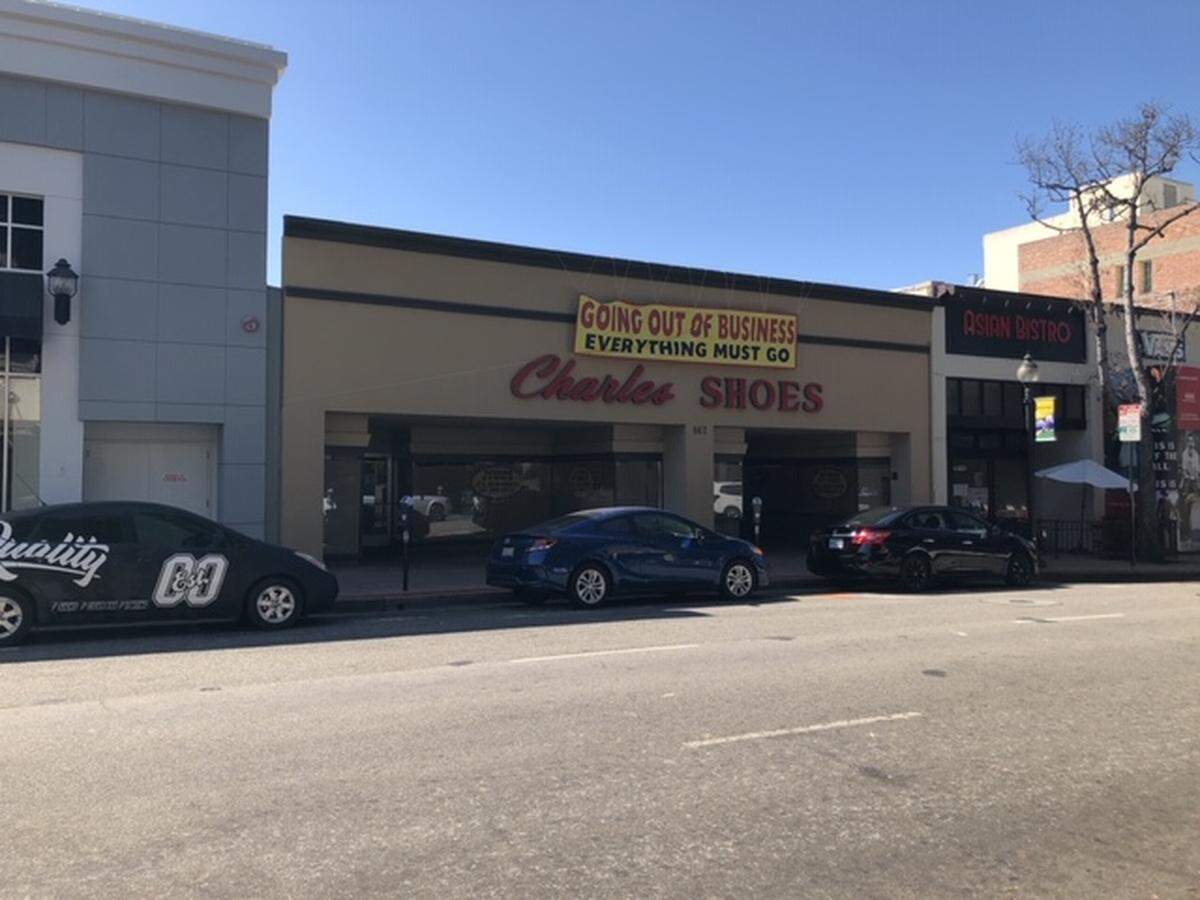
While the future of larger buildings such as the 26,000-square-foot space formerly occupied by Beverly’s and the 6,800-square-foot space long occupied by Charles Shoes remain in the hands of the property owners, SLO officials believe there will be movement on those commercial units.
The commercial buildings could sell or new tenants could move in, depending on how the owners choose to move forward.
Beverly’s closed in November 2020 and Charles shuttered in 2019, both family-owned operations that decided to move on.
It’s unclear if a project such as a marketplace, dividing larger spaces into separated smaller commercial tenants, could move in or whether a new business could fill a larger building.
“The ownership side is waiting to see the shakeout from the pandemic, and it’s been a relatively short period of time,” said Johnson, SLO’s economic development manager. “There are a lot of people interested in investing downtown.”
Codron said the city’s zoning would accommodate for larger commercial floor space to be retrofitted and “essentially carved up into smaller vendor-type spaces.”
The Beverly’s space could be well suited for that because of its size and entrances on both Monterey and Higuera streets.
“We don’t know whether the property owner has an interest in doing that, whether that makes financial sense for the owner trying to lease the space, and so where we come in is just trying to hear what their ideas are and work towards facilitating permits to move their ideas forward,” Codron said.
Representatives from Beverly’s didn’t respond to a Tribune request for comment on what route the property owner may take.
Deputy City Manager Greg Hermann added that “focusing on what’s directly in our control public spaces, public infrastructure and services” encourage investment.
“I think the things that have been allowed downtown and density have made the downtown property extremely valuable,” Lee Johnson said. “There are plenty of people who would buy those places at market-rate plus. So, it’s a question of the market taking its time to sort this out.”
Developer weighs in
Damien Mavis, whose company CoVelop owns and leases spaces in the Creamery on the 570 block of Higuera Street, said that the goal when his group redesigned and renovated the 26,500-square-foot retail center from 2016 to 2018, was to “keep the historic bones” of the buildings that existed there while adding “smaller lease spaces.”
“Our target was to make spaces for an authentic San Luis Obispo collection of shops, services, and food and beverage,” Mavis said. “We weren’t constraining ourselves with what a Starbucks might need with a certain ceiling height or something like that. We knew that they weren’t our target market.”
The tenant spaces are now fully filled with locally owned food and beverage and artisan shops such as such as Nite Creamery, Mistura, Active Coffee, Joliene Bakery, Trio Boutique, and SeaBreeze Cupcakes.
A patio with outdoor seating and walking areas allows people to gather or stroll through and check out the offerings.
“My space has been great,” said Christy Gierson, owner of Trio Boutique. “I think the small space is perfectly manageable after 16 years in business in SLO. I think being amongst all of the great restaurants really has helped my business. I would not want the responsibility of a large store on the main street or the price of rent there.”
Grierson added: “We have higher maintenance fees being in a complex, but hopefully we can keep the rent from rising and encourage new fun small businesses to join in downtown. People always comment how charming the Creamery is and how exciting it is to shop at small businesses.”
Seeking out dining establishments was a purposeful move, Mavis said.
“Food and beverage gathering places were really a focus, and the idea of a place you choose to recreate and hang out with your friends and your family,” Mavis said.
Mavis said because of the online competition “it’s particularly important that you differentiate your place into someplace where people actually want to be.”
“The recent pandemic experience has made people more hesitant to to leave their house so it better be worth it,” Mavis said.
Grierson said: “People love the charm of the history of the (Creamery) complex. Our current free parking is an asset and people say they love it.
Breanne McLaughlin, owner of SeaBreeze Cupcakes & Sweet Treats in the Creamery, said the smaller spaces help people get into a first shop and stay there.
“My space is only a little over 500 square feet and although I’ve outgrown the space, I can’t afford to have a bigger space,” McLaughlin said. “When places are thousands of square feet and $3 to $6 per square foot, that adds up when you have to consider overhead costs. It’s not easy to stay in business and it takes work.”
For his part, Mavis believes that a number of the larger spaces such as the old Beverly’s and Charles Shoes storefronts are “likely to be divided” into smaller business spaces.
“There are a lot of details, but a number of these larger spaces will probably get broken up broken up into a collection of smaller spaces,” Mavis said.
Mavis said mixed-use redesign could be possible as well for bigger empty buildings.
“It certainly is more complicated and you’d have concerns with fire separations for the different uses and sound separations with where you put your range hoods for restaurants, for example,” he said. “They may be going straight up, right next to a residential unit that can be noisy, so there’s a lot to consider.”
Those types of problems would bring more cost.
But Mavis added: “I think it’s very clear that having housing right downtown is one of the keys to both making the downtown safer and supporting the downtown businesses.”
Johnson noted that overall, SLO has weathered the economic and consumer shifts well and has avoided much more damaging impacts that have hit some downtowns.
“We’re not back all the way (after pandemic impacts),” Johnson said. “But downtown compared to almost everywhere has bounced back well, we’re seeing a lot of support, and it’s really been exciting to see.”
Coming tomorrow: As the pandemic hammered Santa Barbara businesses, the city closed State Street to cars. Would SLO close Higuera?
This story was originally published November 10, 2021 at 5:00 AM.
%20Cropped.jpg)