Kristin Smart hearing: Prosecution says ‘other suspects’ in disappearance were ruled out
The lead detective in the case against the men accused in the alleged murder of missing Cal Poly freshman Kristin Smart spent all day on the stand Monday fielding questions about the extent to which investigators looked into people the defense calls “other suspects.”
Witness testimony resumed Monday in San Luis Obispo Superior Court in the month-long preliminary hearing in the case against Paul Flores and his father, Ruben Flores.
Superior Court Judge Craig van Rooyen said in the court’s morning session that the prosecution planned to call Paul Flores’ ex-girlfriend to the stand in the afternoon, but the detective’s testimony ultimately lasted through the day.
The prosecutor, Christopher Peuvrelle, said in court that the woman — identified as Angie C. — would testify that she was hurried away from the backyard of Ruben Flores when she ventured near Ruben’s avocado trees — near where investigators say Smart’s remains were buried.
It is unclear whether the woman will testify on Tuesday.
Prosecutors allege Smart was murdered by Paul Flores during a rape attempt in his residence hall room more than 25 years ago.
Paul Flores, 44, is the last person known to have seen the 19-year-old freshman alive after walking her back from the party toward the Cal Poly campus residence halls on May 24, 1996.
Smart’s body has never been found but investigators believe her remains were buried at the Arroyo Grande home of 80-year-old Ruben Flores, and recently moved. Ruben Flores has pleaded not guilty to accessory after the fact.
Monday marked the fifth day of testimony in the evidentiary hearing for Paul and Ruben Flores, which was originally expected to last about 12 days. Superior Court Judge Craig van Rooyen said last week that it’s likely to proceed through August.
Late last week, the defense posed questions about “other suspects” in the case, including convicted murderer Scott Peterson, who the defense claims could testify in the case. Prosecutors say Peterson was long ago ruled out as a suspect in the Smart case.
Those other suspects were the partial subject of a defense motion to suppress evidence gleaned from dozens of searches over more than two decades. The defense is challenging the fruits of those searches, based on, among other things, investigators’ lack of mention of the “other suspects” in their affidavits to judges when seeking search warrants.
Prior to Paul Flores’ arrest, the Sheriff’s Office made public statements that he is “the only suspect” in Smart’s disappearance.
The preliminary hearing is not being live-streamed and media in attendance are under strict rules prohibiting the use of electronic devices and photographing or recording witnesses in the courtroom.
At the conclusion of the hearing, van Rooyen will rule whether prosecutors established probable cause — a lesser standard of proof than guilt beyond a reasonable doubt — to proceed the case toward trial.
Here’s what happened in Monday’s hearing.
.jpg "Afternoon FLORES1501-2 (1).jpg")
Detective fields more questions about defense’s ‘other suspects’
Testimony began about an hour late Monday morning following an in-chambers conference, during which the defense was provided with records of interviews previously undisclosed to the defense.
Those interviews are related to men that defense attorney Robert Sanger, who is representing Paul Flores, previously said should have been followed up on by investigators as possible suspects.
Those include Shahn Whitted, who had been dating Smart around the time of her disappearance. After they broke up, Whitted burned her shoes on her doorstep and left a “mean note,” according to the defense’s motion to suppress evidence.
On Monday, San Luis Obispo County Sheriff’s Office Det. Clint Cole, the main investigator in the Smart case, testified that Whitted admitted burning Smart’s shoes because he said Smart was spreading lies about him. But Whitted told investigators the two made up shortly thereafter, Cole testified the reports showed.
Whitted said he last saw Smart a couple days before she disappeared.
The defense has also raised the question of whether Smart was pregnant at the time of her disappearance. They contend that investigator reports from the late 1990s shows she had dated a fellow student named Sean Farrell in early 1996, and was seen by a witness that spring distraught and discussing pregnancy on a pay phone outside a concert at the SLO Vets Hall.
The defense had also previously said that a “Yanish” who lived on the second floor of Muir Hall above Smart, had stalked Smart and stood outside her window prior to her disappearance.
Smart reported this to a resident assistant, Sanger wrote in a defense motion, but there was no follow-up investigation on Yanish. Cole testified that there was no one by the name Yanish attending Cal Poly in 1996.
But on Monday, Cole said that San Luis Obispo District Attorney’s Office investigator J.T. Camp may have discovered the identity of Yanish as a person named Janusz Bejasarowicz, who “could be” the Yanish sought by the defense.
In an FBI questionnaire sent to all students and faculty at the university in the late 1990s, Bejasarowicz reportedly responded that he was in Muir Hall on Memorial Day weekend and that he knew Smart from a shared class and the dorm.
According to Cole, a Cal Poly police incident report was found in Smart’s dorm room that shows that Bejasarowicz submitted a report that Smart had been “stalking” him and calling him in the early morning hours.
The report states that on April 28, 1996, Bejasarowicz awoke to see Smart standing in his dorm room looking at him. Once she saw he was awake, she left the room, Cole said, citing the report.
Sanger also questioned Cole about Ted Munley, a Cal Poly student who slept in Smart’s dorm room the night she went missing, after Smart’s roommate slept over in Munley’s room with his roommate.
Smart’s roommate had let a traveling friend sleep in her bed that night, and that friend let Munley into the room.
Munley told investigators in the first of two interviews that he slept in his own dorm room that night. When confronted about the discrepancy in a later interview, Munley said he had been drinking heavily that night and forgot.
According to testimony, when asked during one of the interviews what happened to Smart, Munley reportedly said she “got into a car with some strange guy.”
Following the lunch recess, Cole continued taking questions from Sanger about “other suspects” in the case.
Sanger again brought up convicted murderer Scott Peterson as a possible suspect in Smart’s disappearance, and a report in the Smart file from a Modesto police detective who spoke to Peterson’s brother, who reportedly said that Scott Peterson had discussed Smart with him prior to his arrest for the murder of his wife.
Scott Peterson reportedly told his brother “I hope they don’t search my pond.”
Sanger questioned Cole about Trent Buckle, who was named in a 1998 tip to Crime Stoppers. Buckle, who was a student at Cal Poly until dropping out around the time of Smart’s disappearance, was convicted of the murder of a woman in San Diego County in the late 1990s. That conviction was later overturned and Buckle was ultimately convicted of manslaughter and later released from prison.
While in San Luis Obispo County before his conviction, Buckle operated a business named SLO Models, which was a front for prostitution and employed college students, Sanger said, citing an investigator’s report from the time. According to the tip received by Crime Stoppers, Buckle employed a woman named Roxy, which was one of Smart’s known aliases.
Sanger said he was not introducing the reports about those “other suspects” to speak to the truth of allegations against any of them, but rather to show that they were suspects who should have been followed up on and included in search warrant affidavits.
At several points during Sanger’s lengthy questioning, Deputy District Attorney Peuvrelle sat stroking his brow in frustration and shaking his head.
Prosecution says Scott Peterson, others ruled out as suspects
Cole said those leads were followed up on and either went nowhere or were ruled out completely.
Under redirect from Peuvrelle, Cole testified that he was a Sheriff’s Office patrol deputy in 2004 when he was assigned to a special detail to photograph ponds on Peterson’s properties including a ranch in Morro Bay, though he did not know at the time why.
Asked what he was told he was looking for, Cole said: “Anything to do with Scott Peterson was about all I was told at the time.”
A Sheriff’s Office dive team later searched both ponds and found nothing unusual, Cole said.
Investigators also interviewed several of Smart’s friends and dorm mates and none reported knowing or seeing either Scott or Laci (Scott Peterson’s wife whom he met at Cal Poly) Peterson or hearing Smart mention them.
Asked about Munley, Cole said Munley’s whereabouts are accounted for by other witnesses, whose timelines put Munley either at his own dorm or at Muir Hall, where he slept in Smart’s room in the early morning hours.
Though Munley initially lied to investigators about sleeping in Smart’s room, he later said he had been drinking heavily at the party and appeared to not remember. Munley was given a polygraph by the FBI in 1996, and agents found there was “no deception” on his part and that he was “not considered a viable suspect,” Cole said.
As for Farrell, Cole said the Sheriff’s Office quickly found that he left for the Bay Area for a family member’s graduation the night of Smart’s disappearance and didn’t return until the next night.
Cole said the Buckle tip was followed up on as well, and a former sheriff’s detective was unable to find any connection between Buckle and Smart, and one woman who worked at SLO Models in the six months before Smart’s disappearance told the detective that she didn’t recall Smart.
For those reasons, Cole said he didn’t include information about those leads in affidavits he submitted in the case.
Asked by Peuvrelle why Paul Flores is considered the only suspect in the case, the detective said it was the totality of the evidence: cadaver dogs alerting to Flores’ dorm room, Flores’ inconsistent statements during interviews, his denial of having any contact with Smart at the Crandall party, his black eye in the days after Smart’s disappearance, and a long list of other reasons.
Cole added that in early investigators’ interviews with witnesses and people of interest in the case, many were asked their opinions about where Smart could be. Paul Flores was the only one to say he thought Smart was dead.
“There’s nothing in the case file said by anybody else at that point, who said she was dead,” Cole said. “There was just lots of things pointing to (Paul Flores) being a suspect in the case. That’s what led me to call him the prime suspect.”
Cole noted that statements by Susan Flores, Paul’s mother, also pointed to Paul as a suspect. Susan Flores, in an interview with KSBY-TV following a 2021 search of her home, contained statements inconsistent with her words in an earlier deposition. He also cited a wiretap in the case that picked up Susan Flores telling Paul Flores to listen to the Your Own Backyard podcast about the case in order to “punch holes in it.”
“You, you’re the one that can tell me,” she told her son in January 2020, according to court records. Paul Flores didn’t respond to that statement on the call.
Paul Flores’ ex-girlfriend to testify in preliminary hearing
Before the lunch recess, attorneys for both sides discussed the expected testimony of Angie C. — her full name was not published in court documents or mentioned in court — who was Paul Flores’ girlfriend for approximately two years from 2003 to 2005, according to an unsealed prosecution statement of the case.
She was expected to take the stand Monday afternoon, but Cole remained on the stand all day.
The woman previously told investigators she moved in with Flores in Lawndale after they met at a bar when she was 21 years old and he was 28, according to the unsealed documents.
The woman told investigators of one incident where she and Flores were “rough-housing” and he took it too far and “snapped,” according to the unsealed documents. In that incident, he held a butter knife to her throat, she told investigators.
The woman had also told investigators of a time when the couple passed a Kristin Smart billboard in Arroyo Grande and she asked Flores about the sign. He responded, “Oh, just some girl who went missing,” she said, and never mentioned any involvement.
The couple then went to Ruben Flores’ property on White Court in Arroyo Grande. The woman says she attempted to pick an avocado from the backyard of the property and was abruptly told to get out of the back yard by Paul and Ruben Flores.
Van Rooyen said he would limit Angie C.’s testimony to her experience in Ruben Flores’ backyard, noting that the other information she told investigators would only speak to Flores’ character and not be useful for the purposes of a preliminary hearing.
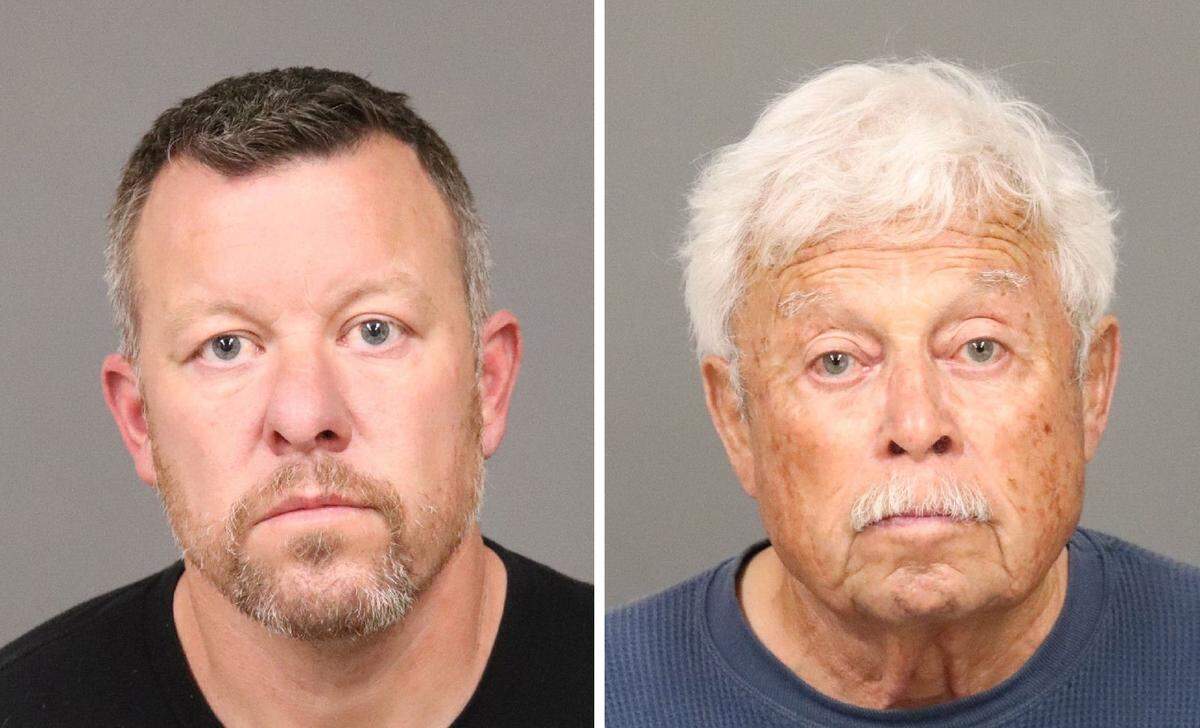
Kristin Smart murder case at a glance
After a decades-long investigation, Paul and Ruben Flores were arrested in connection with Smart’s disappearance on April 13 in San Pedro and Arroyo Grande, respectively, and the San Luis Obispo District Attorney’s Office announced the criminal charges against the men the following day.
Paul Flores, a San Pedro resident, is charged with one count of murder. Ruben Flores, who lives in Arroyo Grande, is charged with felony accessory after the fact.
Paul Flores and his father pleaded not guilty at their arraignment on April 19, when van Rooyen ordered Paul Flores be held without bail.
Paul Flores remains in San Luis Obispo County Jail, where he’s being held without bail for the remainder of proceedings.
Ruben Flores was released from County Jail on April 22, hours after Superior Court Judge Craig van Rooyen significantly lowered his bail because he is not a flight risk or a risk to public safety.
Ruben Flores remains out of custody.
Paul Flores faces a sentence of 25 years to life if convicted of first-degree murder.
Ruben Flores faces a maximum of three years if convicted of the accessory charge, though it is not clear if that sentence would be served in County Jail or state prison.
Testimony in the preliminary hearing began Aug. 2 with Smart’s parents, Stan and Denise, and continued through Aug. 3 with several former Cal Poly students who lived with Smart at the university’s Muir Hall or attended a house party with her in the hours before she vanished.
Aug. 4. featured legal arguments over admitting a booking photo that showed Paul Flores with a black eye days after Smart’s disappearance. The retired Cal Poly police detective who was the first to interview Flores, Lawrence Kennedy, also recounted his investigation.
Van Rooyen also unsealed a defense motion to suppress evidence that speculates about other people the defense says should have been investigated and reveals a few new details about searches conducted by law enforcement in the case over more than two decades.
Smart’s friend and next-door neighbor in Muir Hall testified on Aug. 5 about going out to a house gathering earlier in the evening of Smart’s disappearance. She recalled splitting up with the then-sober Smart, who wanted to go to a house party on Crandall Way.
The woman described how she and other dorm mates called in a missing person’s report to Cal Poly police, whose investigation she criticized.
Testimony is scheduled to resume Tuesday morning.
This story was originally published August 9, 2021 at 1:20 PM.