SLO judge denies DA’s request for a gag order against Tianna Arata, BLM activists
A San Luis Obispo Superior Court judge on Friday declined to restrict the speech of seven local Black Lives Matter activists who face a host of low-level charges over a protest last summer that blocked traffic on the highway.
Superior Court Judge Roger Picquet on Friday denied a motion by the county District Attorney’s Office to impose a gag order on Tianna Arata and her co-defendants, saying their vocal criticisms of the prosecution’s case doesn’t rise to the level of endangering the DA’s right to a fair trial.
Picquet, however, said he could entertain such a motion in the future should circumstances change.
The judge also denied two challenges brought by the defendants, only one of whom, Robert Lastra, faces a single felony charge for smashing a car windshield with a skateboard.
The case involving Arata, Marcus Montgomery, Amman Asfaw and Joshua Powell, as well the related case against Lastra, Sam Grocott, and Jerad Hill, has gained national attention following several television appearances by Arata, who also has a widespread social media following.
In court Friday, Arata was shadowed by a documentary film crew.
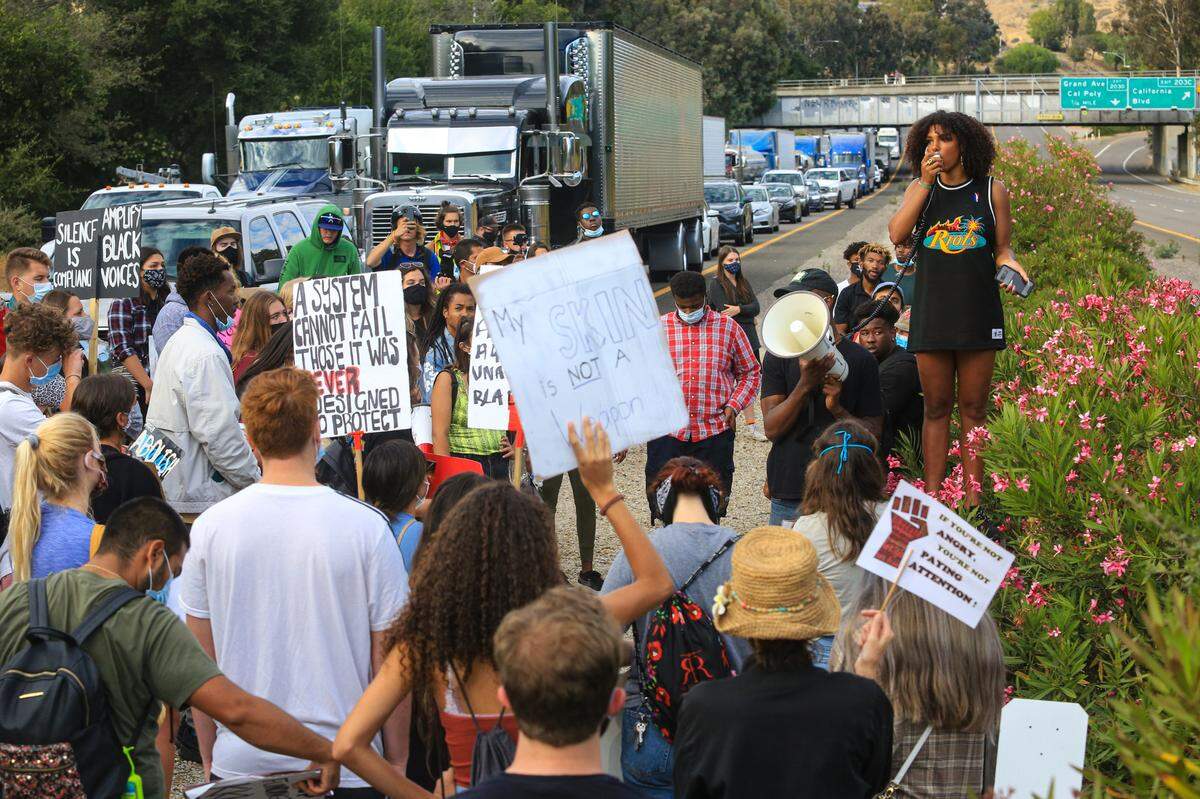
The seven defendants have been charged with misdemeanor false imprisonment, blocking a public thoroughfare and other low-level crimes allegedly committed during a July 21 protest in which roughly 300 people marched onto Highway 101, blocking traffic for about 40 minutes.
Picquet’s ruling follows nearly a full day of arguments on the gag order and other legal challenges that were debated in late April by a dozen attorneys involved in the two criminal cases.
After Friday’s ruling, Patrick Fisher, Arata’s local attorney, called the court’s ruling “beautiful.”
“When the DA’s Office attempted to gag Tianna and her counsel, it was just symbolic of their whole intention in filing the case — they’re trying to silence her,” Fisher said. “They don’t like (the defendants’) message. They don’t like what they stand for.”
He added: “It wasn’t enough to charge (Arata) criminally. They wanted to take her voice away. But they only made her voice louder. And that’s why what the court did today is beautiful: Dan Dow was trying to silence people and the court said no, you can’t do that.”
A spokesman for the District Attorney’s Office declined to comment for this article.
The two criminal cases are currently stalled as the state appellate court reviews a local judge’s decision to disqualify the District Attorney’s Office from prosecuting the case.
Superior Court Judge Matthew Guerrero disqualified District Attorney Dan Dow and his entire office from the prosecution due to “a clear conflict” presented by a political fundraising email sent by Dow’s re-election campaign days after charges were publicly announced by the District Attorney’s Office. Guerrero found that the email sought “political and professional benefit and campaign contributions.”
That ruling has been appealed by both the District Attorney’s Office and the California Attorney General’s Office, and the decision is pending before the Second District Court of Appeal.
A hearing is scheduled for June 30 before Guerrero — who has since rotated to family court and is technically no longer the judge in the protest cases — to review a motion by the DA’s Office regarding the appellate case.
While the cases hang in limbo, the parties have continued to argue in court filings over the requested gag order, which the defense argued violates the First Amendment and the defendants’ right to a fair trial, as well as other legal issues.
The motion for a gag order, filed March 26 by District Attorney Dan Dow and Deputy District Attorney Kenneth Jorgensen, argued that a media campaign led by the defendants’ attorneys has “significantly progressed to include conduct jeopardizing a fair trial by an impartial jury.”
The DA’s motion sought to prevent the defendants from making public comments about the case outside the courtroom and on social media.
Judge explains his ruling
In its request for a gag order, the DA’s Office cited the California Rules of Professional Conduct that prevent an attorney “from making an extrajudicial statement the lawyer knows will be disseminated to the public with a substantial likelihood of materially prejudicing a proceeding.”
The District Attorney’s Office’s motion notes that, in the fall of 2020, the defense unsuccessfully sought a gag order against the San Luis Obispo Police Department and California Highway Patrol from issuing media statements, which Judge Guerrero denied.
The District Attorney’s Office’s motion also cited “inflammatory statements made by defense attorneys” involved with the cases, “calling the district attorney a racist criminal; criticizing the ineptitude of then-California Attorney General Xavier Becerra; and criticizing this court as weak-willed, alleging it is under the influential pressure of the District Attorney’s Office.”
The motion cites Arata’s social media statements, a podcast featuring three of the attorneys discussing the case, and drone footage released by attorney Vincent Barrientos, who represents Grocott.
On Friday, Picquet wrote in his ruling that both the defendants and the prosecution have a right to a fair trial before an impartial jury and that the testimony of witnesses is not compromised or tainted by statements published in the press, social media or other sources.
But he said public statements made so far do not rise to the level of necessitating the restriction of free speech, and the ongoing appeal makes the timing of the DA’s request problematic.
“Accordingly, this court is unable to find at the present time and under the current circumstances that there is a clear and present danger or serious imminent threat to the right to a fair trial, or any other legitimate interest sought to be protected by the issuance of a (gag order),” Picquet wrote.
The judge wrote that he would be open to considering a similar request in the future, after the appeal is settled.
Picquet also rejected a defense request to compel the District Attorney’s Office to turn over records about its decision-making process in the prosecution, which the defense says must exist based on meetings they know occurred at the DA’s Office and thousands of other records of written communications obtained by The Tribune.
Picquet, however, denied the defense request, saying that the assertion the DA was withholding records is “based on a certain degree of speculation and supposition.”
“This court is unable to engage in such speculation,” Picquet wrote. “Should subsequent events demonstrate that the District Attorney has failed to meet his obligations regarding discovery, there are adequate remedies that can be imposed at that time.”
The judge also denied a motion to dismiss the false imprisonment charge against Grocott, who argued he did not waive his right to a speedy trial.
Picquet ruled that the case was stalled by the district attorney’s appeal and would not dismiss the charge.
This story was originally published June 25, 2021 at 12:38 PM.