SLO County DA’s Office disqualified from Tianna Arata case due to Dow fundraiser, judge rules
Update to this story >> >> SLO County DA says there’s ‘no conflict’ after being disqualified from Tianna Arata case
A San Luis Obispo Superior Court judge handed a major victory to a group of Black Lives Matter protesters on Friday, disqualifying the San Luis Obispo County District Attorney’s Office due to “a clear conflict.”
Superior Court Judge Matthew Guerrero on Friday ruled that the entire county District Attorney’s Office is disqualified from prosecuting the multi-co-defendant case due to elected District Attorney Dan Dow’s outspoken activism for causes opposed to the Black Lives Matter movement.
At issue was an email sent to Dow’s supporters by his wife and paid for by his re-election campaign days after his office filed charges against alleged protest organizer Tianna Arata that sought financial donations and claimed that Dow was “leading the fight” against the “wacky defund the police” and social justice movement.
“(The email) established a clear conflict of interest,” Guerrero said in court Friday. “(By) delivering this fundraising email to potentially tens of thousands of people immediately after filing the charges, Mr. Dow sought political and professional benefit and campaign contributions in conjunction with the prosecution of the above-entitled cases.”
In a statement Friday afternoon, Dow said he “respectfully and strongly” disagrees with Guerrero‘s findings and “decision to recuse the district attorney from prosecuting criminal activity that occurred during this summer’s protests.”
“There is absolutely no conflict in this case,” he said in the statement. “To the contrary. While I have been personally attacked on many occasions since the arrests in these cases, I have continued to conduct my duty in a manner that is above reproach without bending to popular opinion and public pressure.
“I am proud of the professionalism that our office has maintained under months of immense public pressure. We have thoroughly, fairly, and objectively reviewed volumes of evidence, conducted additional independent investigation, and made every decision based on the facts and the applicable law. We have never wavered from our steadfast commitment to ensure that every defendant receives fair treatment while we perform our important Constitutional duty.”
In the absence of the District Attorney’s Office, the state Attorney General’s Office could take over the case, should it choose to do so. A representative logged into the proceedings Friday indicated that the office knew very little about the case.
The ruling affects Arata, 20, and her three co-defendants, as well as three other men charged separately who joined in Arata’s defense motion. One protester, Elias Bautista, who is being charged with a felony, did not join in the motion and will continue to be tried by the local agency.
Three of Arata’s co-defendents — Marcus Montgomery, 24, Joshua Powell, 23, and Amman Asfaw, 22, as well as Robert Lastra, who’s charged separately with a felony — were in court Friday as Guerrero issued his ruling, as Arata watched the proceedings via Zoom. The defendants and their attorneys called the ruling “huge” following the hearing.
Guerrero also approved a defense request for the DA’s Office investigative reports and other evidence that would show whether it was discriminatory when deciding which of the hundreds of protesters to charge.
But the judge denied requests to place a gag order on the San Luis Obispo Police Department and California Highway Patrol over alleged biased statements, and ruled against entirely dismissing the case on First Amendment grounds.
As a result of the rulings, Arata, who was arrested in July and charged with 13 misdemeanors, and her three co-defendants — Asfaw, Montgomery and Powell — entered not guilty pleas Friday to the charges against them.
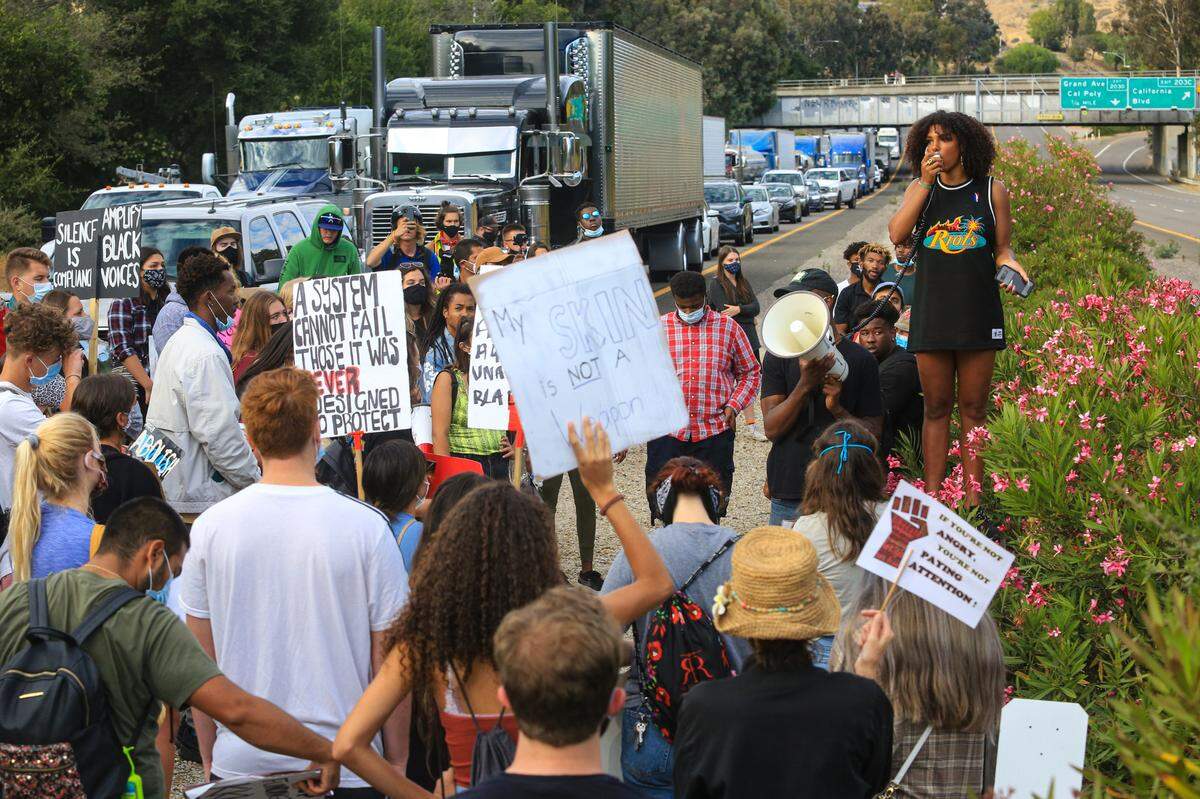
Tianna Arata, co-defendents face charges for SLO protest
The charges in the four-defendant case stem from a July 21 protest in which demonstrators marched on Highway 101 in San Luis Obispo, blocking traffic for less than an hour.
Arata, a former San Luis Obispo resident, was arrested as she was loading signs into a car at Mitchell Park after the protest. She faces charges of false imprisonment, obstructing a public thoroughfare and resisting arrest.
Her co-defendants, Asfaw, Montgomery and Powell, are facing between one and three similar misdemeanors each. They all live in San Luis Obispo.
Each charge carries a maximum of six months in San Luis Obispo County Jail and a $1,000 fine.
While the county District Attorney’s Office argues the protesters, led by Arata, held residents “hostage” on the highway and elsewhere around the downtown area, the defense has argued in court documents the prosecution “would severely chill lawful assembly and freedom of speech,” and “is not even remotely ethical.”
In a case that has attracted national attention, at least one of the prosecution’s alleged victims publicly accused the District Attorney’s Office of trying to convince him he was victimized by the July 21 protest, despite his objections.
Several other people are facing both felony and misdemeanor charges related to the July 21 event as well as a June 1 protest in which San Luis Obispo police officers fired tear gas and pepper bullets at demonstrators.
Judge: Dan Dow’s campaign fundraiser ‘a clear conflict’
In his ruling, Guerrero wrote that a district attorney may be disqualified from prosecuting a case when a prior association or conflict of interest makes it impossible for him or her to act.
He wrote in his written ruling that the court has to consider whether there is in fact a conflict of interest, and whether that conflict is so severe as to disqualify the district attorney from acting. The motion can’t be granted unless the evidence shows that a conflict of interest exists that would render it unlikely that the defendant would receive a fair trial, he wrote.
In making his decision, Guerrero wrote that he considered several instances where Dow made comments or attended events that showed bias against the Black Lives Matter movement.
In his written ruling, Guerrero lists a Dow appearance on a talk show hosted by a far-right group that called the movement a “Marxist” group who promote “cop killings, prostitution, anti-Semitism, anarchy, and the suppression of speech and religion.”
The judge noted a lengthy post written by Dow on Sept. 4 in which he explained his filing decision against Arata to a private conservative Facebook group while declining to comment on the case to the general public. The group, Protest Paso, has been outspoken in opposition to the Black Lives Matter movement, including making threats of violence against protesters.
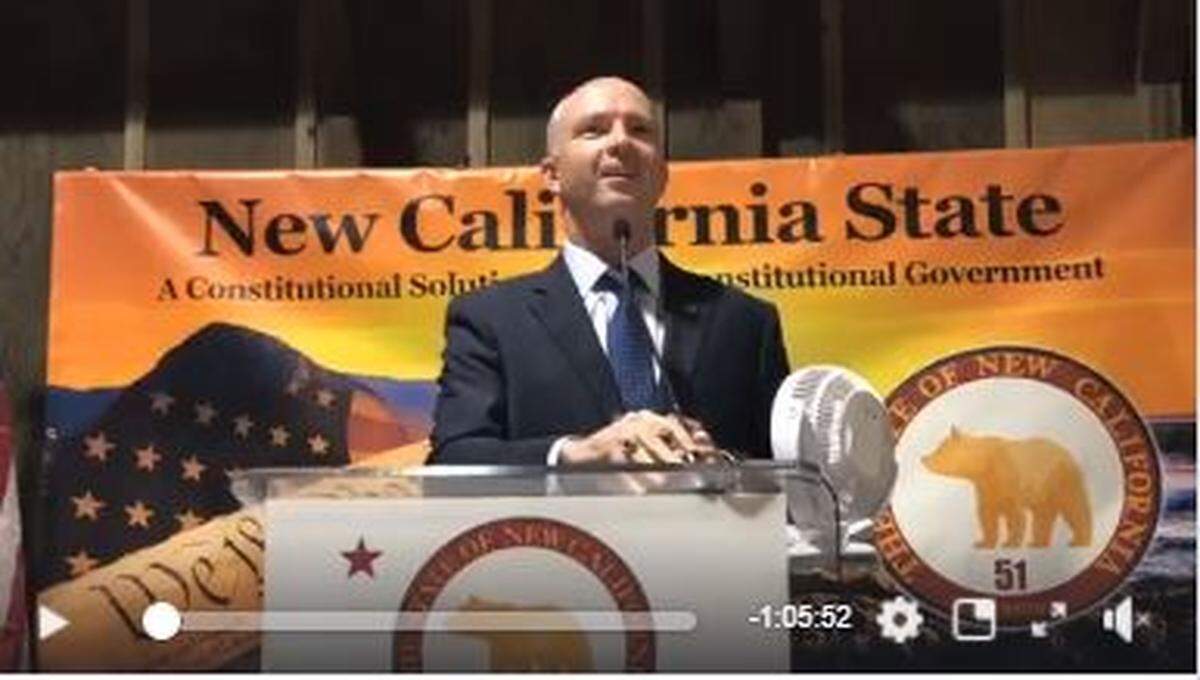
Dow also appeared at a California secessionist movement group’s fundraiser in October, Guerrero noted, an event that featured prominent Black Lives Matter critic Candace Owens, who called BLM “one of the most racist movements that ever existed in this country.”
But the basis of Guerrero’s ruling came from the Sept. 4 email that Wendy Dow, Dow’s wife, sent on behalf of Dow’s re-election campaign within 48 hours of charges being filed against Arata. The day was also Dow’s birthday, Guerrero wrote.
“Dan needs to know more than ever that you support him, and he really needs your financial support so he can keep leading the fight in SLO County against the wacky defund the police movement and anarchist groups that are trying to undermine the rule of law and public safety in our community,” Wendy Dow wrote in the email, which stated it was “Paid for by Dan Dow for District Attorney 2022.”
The email continued: “We had planned this kick-off re-election campaign fundraiser to be this month, but due to COVID and all the crazy protest activity, we were not able to pull it off. ... Your support will help ensure that Dan will continue in spite of the ‘defund police’ and George Soros-type opposition happening against DA’s all over the state and nation.”
“(The) statement used inflammatory terms such as ‘anarchist,’ ‘crazy,’ and ‘wacky,’ which is an extrajudicial statement made to potential jurors in an attempt to sway them and get them to make a financial contribution,” Guerrero wrote in his ruling. “This interferes with the defendants’ right to a fair trial.”
“The men and women charged here are entitled to a prosecution not clouded by political or personal advantage to the prosecutor,” Guerrero continued. “This is especially pointed in a case where all defendants are protesting injustice and systemic bias. The court must protest all parties’ right to due process and to seek justice.”
The judge found that he must disqualify the entire office due to its small size, and the fact that all deputy prosecutors answer to Dow and have a relationship with him.
‘This court heard’ concerns, Tianna Arata’s attorney says
Arata’s local attorney, Patrick Fisher, said in a statement after Friday’s ruling that “the significance of this ruling cannot be overstated.”
“As someone who grew up in this community, it has been extremely upsetting to see the racial unrest our community is dealing with. It has also been upsetting to see the way our district attorney’s office has been politicized,” Fisher wrote to The Tribune. “Our court sent a much needed message to our district attorney today that the court will not tolerate prosecutorial decisions that are politically motivated.”
Fisher said that as “moving” as the decision was for him, “it is much more moving for those in the BLM community, the ones taking to the streets and putting their safety and freedom in jeopardy.”
“The BLM movement is largely an effort to get white America and American institutions to stop ignoring racism, to stop and listen,” he wrote. “Today, they know this court heard.”
DA’s Office must hand over internal records to defense
After reading the surprise ruling, Guerrero also granted the defense’s motion to compel the District Attorney’s Office to turn over their investigative reports and other evidence that shows how they concluded who to charge in the case, when there were upwards of 300 protesters.
Fisher argued Thursday that the defense wanted to obtain evidence of the District Attorney’s Office’s investigation into “similarly situated individuals (who) were not prosecuted.”
Guerrero granted the motion to compel discovery, but stipulated that the defense’s request was overbroad, and attorneys must limit their request to police and CHP forms referring cases to the DA for prosecution, as well as “other documentation of the decision-making process such as (DA’s Office) internal memoranda and the correspondence and/or minutes of meetings between the prosecutor’s office and law enforcement personnel.”
Judge won’t impose gag order or dismiss case
But Guerrero disagreed with two other defense motions — one to place a gag order on the San Luis Obispo Police Department and the CHP for alleged “blatantly false statements,” and a motion to dismiss the case under First Amendment protections.
Regarding the gag order, Arata attorney Curtis Briggs argued on Thursday that “false and misleading” statements by the agencies on social media following the July 21 protest prejudiced the public against Arata and violated her right to a fair trial.
Guerrero said in court Friday that “free speech is one of the cornerstones of our society,” and that it would take egregious conduct for the court to legitimately stifle that speech, known as “prior restraint.”
He explained in court that to restrain speech, the speech must pose an imminent danger to the protected competing interest, the order must be narrowly drawn, and that no less restrictive alternatives can be available.
“Prior restraints are subject to strict scrutiny and deemed unconstitutional unless all three of these requirements are met,” Guerrero ruled.
Regarding the motion to dismiss the case on First Amendment grounds, in this case a demurrer that tests alleged defects in the criminal case, Guerrero ruled that the court is declining to rule on facts that are in dispute.
Briggs on Thursday argued that the defense filed the motion because, at the time, Arata was the only person being charged related to the July 21 highway protest. He claimed that she was being singled out, among a crowd of hundreds of protesters.
Since then, prosecutors have filed charges against the other six, some of which face similar misdemeanor charges, because they knew their case against Arata was weak without it, Briggs said.
Guerrero found that the prosecution’s complaint contained “ordinary and concise language,” as required by law and declined to weigh in on that claim because both parties have produced conflicting evidence. He also ruled that a demurrer was not the appropriate request for the relief the defense was seeking.
“(This) is an ‘as applied’ challenge not subject to demurrer,” Guerrero wrote in his ruling. “An ‘as applied’ challenge assumes that the statute or ordinance violated is valid and asserts that the manner of enforcement against a particular individual or individuals or the circumstances in which the statute or ordinance is applied is unconstitutional.”
“Here, the defendants seek relief from application of the statute by asserting their conduct is constitutionally permissible,” he continued. “However, this can only be determined after the circumstances of the law’s application have been established by conviction.”
Attorneys for Arata and her three co-defendants are due back in court for a pre-trial conference Tuesday.
This story was originally published December 11, 2020 at 11:16 AM.