What’s happening with Tianna Arata’s case? Could the SLO protest leader go to prison?
When Tianna Arata led a protest against racism and police brutality on July 21 in San Luis Obispo, little did she know the events of the day and her subsequent arrest would catapult the her into the national spotlight.
But that’s where the 20-year-old activist finds herself today as she awaits a decision from the San Luis Obispo County District Attorney’s Office on whether to charge her on any of the eight criminal counts — including five felonies — related to the protest.
In the process, publicity around the case has generated a wealth of false information that has confused people about what is actually happening with Arata.
Here’s what we know about Arata and the criminal case against her:
Who is Tianna Arata?
Arata is a 20-year-old Black woman originally from Portland, Oregon, who moved to San Luis Obispo with her mother in 2016 to be closer to family.
Arata and her mom, Michelle, said they have always lived under the federal poverty level and were forced to move around in order to find affordable housing. Before she graduated high school, Arata attended 10 different schools, she said.
In an interview, she told The Tribune that all of the moving around left her constantly in a position as the new kid in school.
That, along with racial discrimination because of the color of her skin, made Arata feel as though she were always an outcast, she said, and it motivated her to prevent anyone else from feeling the same way.
“I always wanted to make people feel accepted and feel comfortable because there’s been a lot of situations where it’s like I’m the outsider,” Arata said.
Arata found community through local activism in Portland. She joined the group Don’t Shoot Portland, or Don’t Shoot PDX, which protests racism, police brutality and state violence.
At just 14 years old, Arata marched at the front of protests in Oregon’s largest city and sat down to speak to the mayor and Portland Police Department in panels, she said.
When she and her mother moved to San Luis Obispo, she was met with more racial taunts and microaggressions, she said, which made their new home feel unwelcoming.
Arata finished high school at Grizzly Youth Academy and started at Cuesta College in 2017. While there, she ran track for the school’s team.
What happened at the July 21 protest?
Arata and hundreds of other community members in San Luis Obispo had been protesting in solidarity of the Black Lives Matter movement since late May.
On June 1, one protest ended in police dispersing crowds using tear gas after protesters had marched onto the freeway. Arata had been one of a few organizers of that protest.
Dozens of other protests happened in San Luis Obispo County between then and July 21, but none resulted in the kind of standoff and aggressive police action that occurred on June 1.
The protest on July 21 began at 4 p.m. in Mitchell Park near downtown San Luis Obispo. Organizers gave speeches before leading a march downtown.
At one point, protesters stopped at the intersection of Higuera and Chorro streets. A couple of protesters began stomping on an American flag that was partially burnt. A white man came up to stop the protesters, but he was quickly turned away by a group of demonstrators.
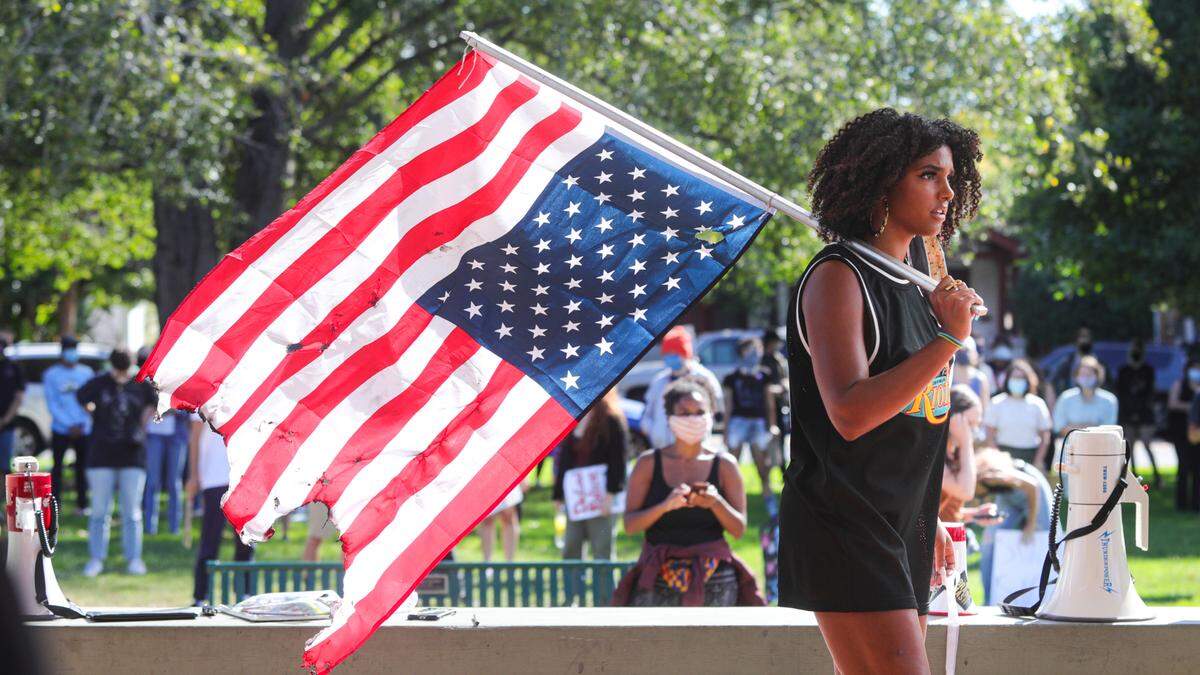
Around 7 p.m., protesters marched onto Highway 101 from Osos Street, forcing the closure of all lanes in both directions for about an hour.
During the closure, District Attorney Dan Dow issued what he called a “public safety alert” on Twitter in response to protesters blocking the highway, writing, “This is unlawful and incredibly dangerous. It must stop.”
The blockade backed up traffic on the highway, and tensions rose when one driver tried to push his way through protesters, hitting county resident Sam Grocott. As the silver sedan pushed past, protesters smashed the hood and rear window of the vehicle, which, according to police, had a 4-year-old child in the back seat.
Afterward, the San Luis Obispo Police Department posted an edited video on its Facebook page showing a small group of protesters getting hitting by a gray vehicle near the intersection of Chorro and Pacific streets at around 8 p.m.
That video appears to show a protester being dragged onto the hood of the vehicle for a short time before the car drives away, narrowly missing Arata and other protesters.
The Police Department then issued a news release seeking the identity of the car’s driver, described as a “vandalism victim.”
Why did San Luis Obispo police arrest Arata?
After leaving the freeway, protesters headed back to Mitchell Park and dispersed around 8 p.m.
Just before 8:30 p.m., several San Luis Obispo police officers approached a group of protest organizers as they were placing their signs and other materials in a car.
The police identified Arata, the protest’s main organizer, and immediately grabbed her and placed her in a nearby SUV.
The arrest was “based on Arata’s actions and the actions of the organized group,” police said in the release.
Another protester, Elias Bautista, was captured on video kicking an officer in the groin before being chased down by police and subsequently arrested.
Arata was booked into San Luis Obispo County Jail just before 11 p.m. on July 21 on charges of participation in a riot, unlawful assembly, conspiracy, unlawful imprisonment and resisting arrest, according to the police.
Police originally held Arata on bail set at $75,000, according to attorney Dustin Tardiff.
However, Arata was released from jail at 1 a.m. July 22 on her own recognizance without bail due to COVID-19 precautions at the facility, Tardiff said.
Arata has remained out of custody since then.
What charges is Arata facing and could she go to prison?
On Wednesday, Aug. 5, the San Luis Obispo Police Department sent its investigative report to the District Attorney’s Office, according to the chief deputy district attorney Jerret Gran.
The Police Department recommended a total of eight charges against Arata: four felony counts of false imprisonment; one felony count of conspiracy; and three misdemeanor counts for resisting or obstructing a peace officer, participating in a riot and unlawful assembly.
Arata has not yet been formally charged with any crimes as the district attorney considers the case.
Because Arata has not yet been charged, she does not face any penalty right now. And because she is no longer in custody, prosecutors have time to conduct their own investigation and have the option to file charges even after the Sept. 3 arraignment date, if needed.
According to a statement from District Attorney Dan Dow, ”a decision on whether to file criminal charges will have been made prior to that date.”
If convicted on the recommended charges, Arata will not face prison time because none of the crimes are prison eligible, said Assistant District Attorney Eric Dobroth. Instead, she would face time in County Jail, but that is determinate on the sentencing recommendation made by the district attorney — if prosecutors chose to pursue the charges in the first place.
Though many people on social media shared posts claiming that Arata faces 15 years in prison, Dobroth said that is fundamentally inaccurate.
“The reckless statement that she’s going to prison is absolutely incorrect,” Dobroth said. “And the 15-year mark ... they’re doing incorrect arithmetic and sentencing calculations, and they really should seek to consult an attorney before they engage in that process because criminal sentencing is actually quite complex.”
The District Attorney’s Office and Arata’s case have received national attention from news outlets and celebrities. Dobroth said that will not influence the office from doing its job.
“We’re just bombarded with allegations that were racist, allegations that we’re trying to quiet or subvert Ms. Arata’s right to protest peacefully. That’s certainly not what we’re doing,” he said. “The job of prosecutors is neutrally and thoroughly evaluating the facts of a particular circumstance and applying the law and determining whether or not a crime was committed — that’s what we’re doing here.”
“It very well may be in this case that that we do file. There’s a chance that we don’t. We haven’t reviewed the entirety of the file.”
What is Arata doing right now?
Right now, Arata is in a state of “legal limbo,” according to her attorney, Patrick Fisher. She has been advised by Fisher to lay low and not attend the ongoing protests in San Luis Obispo.
Meanwhile, she and her family have received serious threats, Arata said, calling her a domestic terrorist, comparing her to Charles Manson and musing over different ways to kill or injure her and the other protesters.
She plans to attend a California university to pursue a degree in the fall.
Her case has been shared nationally through news organizations like Teen Vogue, Cosmopolitan, Newsweek and the International Business Times India edition. Celebrities like Dom McLennon from Brockhampton, comedian Elijah Daniel and YouTuber Sarah Baska have shared posts on social media in support of Arata.
Lee Merritt, the well-known civil rights attorney based in Texas, shared a post on his Instagram directed at Dow that said, “You have a very small window of time to drop these charges before your county, city and home are bombarded by activists from all over the country.”
Merritt is representing the family of Ahmaud Arbery, the 25-year-old Black man who was followed by three white men and then fatally shot while he was jogging in a South Georgia neighborhood in February. He is also the co-counsel for the families of George Floyd and Breonna Taylor, two Black Americans recently killed by police.
In response, Dobroth said their decision on whether to charge Arata will not be changed by outside pressure.
A GoFundMe campaign has raised more than $40,700 for Arata’s legal costs. Only $10,000 of that will cover her legal fees and the rest will go to bail funds for other social justice activists, according to the campaign.
And a petition asking for Dow to drop the charges, which his office cannot do until prosecutors have fully reviewed the details of the case, has garnered well over 230,000 signatures as of Tuesday.
This story was originally published August 12, 2020 at 5:00 AM.