Were Tianna Arata’s free speech rights violated? Defense argues for case dismissal
A local Black Lives Matter organizer and six of her fellow activists were in San Luis Obispo Superior Court on Thursday morning, when a judge heard arguments from attorneys over a handful of motions including a request to dismiss the case.
Neither Tianna Arata, a 20-year-old protester who was arrested in July and charged with 13 misdemeanors, or her three co-defendants — Marcus Montgomery, 24, Joshua Powell, 23, and Amman Asfaw, 22 — have yet entered pleas in their case pending Superior Court Judge Matthew Guerrero’s rulings on the various defense motions.
As of press time Thursday, Guerrero had heard arguments on two of four of the motions, but said he is expecting to issue rulings on each in the coming days.
The charges in the four-defendant case stem from a July 21 protest in which demonstrators marched on Highway 101 in San Luis Obispo, blocking traffic for less than an hour.
Tianna Arata, co-defendents face charges for SLO protest
Arata, a former San Luis Obispo resident, was arrested as she was loading signs into a car at Mitchell Park after the protest. She faces charges of false imprisonment, obstructing a public thoroughfare and resisting arrest.
Her co-defendants, Asfaw, Montgomery and Powell, are facing between one and three similar misdemeanors each. They live in San Luis Obispo.
Each charge carries a maximum of six months in San Luis Obispo County Jail and a $1,000 fine.
While the San Luis Obispo County District Attorney’s Office argues the protesters, led by Arata, held residents “hostage” on the highway and elsewhere around the downtown area, the defense has argued in court documents the prosecution “would severely chill lawful assembly and freedom of speech,” and “is not even remotely ethical.”
In a case that has attracted national attention, at least one of the prosecution’s alleged victims publicly accused the District Attorney’s Office of trying to convince him he was victimized by the July 21 protest, despite his objections.
Several other people are facing both felony and misdemeanor charges related to the July 21 event as well as a June 1 protest in which San Luis Obispo police officers fired tear gas and pepper bullets at demonstrators.
Although there are four defendants in Arata’s case, three other individuals — Robert Lastra, Sam Grocott, and Jerad Hill — are being tried separately for damage allegedly committed July 21 to the vehicle of a motorist who struck Grocott on Highway 101. Those men also appeared in court Thursday, accompanied in person or via Zoom by their attorneys.
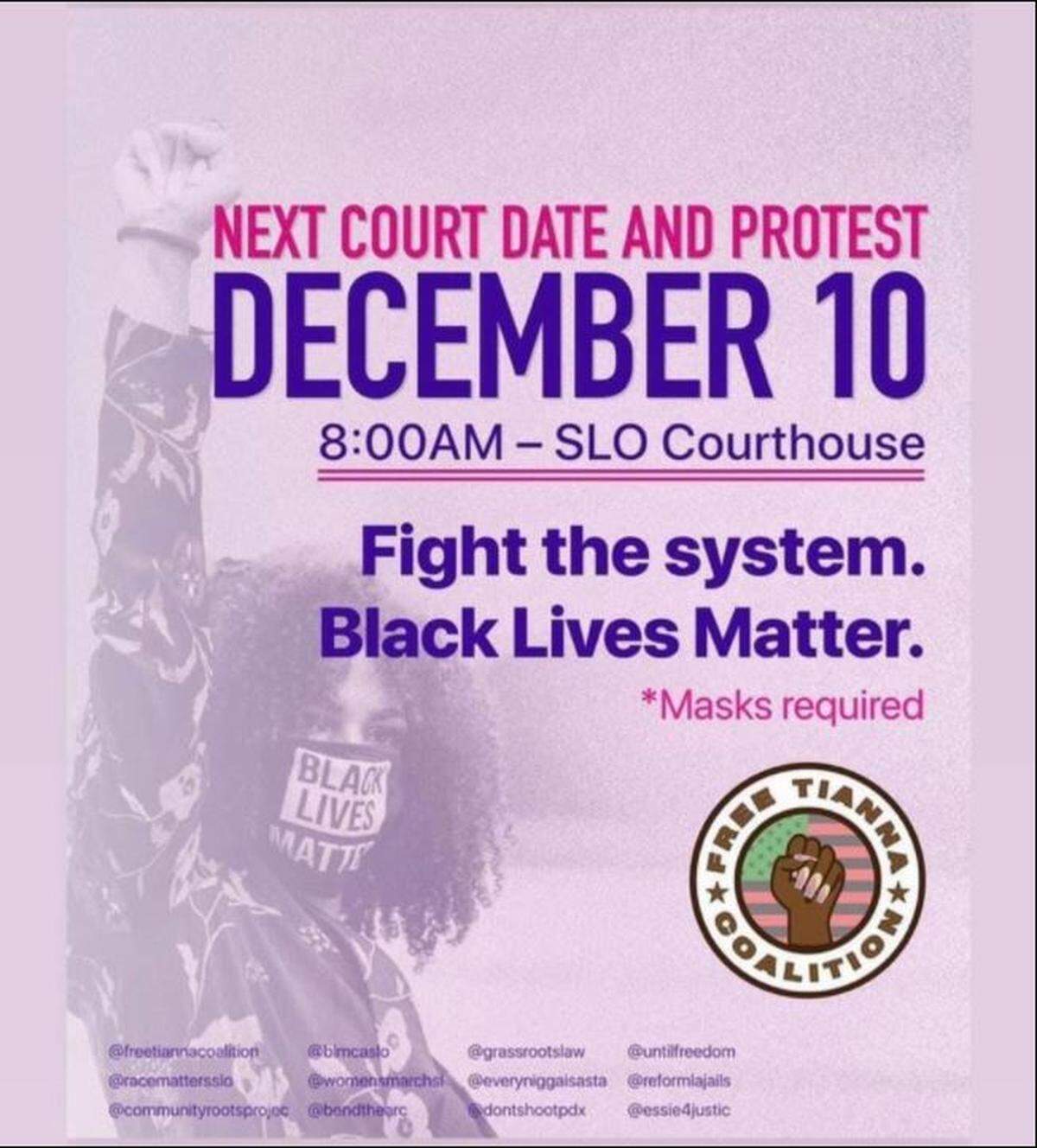
Roughly 50 supporters of Arata and her co-defendants arrived outside the courthouse around 8:30 a.m. Thursday for a demonstration protesting the District Attorney’s Office case against them, as they have at each of Arata’s court appearances.
On Thursday, Guerrero is expected to hear verbal arguments from defense attorneys Patrick Fisher, Curtis Briggs, and others, as well as deputy district attorney Delaney Henretty over a handful of defense motions.
Those include a motion to dismiss the case on First Amendment grounds, a motion to place a gag order on San Luis Obispo police and the California Highway Patrol from publicly commenting further on the case, and a request to have the District Attorney’s Office removed from prosecuting the case.
The defense alleges that biased statements made to the public by Henretty and elected District Attorney Dan Dow, who has spoke at events in which speakers were critical of Black Lives Matter, would deprive the defendants of a fair trial before a jury.
Guerrero said in court Thursday that he would not issue his rulings on the case of Arata and her three co-defendants on Thursday.
Instead, he said, his rulings will be announced in a hearing Friday morning.
Attorneys request gag order on SLOPD and CHP
Before recessing for the lunch break, Guerrero heard arguments from attorneys for the seven defendants, as well as the District Attorney’s Office, the city of San Luis Obispo, and the state Attorney General’s Office, which is representing the California Highway Patrol in the gag order request.
During discussion of the gag order, Arata attorney Curtis Briggs argued that “false and misleading” statements by the San Luis Obispo Police Department and the CHP on social media following the protest prejudiced the public against Arata and violated her right to a fair trial.
However, Briggs conceded that, since the filing of charges, the agencies have not made any more such statements and that he expects “fair dealing from here on.”
Anthony Gomez, a deputy attorney general representing the CHP, argued that most of the media and other information released to the public since the case was filed have come from the defendants, who he argued can’t now voice concerns about pre-trial publicity.
Christine Dietrick, San Luis Obispo city attorney, argued that the San Luis Obispo Police Department has not made any public statements on the case since it was handed over to the District Attorney’s Office.
“There just isn’t anything to restrain,” Dietrick told Guerrero.
She also argued that the police department did not make false statements, and that “multiple people can look at the same pieces of video evidence and see different things,” referring to drone and cell phone footage collected in the case.
In a rebuttal, Briggs argued that it’s his duty to publicize his client’s case due to the alleged misinformation released by the city and the CHP to “balance out the jury pool.”
He suggested scheduling an evidentiary hearing to persuade Guerrero to rule on what the evidence shows.
“We would love to have (an) evidentiary hearing,” Briggs said.
Should case be tossed under the First Amendment?
After taking the gag order request under submission, Guerrero moved on to the request to dismiss the case under First Amendment grounds.
Briggs, again leading the arguments, told Guerrero that Arata’s defense filed the motion because, at the time, Arata was the only person being charged related to the July 21 highway protest. The defense claimed that she was being singled out, among a crowd of hundreds of protesters, and the defense wanted to “stop that train.”
Since then, prosecutors have filed charges against the other six, some of which face similar misdemeanor charges, because they knew their case against Arata was weak without it, he said.
“They fixed it,” Briggs said of the District Attorney’s Office’s case. “They knew what they were doing.”
Still, Briggs argued, “trials are not remedies for violations of Constitutional rights.”
But Henretty, the deputy district attorney, argued that a person’s right to free speech “ends when you infringe on the freedoms of others.”
“They have no right to hold our citizens hostage on a freeway,” Henretty said. “One can not infringe on someone’s freedom and liberty then invoke your right to free speech. To do so would be anarchy.”
Henretty said that Arata’s communications with former San Luis Obispo Police Chief Deanna Cantrell proved that Arata was the main organizer of the July 21 protest.
“What we have here is a situation where Arata refused to comply (with agreed upon plans) because of her hatred for police,” he said.
He added that protesters were not “changing anyone’s minds” through the July 21 protest and, in his experience in the U.S. Marine Corps, he learned that people do not respond positively to oppression.
Steve Rice, one of two attorneys representing Powell, argued to Guerrero that local authorities have not been consistent in their alleged limiting of free speech. He pointed to recent MAGA Drag the Interstate rallies held by supporters of President Donald Trump in which caravans of trucks on several occasions drove across San Luis Obispo County highways and city streets.
“Their intent was to slow and impede traffic to get out their message — and no police were to be seen,” Rice said.
“Black Lives Matter shouldn’t be treated differently than the pro-Trump parade if the argument is restricting movement,” he added. “(The police department) doesn’t get to pick and chose how and when to practice free speech.”
Henretty replied that he wasn’t aware of any crimes that were reported in any of the MAGA rallies.
Systemic racism driving case, defense argues
After a lunch recess, Guerrero heard the defense’s motion to compel the District Attorney’s Office to turn over their investigative reports and other evidence that shows how they concluded who to charge in the case, when there were upwards of 300 protesters.
Patrick Fisher, Arata’s local attorney, argued that protests, historically, are designed to make people uncomfortable and to force a message on people who may be resistant.
He said effective protests “disregard the direction of the government ... especially when the protest is about things the police are getting wrong.”
“Historically, protesters take to the streets, they block traffic, because that’s what get people’s attention,” Fisher said.
The attorney argued that systemic racism must be behind the District Attorney’s Office’s case due to the way charges unfolded fist against people of color, among other reasons.
“I don’t think the (prosecution) understand systemic racism,” Fisher said. “Six out of the eight people charged for this protest are non-white. How can that be?”
Fisher said the motion was to obtain evidence of the District Attorney’s Office’s investigation into “similarly situated individuals (who) were not prosecuted.”
Henretty replied that he never claimed racism doesn’t exist.
“It does exist,” he said, though he added that the conduct of protesters — who on July 21 were protesting comments made by county Sheriff Ian Parkinson who said he doesn’t see systemic racism locally — would lead to “the road of tyranny.”
In response to allegations of a one-sided investigation, Henretty said, “You have to let the facts presented to you lead the investigation.”
He also disputed the claim that the agency targeted people of color, saying that Arata “singled herself out as the leader of the protest” and calling “patently untrue” any allegation that District Attorney’s Office investigators were able to identify white protesters engaged in the same conduct but chose not to prosecute.
“Every effort was made to find everybody who fit that criteria,” Henretty said. “There was no overlooking of individuals who may have been of a different race.”
Does district attorney’s politics ‘trickle down’ to protester case?
Lastly, Guerrero heard arguments about Dow’s well-publicized conservative politics, and whether his office can fairly prosecute Black Lives Matter-related cases.
Fisher, who said he has long had a good personal relationship with Dow, noted the district attorney’s angry social media comments on the day of the protest, and subsequent statements made by Dow at events featuring speakers critical of the Black Lives Matter movement as examples of bias.
He also noted a re-election campaign fundraiser email sent by Dow’s wife, paid for by Dow’s political campaign, solicited political donations the day after Dow’s office charged Arata. He called Dow “a uniquely, politically vocal DA” and said that “nothing’s going to be done (in his office) without his blessing.”
“His views are very important to this case because they’re antithetical to the views of the protesters,” Fisher said, adding that his conservative views have “invaded his decision making.” “This just isn’t the right case for Mr. Dow.”
As further evidence, Fisher argued, Dow has told the public at large he cannot comment on the ongoing case yet wrote a lengthy post on a private conservative Facebook group to “defend himself to his base” over the case.
Henretty defended his boss, saying Dow is a fair decision maker who ultimately charged a motorcyclist who ran into Black Lives Matter protester in an incident in September.
“People talk about Mr. Dow being biased. They don’t mention how he meets with minority groups regularly,” as well as prisoners in rehabilitaton programs, Henretty told Guerrero. He added that, as a prosecutor, he would personally not take a case he thought were the result of bias.
Henretty added that Dow’s campaign email was sent on his birthday, which the email noted, and which happened to coincide with the filing of Arata’s charges.
A representative from the California Attorney General’s Office also told Guerrero that the agency opposes taking over the case from the District Attorney’s Office.
But Fisher said the damage done in the case is irreversible.
“This office can’t handle this case. It’s too messy,” he said. “This court, all due respect, needs to clean it up.”
A ruling on each motion is expected Friday morning.
This story was originally published December 10, 2020 at 9:12 AM.