More rebel than rock star: Meet Patrick Fisher, the local half of Tianna Arata’s defense team
Sitting down for an interview on a Thursday night after band practice, attorney Patrick Fisher is clad in his late father’s poncho hoodie and knit skull cap.
Away from the courthouse, he gives off a distinctly coastal California vibe and appears a far cry from the sharply dressed lawyer who is representing activist Tianna Arata in probably the biggest local court case of the year.
Before Arata’s arrest catapulted him into the national spotlight, Fisher, 42, had already enjoyed a long career practicing criminal law in San Luis Obispo County, punctuated by several high-profile cases.
The second-generation San Luis Obispo County defense attorney has taken on law enforcement crackdowns on medical marijuana providers, his defense investigations have unveiled police abuses, and his trial arguments before juries have led to acquittals for his clients who were wrongly accused or over-charged.
In the Arata case, Fisher is working alongside prominent Bay Area civil rights attorney Curtis Briggs, but the local attorney known for his relaxed nature in the courtroom has recently made headline-grabbing statements of his own on the issue of systemic racism.
Fisher said he believes the actions of local law enforcement have proven the point of the Black Lives Matter movement, adding that Arata, a vocal Black woman, was targeted for prosecution out of hundreds of mostly white protesters.
The case is a good fit for Fisher, who says he’s always had a strong sense of social justice thanks to his parents, namely his father David Fisher, who spent decades practicing criminal defense before his death in 2018.
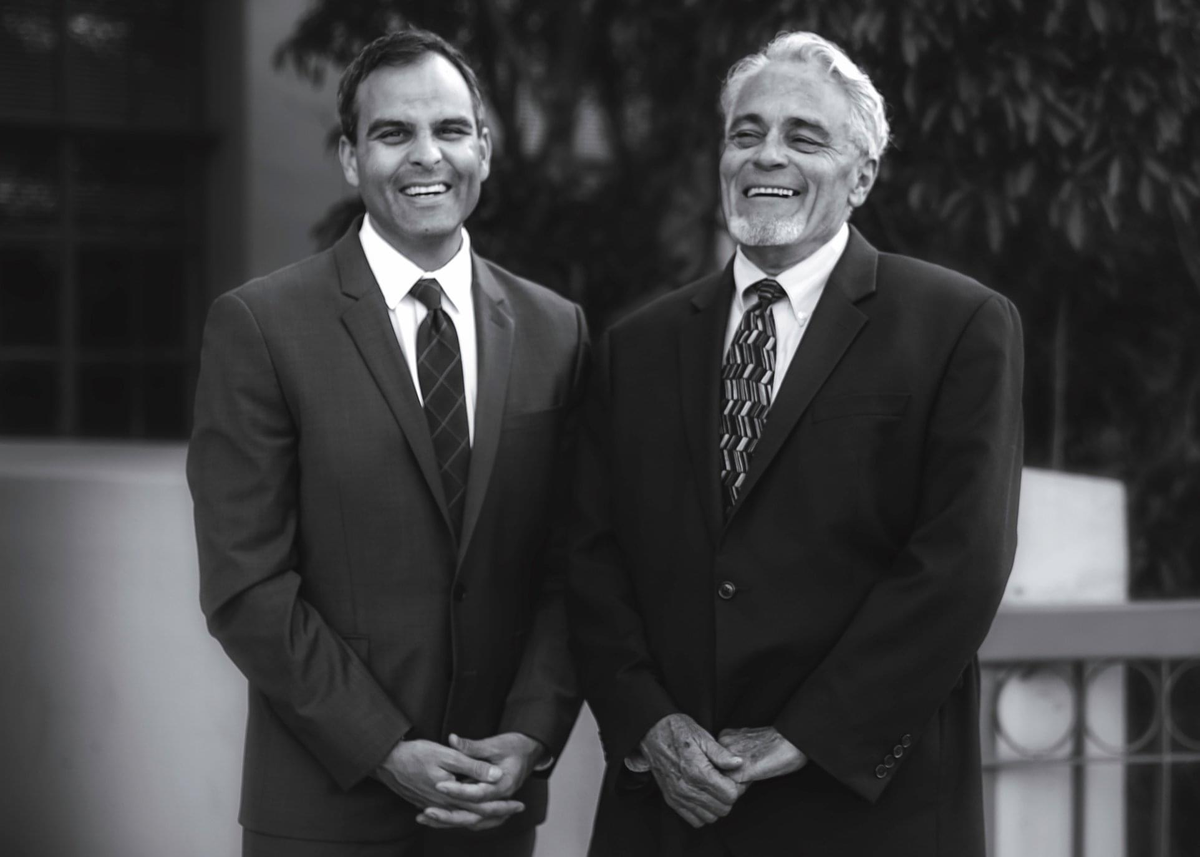
The two had shared a San Luis Obispo law practice for 15 years, and the father-and-son duo walking together to court from their Marsh Street office was a common sight any given weekday.
Fisher said his father, an artist with a rebellious nature in his own right, taught him the importance of “sticking up for the underdog.”
“A private person, who now has the resources of the government coming at them, that’s an underdog in any sense of the word,“ Fisher said. “I remember my dad telling me stories about cases he had where people who ... really had their rights violated by law enforcement, and that really stuck with me.”
He added: “And if it’s not criminal defense attorneys who are going to point out these abuses of power, who’s going to do it?”
‘A balance of intellect and creative ability’
Born in Corona, Fisher lived in Southern California before his parents bought a house near the beach in Morro Bay in 1990.
A graduate of Morro Bay High School, he’s been with his wife, a San Luis Obispo High grad, since he was 21. The couple, along with their 10-year-old son and 6-year-old daughter, live in Arroyo Grande.
He said both his parents had a profound effect on his adult life, and credits them with encouraging his creativity. His mother, Morro Bay resident Jill Garman, who he said had her “finger on the pulse” of current events, greatly influenced his sense of political and social awareness.
Initially more interested in music than law, Fisher played in several rock bands and said he inherited his artistic tendencies from his father, who was also a well-recognized painter.
In an interview with The Tribune, Fisher recalled growing up with some of the same music that still influences him today — John Lennon, Paul Simon, Led Zeppelin — and how his dad would accompany him to see groups such as The Henry Rollins Band and Tool.
While attending Cuesta College, he worked in his father’s office, filing paperwork and performing other duties, before deciding to follow in his dad’s footsteps.
After a growing up around the law office, he found himself “relating a lot more to the attorneys in town more than some of the other bands we played with,” he said. He would listen in as David Fisher and his former partners, including attorney Chris Casciola, would discuss the dynamics of the local criminal justice system.
“It really gave me an education early on,” Fisher said.
Casciola, who still practices in the county, joked that he “didn’t know Patrick was listening.” He said he’s proud of his former officemate, whom he described as “the right balance of intellect and creative ability.”
“Some of the best attorneys are those you might say were rebels in their youth, or people who refuse to march to the same drum,” Casciola said.
Fisher completed his law degree online while working for his father’s firm, passing the bar exam on the first attempt.
The professional partnership would last for more than a decade, and when David suffered a sudden fatal heart attack and stroke in 2018 after working as a lawyer in SLO County for nearly 30 years, his passing left his family and the local legal community in shock.
“My dad and I were so much alike, it was kind of weird for our family members, it was almost like we were the same person in many ways, which makes (his death) very hard,” he said. “I’d say he was my best friend.”
Fisher says he’s tried to lead his professional life by his father’s example of caring deeply about clients, keeping calm, and maintaining healthy relationships with adversaries within the criminal justice system.
Life is pretty good for the counselor these days, he said.
“I love my life right now. I have leisure time, I keep in good mental health,” Fisher said. “All I want is to take my family to stamp our passports somewhere, go backpacking and surf, play music, and get my ire up on some case I’m handling.”

One of his projects is the local band Eat The Wolf, for whom he sings lead vocals — usually in an eclectic get-up — and which he describes as “aggressive rock.” The band has played local shows at SLO Brew and The Siren, though the live music shutdown due to COVID-19 has put their public performances on hiatus.
He said he’s considered more lucrative law gigs outside of criminal defense in the past, he said he’d “be perfectly content” keeping his current practice for the rest of his career.
“Totally uninterested,” Fisher said. “Criminal defense is more rebellious than being a rock star.”
Defending the accused
A private attorney who also represents defendants in cases in which the Public Defender’s Office has conflicts, Fisher has been one of the most steadily working defense attorneys in the county for over a decade.
In one of his high-profile cases, the Fisher’s firm represented several of a dozen medical marijuana growers and delivery service operators dubbed by local media the “Doobie Dozen.”
Two days after Christmas in 2010, several families’ homes were raided by SWAT gear-clad members of the Sheriff’s Office’s now-defunct Narcotics Task Force after an undercover operation targeted mobile marijuana dispensaries in the county who accepted cash for their services. Those businesses were each operating under the state’s Compassionate Use Act and reportedly followed guidelines published by the state Attorney General’s Office.
Twelve people — not including three from outside the county — were arrested, and an alleged $3.5 million of marijuana and other paraphernalia were confiscated. A couple’s small dog died of cardiac arrest during the search, and six children were placed in protective custody by the SLO County Department of Child Welfare Services.
The cases meandered through the legal system for more than two years, until a judge’s ruling in one of the Fisher’s clients’ cases led to charges being dismissed against each local defendant.
“This county was behind when it came to understanding medical marijuana, and those cases were really a process of educating law enforcement about the state of the law,” Fisher told The Tribune.
Oftentimes, proving a client’s innocence requires painstaking investigation,and the defendants aren’t always sympathetic.
In 2015, a 30-year-old South County man with a lengthy criminal history was accused by two teenage girls of sexual assault. The alleged victims, Fisher revealed in court, were allowed to be interviewed together, and changed their stories several times to investigators, who still pushed for prosecution.
After just two hours of deliberations, the jury in the three-week trial unanimously found Michael McGrew not guilty of several felony charges that could have led to a life sentence had he been convicted.
By the conclusion of his trial, McGrew had spent two years in County Jail custody, where he was attacked five times by fellow inmates, losing two teeth, according to a lawsuit McGrew later filed against the county.
Fisher says he at first believed his client to be guilty, but his investigation soon found otherwise.
“I ended up apologizing to him,” Fisher said. “It was eye-opening.”
Other cases are outright tragic, and the defense’s role is to advocate for a just resolution.
In July 2018, Fisher defended former San Luis Obispo resident Jessica Allred, who caused a fatal head-on collision while driving intoxicated from a Pozo country music concert in 2016.
Following a weeklong trial, Allred, 25, was convicted of vehicular manslaughter while intoxicated for the death of Santa Margarita resident Denise Fox.
But Fisher’s defense raised doubts about whether she was driving erratically from the event, and jurors found her not guilty of the prosecution’s more serious charge of felony vehicular manslaughter with gross negligence. The jury’s lesser finding reduced her potential prison sentence by about six years.
Asked about defense work, and representing people who have committed crimes, Fisher says it’s not something he struggles with. Even in heinous cases, the role of a defense attorney is to provide the best advocacy for the client.
“You compartmentalize and remind yourself of your role,” he said. “My role is not to be judge and jury.”
Defendants are also at their lowest point in their life, Fisher said, and on a human level, should have an advocate to be by their side. Despite how some may feel about defending people who commit crimes, Fisher said that without a competent defense, “the whole system falls apart.”
“A society is only as good as how we treat our least desirable members,” he said.
‘I believe in the cause,’ attorney says
Fisher’s involvement in Arata’s case came through a friendship with her mother; he said he offered his services after Arata’s July 21 arrest. Since then, he’s partnered with Briggs, who Fisher says, despite his big-city attorney persona is down-to-earth and a pleasure to work with.
Fisher declined to discuss specifics of the case for this article, but the two attorneys have made waves with strongly worded legal filings in the case and for calls at public events for former Police Chief Deanna Cantrell to resign.
Court filings in the case rail against the city’s Police Department, Cantrell, the CHP, and the District Attorney’s Office in the prosecution of Arata, the 20-year-old college student and Black Lives Matter activist who was charged with seven others for a July 21 protest that blocked Highway 101.
Though Briggs has taken the spotlight in public appearances about the case, a demurrer filed by the two attorneys claim that the District Attorney’s Office case is “not even remotely ethical” and “egregious” in that it “tramples” on Arata’s First Amendment rights.
They further allege that Arata was “targeted” by police because she’s “an outspoken and charismatic young Black woman,” and was retaliated against “to cover for Cantrell’s incompetence.”
“The officers felt attacked. Deanna Cantrell felt attacked, embarrassed. She was getting pressure from some in the community,” Fisher told The Tribune. “She couldn’t keep things under control.”
The defense team later requested that the court impose a gag order on the Police Department and CHP, which released “blatantly false narratives and prejudicial misinformation” following Arata’s arrest which, they say, could violate her right to a fair trial.
Though Fisher is no stranger to calling out a violation of a defendants’ rights, it’s usually within the courtroom.
Arata’s case, he said, is different.
“I do think there’s a calculation, a balance between saying what needs to be said in advocating for your client, and what crosses the line and would be counter-productive,” Fisher said. “In this case, we didn’t feel we’d be doing our jobs (without the motions).”
Fisher said he’s is a supporter of the Black Lives Matter movement, and he does believe that systemic racism exists in San Luis Obispo County, contrary to statements made by local elected officials. Five of the eight people facing charges over the July 21 event are people of color.
“I believe in the cause,” he said. “The very thing (Arata) is protesting is the way law enforcement has treated Blacks.”
He pointed to the case of another client, LeiYahna Jefferson, who was struck by an aggressive motorcyclist as she crossed Osos Street in downtown San Luis Obispo during a Sept. 2 march. Jefferson was not seriously injured and the motorcyclist, David Medzyk, was later charged with a single charge of misdemeanor reckless driving.
But the Police Department also issued infraction citations against two demonstrators for allegedly walking outside the crosswalk.
“This guy runs into (Jefferson), and it’s misdemeanor reckless driving? That’s assault with a deadly weapon in 99 out of 100 cases — that’s undeniable,” Fisher said. “And I have to think that this has to be a factor: What was she protesting?”
Though he’s personally received just a few angry messages over the case — more or less “you suck,” he said — people he’s known for years have made what he calls racist comments over the controversy.
“And I don’t even know that they know they’re supporting racism,” he said. “As a white person, it’s very disappointing, and I can’t imagine if I wasn’t white. It wouldn’t make me feel very safe.”
One nuance lost, Fisher says, is that despite his criticism of the District Attorney’s Office’s in the Arata case, he has ample respect for law enforcement and says he tries to reach out to officers during a case when he feels they’ve done a good job. And while he’s on an opposing side in the courtroom, the defense attorney also has admiration for many in the DA’s Office.
“There’s nobility in being a prosecutor,” Fisher said. “There are people that get victimized, and sometimes their only support comes from a prosecutor.”
Calling himself pro-law enforcement, he says that if he’s ever in trouble, “I call a cop.”
“But I just can’t stand by and let power go unchecked,” he said. “Is there anything less American?”