
What caused damaging waves that slammed SLO County? Inside California’s recent ‘bomb cyclone’
I’ve been forecasting waves along the Central Coast since 1991, but the recent swell event marked the longest period and wavelengths I’ve ever observed. The waves were immense and powerful, breaking with extraordinary force.
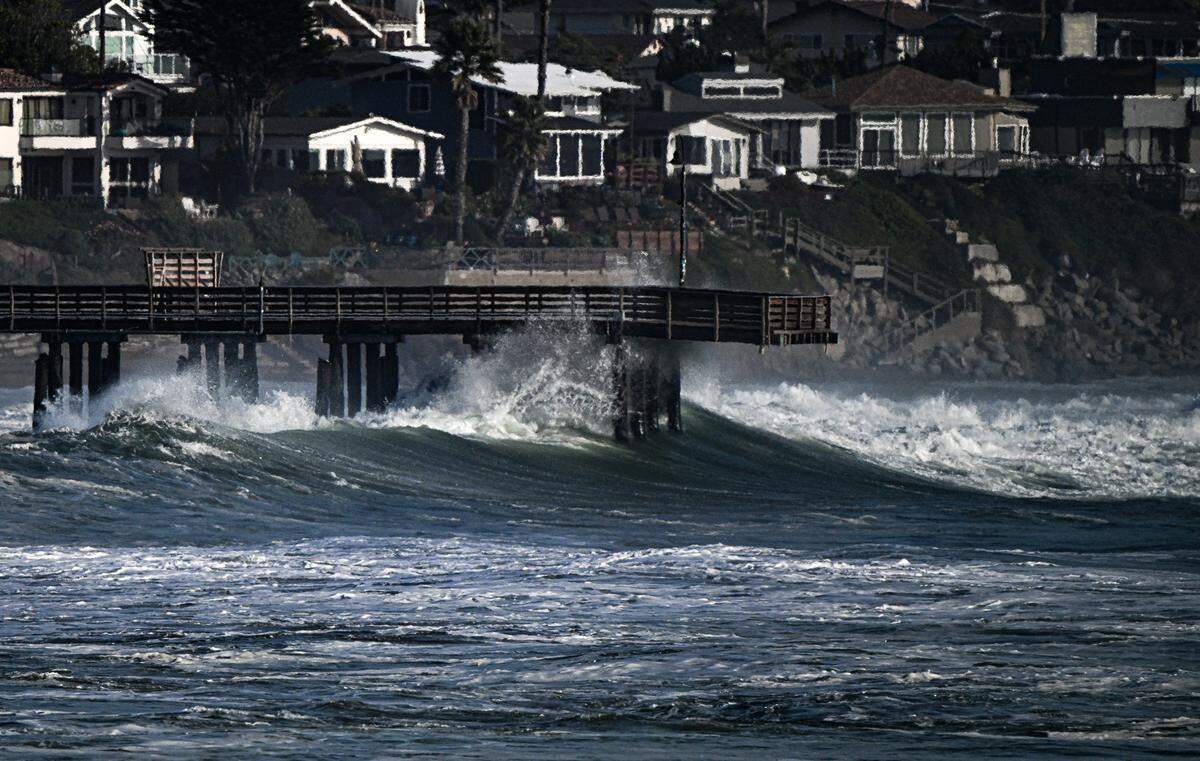
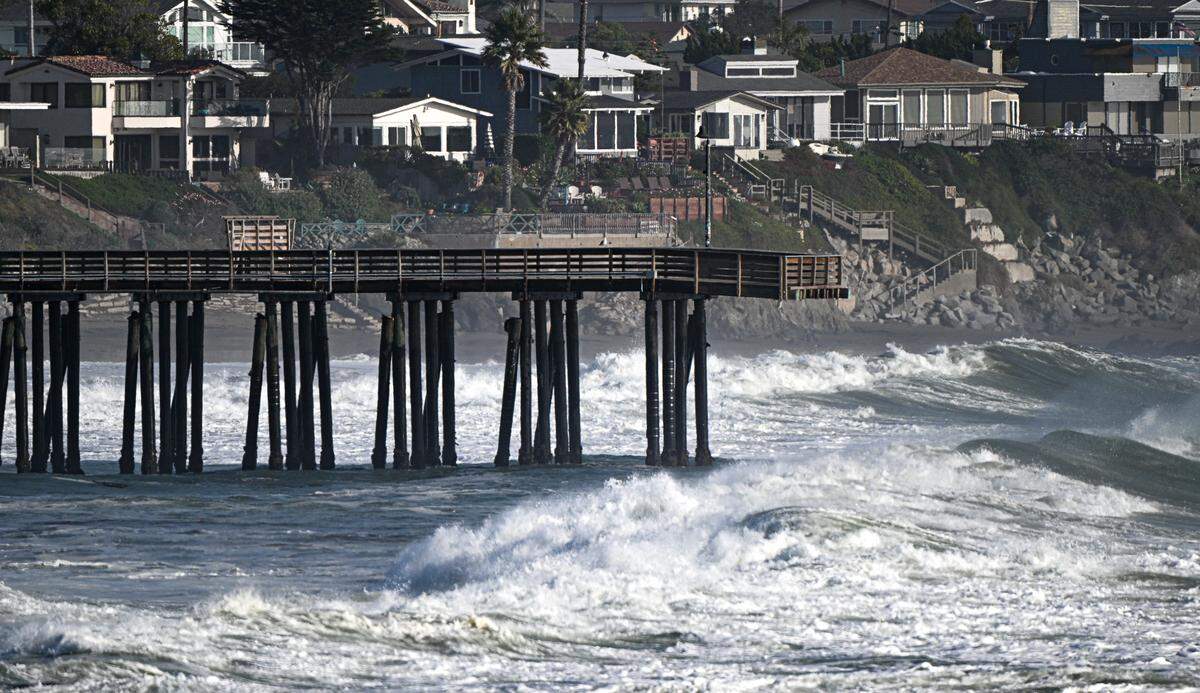
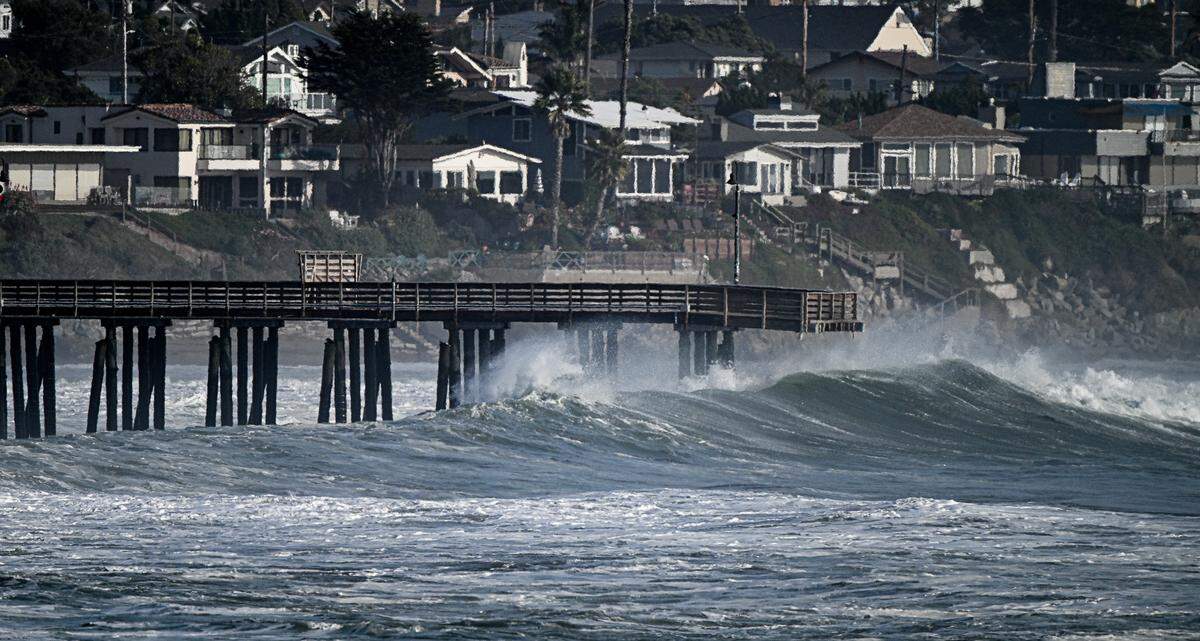
On Dec. 23, I captured some photos from Estero Bluffs State Park that illustrate the intensity of this event.
One image shows a wave crest nearly reaching the deck of the Cayucos Pier, with spray shooting several feet above it, while another highlights the calmness between the swells and how far the water level was from the pier’s base. The pier’s deck is around 20 feet above sea level.
The timing of this swell event was fortunate, and here is why: The tide was only 2.8 feet at 3:15 p.m. when I took the photos of these massive, long-period waves striking the Cayucos Pier.
Had the tide been higher — 6 feet or more, which is not uncommon — the pier could have sustained significant damage. Imagine a wave of this size riding on water levels 3-plus feet higher!
In a worst-case scenario, several factors coming together simultaneously could have partially submerged the pier during the crust of these extraordinarily long-period waves: A 7-foot tide could have coincided with a 2-foot storm surge from gale-force southerly prefrontal winds associated with an intense storm off the coast.
Warmer seawater would cause thermal expansion of the water column, raising sea levels by another half a foot, which is often the case during El Niño conditions.
Additionally, El Niño storms often generate swell trains from a west-southwest direction, allowing waves to hit typically sheltered beaches like Cayucos and Avila Beach with full force.
The physics of long-period waves
Longer-period waves are far more powerful than their shorter-period counterparts.
A wave’s period refers to the time between two successive crests, and its wavelength — the distance between crests — determines how deeply it interacts with the ocean floor.
For example:
- A 5-second period wave has a wavelength of 130 feet and impacts to a depth of 65 feet.
- A 15-second period wave has a 1,200-foot wavelength, reaching depths of 600 feet.
- A 25-second period wave boasts a 3,200-foot wavelength, stirring the ocean down to 1,600 feet.
These waves move exponentially larger volumes of water, amplifying their destructive potential.
When they reach the shore, they surge farther inland, eroding beaches and shifting sand back into the ocean’s depths.
The meteorology behind high wave events
This most recent high-energy swell originated on Dec. 20, when a mid-latitude cyclone near the International Dateline intensified rapidly.
Its pressure plummeted from 973 to 941 millibars in just 12 hours, far exceeding the 24-millibar in 24 hours classification for a “bomb cyclone.”
Wave spectral analysis from the Diablo Canyon buoy suggested the storm may have been even stronger than surface charts and models indicated.
On Dec. 23, the west-northwesterly swell peaked at 19.8 feet with a 20-second period.
Notably, the wave energy in the 22+ second spectral band reached 7,159 cm² — the highest ever recorded at the Diablo Canyon buoy since its deployment in June 1983.
Nearby, the Santa Lucia Escarpment buoy reached 7,863 cm², while the Point Sur buoy hit 10,220 cm² in the 22+ second spectral band.
For context:
- On Jan. 16, 2016, a 13.1-foot swell with a 22-second period generated energy levels of 2,657 cm² in this band.
- On Jan. 10, 2021, a 14.5-foot swell with an 18-second period recorded 2,728 cm².
- The highest significant swell height measured at Diablo Canyon was 21.3 feet on Jan. 11, 2001, but with a much shorter 17-second period.
What challenges increased wave power poses to coast
This event aligns with research linking rising sea surface temperatures to increased wave power.
A study by UC Santa Cruz’s Institute of Marine Sciences found that wave power has grown globally by 0.4% yearly since 1948.
Data from the Diablo Canyon buoy shows a 5% rise in long-period wave events over the past 40 years, driven by more powerful Pacific storms with stronger winds blowing across the ocean, generating higher waves with longer wavelengths.
These trends suggest that coastal communities face mounting challenges as a warming atmosphere generates more intense storms, warmer seas and rising sea levels.
To explore historical wave data, visit the Scripps Institute of Oceanography Coastal Data Information Program (CDIP) database at cdip.ucsd.edu.
The Central Coast’s waves have always been awe-inspiring, but their increasing power underscores the importance of understanding and preparing for climate change’s impacts on our coasts.
This story was originally published December 31, 2024 at 5:00 AM.