The massive community plan rolls back the building moratorium that has blocked residential development in Los Osos for the last three and half decades and provides a regulatory blueprint to address the three main roadblocks that stunted development in the first place — namely limited water supply, insufficient wastewater treatment infrastructure and environmental protections.
First approved by the county in 2020, the Los Osos Community Plan has come before both the San Luis Obispo County Board of Supervisors and the state Coastal Commission repeatedly over the last few months, most recently this week.
On Tuesday, the Board of Supervisors approved the Los Osos Habitat Conservation Plan to protect endangered species in Los Osos amid development, a key componentof the community plan.
Then, following its first contingent approval on June 13 and the county’s own approval on Oct. 29, the Coastal Commission gave its final certification to green light the plan on Wednesday.
The approval of the conservation plan, coupled with the certification of the community plan, means the nearly 400 people currently on the waitlist to build homes in Los Osos — some of whom have been in line for over three decades — will finally be granted permission to do so starting in the new year.
“It’s been a long and rocky road for Los Osos,” District 2 Supervisor Bruce Gibson, who represents the town, told The Tribune. “Los Osos can now evolve itself into its future.”
A rainbow arches over green hills near Los Osos on April 14, 2024. Mark Nakamura nakamuraphoto.com
The history of Los Osos’ housing moratorium
Los Osos’ development issues can be traced back to a population boom in the 1970s and ‘80s that overwhelmed the community’s water resources.
The Los Osos groundwater basin was — and still is — the town’s sole water source, and back then there was no centralized sewage system. When an influx of people moved in, they overdrew the basin, which polluted the groundwater with chlorides from seawater intrusion, and built shoddy septic tanks that also leaked nitrates into the basin.
As a result, the Central Coast Regional Water Quality Control Board banned any new developments from installing septic systems in 1988, effectively placing the community under a building moratorium, given that there was no public waste management system to use instead.
Over 20 years and at least two failed attempts to build a public sewerage system, the Coastal Commission approved plans to build the Los Osos Water Recycling Facility in 2010, and it has been operational since 2016.
The wastewater treatment facility allowed Los Osos to end its practice of using unreliable septic systems and instead connect existing homes directly to the facility, but the building moratorium remained in place. New lots were prohibited to connect to the sewage system until the county set rules to manage the replenished water supply and protect sensitive habitats.
Now, with the certification of the Los Osos community plan, the SLO County Board of Supervisors and California Coastal Commission have finally done so, effectively ending the 35-year building moratorium in Los Osos.
Visitors tour the Los Osos wastewater facility when it first opened in 2016. Joe Johnston jjohnston@thetribunenews.com
Who will be able to build in Los Osos first, and when?
Starting in the new year, Los Osos landowners will start being able to build on their property.
In 1989 after the building moratorium was put in place, a waitlist was launched to create a prioritization of vacant lots and landowners for when development became sanctioned in the community again.
It currently runs around 382landowners long, with 360 residents waiting to build single-family homes and another 22 waiting to build multi-family dwellings, some of whom have been waiting a generation for their chance to develop their land.
“We’ve heard touching stories of ‘my mom and dad bought this parcel in 1975, they had passed on, it is now my sister and myself that own it,’” Gibson said. “It took a long time.”
An empty lot between two homes on 1300 block of 10th Street. The basin that serves as Los Osos’ source of drinking water is contaminated by nitrates and sea water intrusion. San Luis Obispo County plans for more homes. Laura Dickinson ldickinson@thetribunenews.com
However, only a limited number of plots will be permitted to build each year. When the county approved the community plan on Oct. 29, it did so with a 1% annual growth cap for new residential developments — which equates to about 50 new residents a year as of June, according to a Coastal Commission staff report at the time.
In order to honor the priority order of the waitlist without holding up those who might ready to build but are lower down or not on the list, lots will be allocated for construction in phased batches.
Adhering to the annual limit, those in first priority spots on the waitlist will be granted development permits for their lots first from Jan. 1 to June 1 of each year. Once granted the opportunity to develop, landowners will have approximately 75 days to either submit construction plans or defer their waitlist spot to the next year.
If there are still permits available, they will be offered to the rest of the waitlist from July 1 to Aug. 1 each year.
Finally, from Oct. 1 through the remainder of each given year, all leftover construction permits will be offered to landowners beyond the waitlist.
The county will implement a slow roll to the 1% maximum growth cap on new residents to balance the Los Osos water basin’s yield as the community accommodates new homes, adhering to a 0.4% cap in 2025, 0.6% in 2026 and 0.8% in 2027.
All new developments within the sewage service area must connect to the Los Osos Water Recycling Facility, SLO County Planning and Building Department division manager Cory Hanh told The Tribune.
Per the community plan, 25% of available spaces each year will be reserved for affordable housing projects — including second-story conversions of commercial spaces — and projects outside of the sewage service area,Hanh said.Those dwellings may use septic systems that meet state water quality standards — which have been greatly improved and regulated since the 1980s — so they don’t pollute the basin.
Water supply and basin health issues have also been addressed, Gibson said.
At a June 13 meeting, the Coastal Commission found that, as demonstrated by the Los Osos Basin Management Committee, the community had used less water for several years, noting that the basin was at a safe and sustainable yield and no longer in overdraft.
As a safeguard, new development can be stopped if the basin is somehow overdrafted again, Gibson said.
The only obstacle that remained to resuming development in Los Osos was habitat conservation — until Tuesday’s vote.
The basin that serves as Los Osos’ source of drinking water is contaminated by nitrates and sea water intrusion. San Luis Obispo County plans for more homes. Laura Dickinson ldickinson@thetribunenews.com
Board of Supervisors approves the Los Osos Habitat Conservation Plan
In another monumental vote related to the community plan, the Los Osos Habitat Conservation Plan was approved by the Board of Supervisors on Tuesday in a 4-1 vote, with Supervisor Debbie Arnold dissenting.
The county’s conservation plan is meant to streamline the preservation of protected habitats and species in Los Osos and act as a cheaper alternative to the federal conservation requirement for landowners who want to build.
Los Osos sits on an ancient dune land form, where the unique geography and climate produce a soil type called Baywood fine sands that support certain species found nowhere else on Earth. There are four threatened species in Los Osos: the Morro shoulderband snail, the Morro manzanita tree, the Morro Bay kangaroo rat and the Indian Knob mountainbalm.
As such, the Coastal Commission has generally considered all of Los Osos to constitute an environmentally sensitive habitat area.
“Every square inch of Los Osos sits on a piece of sensitive habitat,” Gibson said.
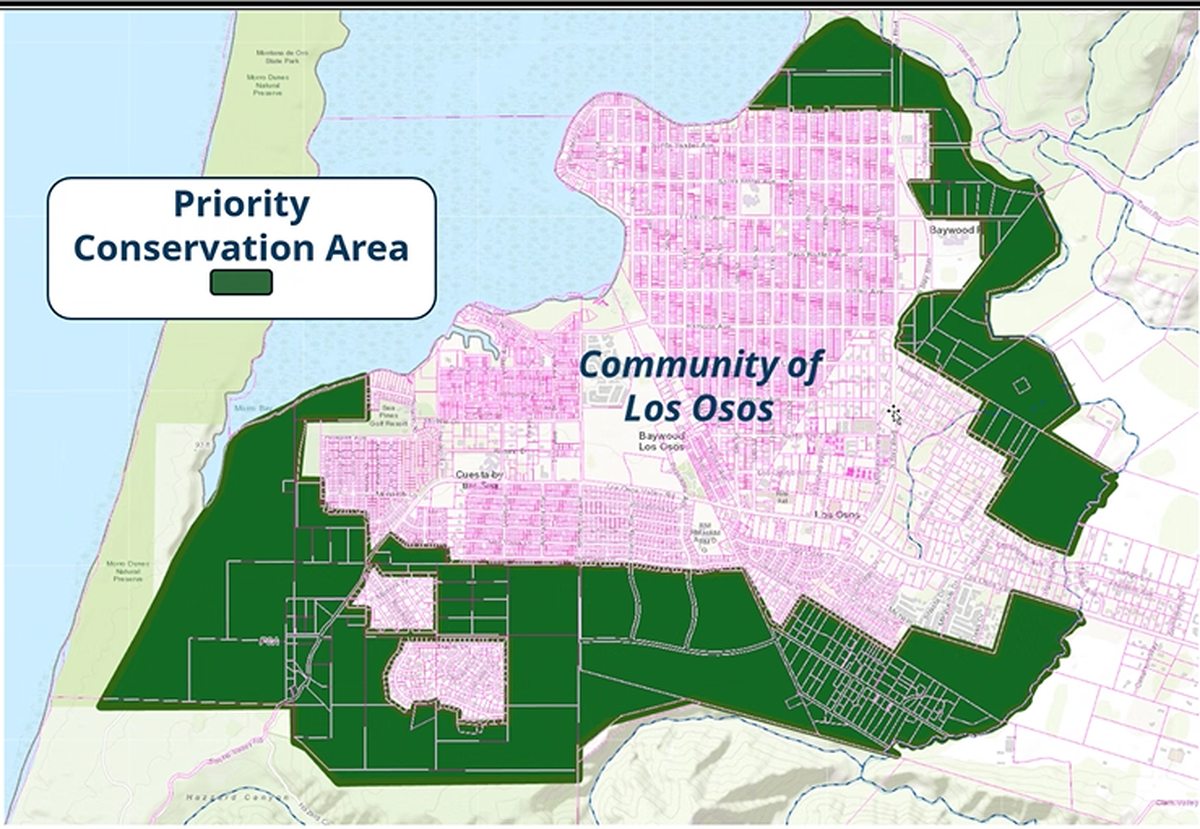
The Los Osos greenbelt is a high priority conservation area where multiple endangered species live. Protection of this area which will become the responsibility of San Luis Obispo County under the Los Osos Habitat Conservation Plan, approved by the Board of Supervisors on Dec. 10, 2024. San Luis Obispo County Department of Planning and Building
Urban Los Osos is encircled by a high priority conservation area called the greenbelt where the bulk of these endangered species live, which will become the county’s responsibility under the habitat conservation plan.
To preserve the greenbelt, the county will either acquire land in the area from willing property owners for the purpose of conservation, or restore government lands already impacted by hiking trails. This widespread conservation efforts will take place in lieu of doing so on individual properties as construction begins.
“We’re mitigating the greenbelt, the priority conservation area,” Hand said. “That way people don’t have to do that on their individual property.”
All in all, the program will cost upwards of $43 million, with a $2 million kickstart fund requested from the county’s General Fund Contingencies on Tuesday, but this cost will be entirely paid back by those developing in Los Osos.
“The county would front the bill, essentially,” Hanh said.
Any landowner who plans to build in Los Osos will be subject to habitat mitigation fees, which will pay for the holistic conservation of Los Osos. The board will vote to implement these fees on Feb. 4.
“The fee is the last step” to implementing the community plan, Hanh said.
For some, however, the cost was still too high. Supervisor Arnold ultimately voted against the plan for budget reasons.
“We’re talking about borrowing $2 million from our general fund at a time that we know we’re going to be super tight with money,” Arnold said at Tuesday’s meeting.
Importantly, these fees would still be in place for residents even without the county’s conservation plan, and probably at a higher cost, Hanh said.
Los Osos’ environmental status means it requires protection by a federally certified preservation program in order for new development to take place. Usually that would be done through the U.S. Fish and Wildlife service’s mitigation banking — the county’s habitat conservation plan is simply a faster and cheaper alternative to a federal requirement, Hanh said.
The federal service’s mitigation fee for their program is $2.73 per square foot of ground disturbance, substantially more costly than the county’s conservation mitigation fee of $1.95 per square foot.
For example, to build a 2,000-square-foot house on a 6,000-square-foot lot, a landowner would pay $16,380 in mitigation fees under the Fish and Wildlife Service compared to only $11,700 in mitigation fees under the county’s plan.
“It’s not a new thing that you have to do, rather, it’s an alternative,” Hanh said. “It’s a more streamlined, efficient alternative to what they’ve already been doing.”
A view from Alamo Drive in the Cabrillo Estates neighborhood looks over the town of Los Osos, which has been under a building moratorium since 1988. Laura Dickinson ldickinson@thetribunenews.com
The county began preparing its conservation plan in 2009 and finally received approval from Fish and Wildlife on Feb. 15, giving the county authority to handle environmental mitigation efforts for individual property owners.
Without the county’s conservation plan, individual landowners would be left to navigate the complicated federal permitting system on their own, potentially causing roadblocks to their desired use of their land, Hanh said.
But under the adopted plan, the county will do all the mitigation work first and landowners will be able to start building their homes immediately and with fewer regulations, he said.
“Instead of asking people to mitigate on their individual properties, this path allows people to use their property fully, and the mitigation can happen where it is most effective, and that’s in the greenbelt,” Hanh said.
Notably, the conservation plan is not only better for landowners’ pocketbooks, but for the protected species of Los Osos, too, he said.
“Having the greenbelt in this contiguous, larger swath of land where they can be undisturbed, that allows the species’ to thrive,” as opposed to having a “piecemeal” strategy of individually protected properties throughout the community, Hanh said. “So we’re going to get the best results for the species and make it easier for property owners at the same time.”
If you are currently on the Los Osos Waitlist to Build and would like to speak to The Tribune about your experience, please email cshrager@thetribunenews.com.
This story was originally published December 12, 2024 at 10:00 AM.
Chloe Shrager is the courts and crimes reporter for The Tribune. She grew up in Palo Alto, California, and graduated from Stanford with a B.A. in Political Science. When not writing, she enjoys surfing, backpacking, skiing and hanging out with her cat, Billy Goat.

%20copy2g%20(1).jpeg "Apr2024-18 (1) copy2g (1).jpeg")