Huge area of Morro Bay Estuary seafloor is for sale for $7 million. Could it be developed?
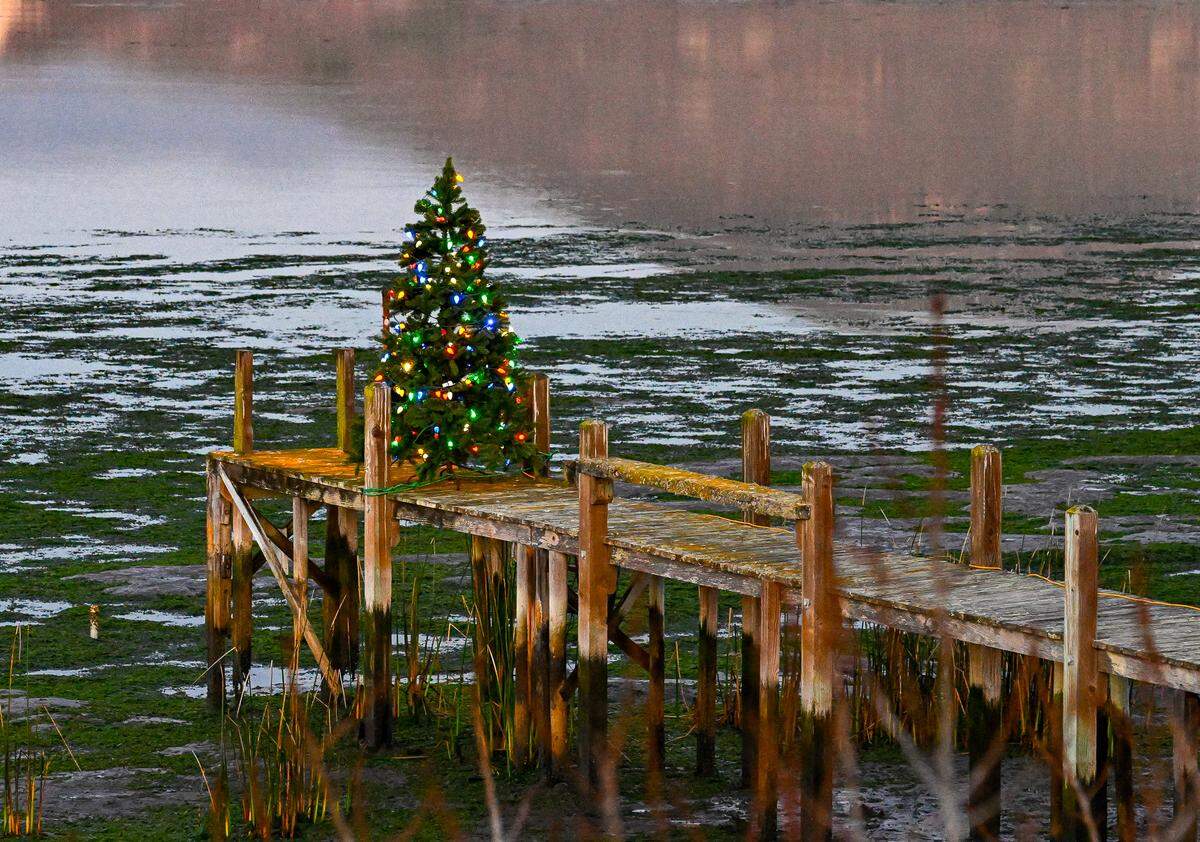
Todd LaVelle strung holiday lights on the Baywood Park Pier on Thursday, pausing every so often to chat with passerby and admire the back bay sparkling behind him.
He said he appreciates the bay’s natural beauty and how Los Osos residents work together to take care of the area.
“It’s a place (that’s) good for your soul,” LaVelle said.
A piece of that place, however, is up for sale, but it’s not anywhere you would expect.
At the back end of the Morro Bay Estuary, a 538-acre parcel of seafloor could be yours for a mere $7 million.
The question is, could you actually do anything with the swath of periodic mudflats lying beneath the shallow waters of a national estuary?
The parcel stretches from Santa Ysabel Avenue in Los Osos across the bay to the sand dunes of Montaña de Oro State Park and then down to Shark Inlet, including the area around the Baywood Pier, the Sweet Springs Nature Preserve and off Sea Pines Golf Resort.
The property was listed on Realtor.com on June 3.
The Morro Bay Land Co. LLC has owned the property since 1999, according to San Luis Obispo County assessment manager Jim Mallon. Before that, the Morro Bay and Land Co. General Partnership owned the property since at least 1975, he said.
But it’s possible that they owned the property for even longer.
“When Proposition 13 passed in 1978, it set a 1975 ‘base year’ on all property in the state,” Mallon said, so the county’s records only show ownership history from 1975 on.
County records list Chuck Ogle as manager of the LLC, but he declined to talk to The Tribune about the listing.
The listing recommended conservation as a future use of the property, because the waters are stewarded by the Morro Bay National Estuary Program.
“It is a dream property for environmental mitigation or habitat preservation that cannot be duplicated anywhere. Preserve it for California today,” the listing said.
Looking out at the peaceful bay, LaVelle said he was OK with the idea of someone buying the undersea property — but only if they took care of the wildlife and continue to allow public access there.
“As long as it wasn’t used for the wrong reason,” he said.
What could be developed on the seafloor?
At a price of $7 million, some buyers might want to get more than conservation for their money.
An ambitious developer, for example, might wish to build over-water bungalows for a luxurious overnight stay on the bay, or a pier complete with shops, restaurants and places to fish.
In the Morro Bay Estuary, however, anything of that level would likely be difficult — if not impossible — given the many overlapping protections in the environmentally sensitive area.
First off, any developer would need to apply to the California Coastal Commission for a coastal development permit to build on the property, agency spokesperson Joshua Smith said.
In order to win a permit, the proposed project would need to comply with the Coastal Act, which prioritizes conserving sensitive habitats and preserving public access to the coast.
Meanwhile, the edge of the property that meets dry land is also under the county’s jurisdiction and zoned for recreational uses or open space, San Luis Obispo County Department of Planning and Building division manager Eric Hughes said.
That portion of the land is a combination of wetlands, marsh and terrestrial habitats, he said. Any use of the area would require a permit approved by the county.
Allowable uses with a permit include fisheries, a coastal accessway or passive recreational activities, he said.
In addition, the property falls within a 100-year flood zone and is a sensitive resource area, which would also limit whatever development might be allowed, he said.
The Estero Area Plan, which manages development for the area from Point Estero to the north to Point Buchon to the south, sets guidelines for land zoned for recreation. Those guidelines include prioritizing development of lower-cost, visitor-serving uses that do not harm sensitive resources and building commercial projects “within or immediately adjacent to urban areas” that do not contain sensitive habitat, he said.
“There are many policies that regulate the types of uses allowed on this parcel, and it requires extensive review of these policies to determine what kind of project might be permitted,” Hughes wrote in an email to The Tribune.
That would translate to a lot of hurdles for any potential buyer with grand plans in mind.
Smith couldn’t say for certain what types of development would be allowed on the property without a full analysis of a project proposal, but he was sure of one thing: “Nothing’s going to happen overnight,” he said.
Listed property falls in the Morro Bay Estuary
As part of the Morro Bay Estuary, the area is looked after by the nonprofit Morro Bay National Estuary Program.
The 2,300-acre estuary contains a variety of protected species, including eelgrass, which is listed as a habitat area of particular concern by the National Oceanic and Atmospheric Administration. The back bay in particular contains an abundance of healthy eelgrass and is important to the overall wellbeing of the estuary, she said.
The estuary is also a popular habitat for migratory birds.

While the estuary program works to monitor, research, preserve and restore the estuary, it is not a regulatory body and has no enforcement authority, executive director Melodie Grubbs said.
“It’s very strange to think of a water body for sale,” Grubbs said.
But the estuary program is aware of the land sale and is coordinating with partner agencies to “explore future conservation opportunities” for the property, she said.
“It’s pretty early on in the game,” she said, but noted, “It’s something that’s definitely on our radar.”
What do Los Osos residents think?
On the shores of Baywood, the aroma of coffee drifted over the parking lot from the nearby Nautical Bean, mingling with the sea air while people walked their dogs on the pier.
A bird skimmed across the surface of the water, spreading ripples across the mirror for a cloudless sky.
“This is sacred land,” Los Osos resident Adam Basden said. “We want it to remain the same.”
He said he hopes any future property owner respects the wildlife, preserves public access and involves the community in any decision-making about the area.
He gestured to his friend, Donovan Crizer, who was picking up litter around the boardwalk.
“Everyone kind of takes care of this place,” Basden said, and he hopes the next property owner also sees themselves as a steward of the land.
Los Osos resident Lee Edgar noted that people use the area for community building, kayaking and bird watching. He hopes the land will be preserved as is.
“It’s inevitable that there will be growth and change, but it would be such a shame for someone to come in and develop that land,” he said.
Minnesota resident Hossein Yeganeh and his wife, Debora, have spent winters in Los Osos for the past three years. The couple enjoys bird watching at Cuesta Inlet and walking their Great Dane, Dean, along the boardwalk. They both hope the bay remains undeveloped.
“I basically grew up in Orange County. It was a small town. I still remember coming out of the house and smelling the orange groves,” he said. “Now, when I take my wife down there, it’s no longer orange trees. There’s nothing left of the old Orange County. And I hope this doesn’t happen to this area, because it’s just a peaceful, beautiful place.”
This story was originally published December 11, 2024 at 10:03 AM.