New Chumash marine sanctuary officially designated off California coast. ‘It’s finally here’
On a quiet, foggy day in San Luis Obispo County, a massive change was made in the way coastal waters will be managed — the Chumash Heritage National Marine Sanctuary was officially designated on Saturday.
The sanctuary protects more than 4,500 square miles of the Pacific Ocean off the coastlines of San Luis Obispo and Santa Barbara counties from oil drilling and certain sea floor disturbances.
“It’s a day we’ve all been waiting for for decades and it’s finally here — just in the nick of time,” Northern Chumash Tribal Councilwoman Violet Sage Walker said.
The purpose of the sanctuary is to protect marine ecosystems, shipwrecks and underwater Chumash cultural and historic sites off the Central Coast.
The late Northern Chumash Tribal Council Chief Fred Collins originally nominated the sanctuary in 2015. The council and Walker, who is Collins’ daughter, carried on his work.
“He would’ve been ecstatic and overjoyed,” Walker said of her father. “He would’ve spent a day at the ocean looking at the waves, walking along the hills and enjoyed what a beautiful day it was.”
On Saturday, Walker enjoyed the news by spending the day at the beach — a moment of rest before the Northern Chumash Tribal Council returns to work advocating for conservation and renewable energy, she said.
“It was just quiet,” but in a peaceful way, Walker said. “Nobody had any phone calls or emails. There was no big fuss.”
The National Oceanic and Atmospheric Administration announced plans to create the sanctuary on Indigenous Peoples’ Day in October, but the agency needed to wait for a 45-day review period before officially designating the sanctuary.
Gov. Gavin Newsom did not object to the sanctuary boundaries or management plan, so U.S. Secretary of Commerce Gina Raimondo rubber-stamped the plans and published them in the Federal Registrar on Saturday.
Walker thanked government officials like Congressman Salud Carbajal, the Biden-Harris Administration, NOAA and the Bureau of Energy Ocean Management for supporting the sanctuary and fighting for its designation.
“Without commitment from our elected leaders, we would not be here today,” Walker said. “They did something life-changing and important for the planet.”
Carbajal has supported the sanctuary since he originally took office in 2017, he said in a news release on Monday.
“I’m proud to have stood with a generation of advocates and Indigenous leaders to see this critical protection implemented for the Central Coast,” he said in the release.
What’s next for sanctuary boundaries?
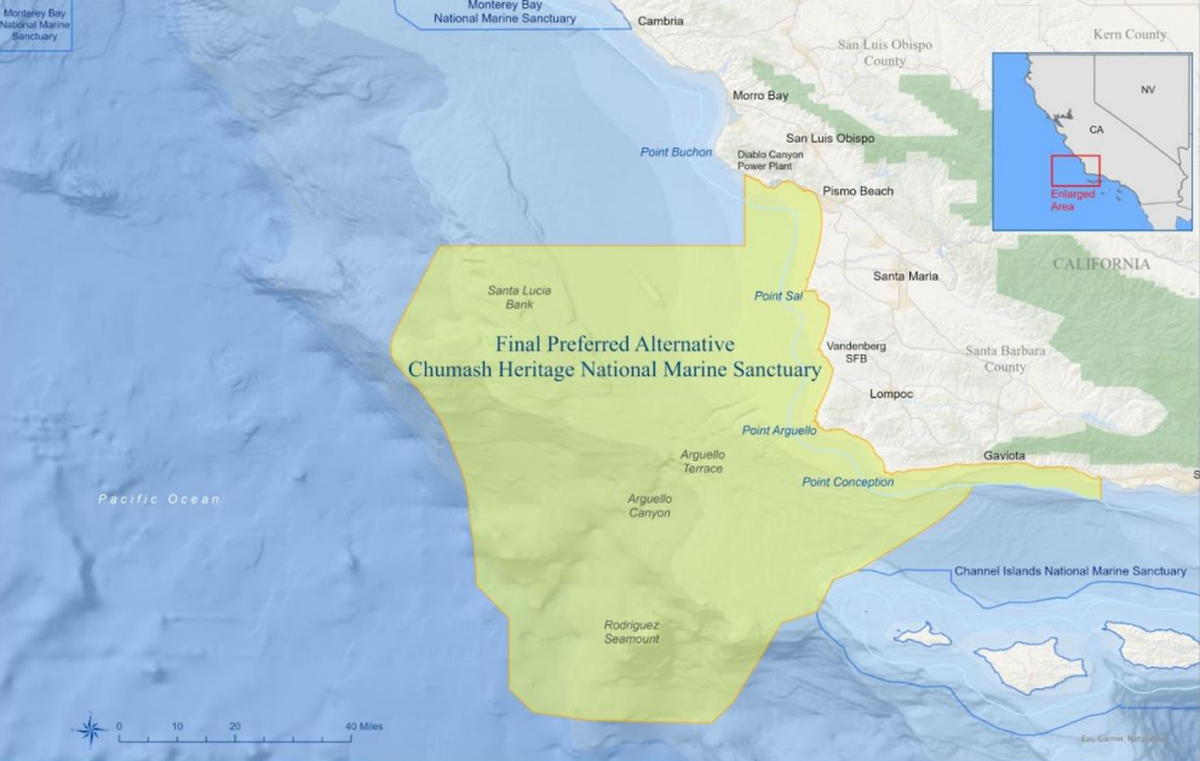
The sanctuary stretches across 116 miles of shoreline from just south of the Diablo Canyon nuclear power plant in San Luis Obispo County to Naples Reef on the Gaviota Coast in Santa Barbara County — protecting 4,543 square miles of the Pacific Ocean.
While NOAA is the lead agency managing the sanctuary, the Northern Chumash Tribal Council and other Native American tribes will be included as co-stewards on numerous governing boards.
The current boundaries are smaller than the design the Northern Chumash Tribal Council suggested in 2015. Those boundaries would have extended north to meet the Monterey Bay National Marine Sanctuary, covering 7,600 square mile of the ocean.
NOAA shortened the northern boundary to allow for the development of underwater cables that would carry electricity generated by offshore wind turbines in the Morro Bay Wind Energy Area to shore.
The final sanctuary management plan identified three areas that were excluded from the sanctuary: waters from Cambria to Diablo Canyon, the Morro Bay Estuary and deeper waters west of the outer boundary.
The management plan requires that NOAA start exploring options to expand protections of those areas by January 2032. To grant sanctuary status to those waters, NOAA could expand the boundaries of the Chumash Heritage National Marine Sanctuary, expand the Monterey Bay National Marine Sanctuary or designate a new national marine sanctuary, the final management plan said.
This plan, however, does not guarantee an expansion of the sanctuary. NOAA must conduct a separate public process to decide on the expansion in the future.
While the Northern Chumash Tribal Council originally preferred the larger boundaries, it agreed to the smaller sanctuary to ensure that it would be designated sooner rather than later, Walker told The Tribune in September.
On Monday, Walker said the Northern Chumash Tribal Council is committed to overseeing the development of offshore wind to ensure that it is done in an environmentally sensitive manner.
“We have a lot of work to do,” she said.