Will SLO County beach town get offshore wind port? Developer shares vision at tense meeting
A developer interested in building an offshore wind port in San Luis Obispo Bay introduced himself to the community on Monday at an Avila Valley Advisory Council meeting while fielding a tense question-and-answer session after his presentation.
Clean Energy Terminals partnered with the Port San Luis Harbor District to study the potential for an offshore wind port in San Luis Obispo Bay.
The feasibility study will take six to 18 months, and will determine where the pier could be built and its scale of operations.
“What could an (operations and maintenance) port at San Luis Bay entail?” Clean Energy Terminals CEO Brian Sabina said during the meeting. “We don’t have a final answer. We haven’t spent those six to 18 months to do all the work. We’re at the very beginning of that, but we have some initial concepts that can help us frame the scale and scope of that conversation.”
Some residents, like Avila Beach resident Jim Meyers, expressed support for the project.
“We should all be for making informed decisions based on real facts and information,” Meyers said. “That’s what is at the heart of the Harbor District’s project evaluation agreement. It requires technical and environmental feasibility studies that will provide residents in the Harbor District with the information we need to decide if we want to support docking facilities for maintenance ships.”
Most attendees, however, showed up to protest the possibility of the port.
“We don’t like the project, and we’re not going to put up with it,” local attorney and longtime Avila Beach resident Saro Rizzo said. “Good luck, and welcome to the neighborhood.”
What could the port look like?
Clean Energy Terminals is collaborating with the Port San Luis Harbor District to study if San Luis Obispo Bay could support an operations and maintenance port.
If the answer is yes, the study would also explore a potential design, location, cost and scale of operations for the port, Sabina said.
When the study is complete, the Harbor District’s Board of Commissioners would have to vote to approve an official design and permits before the port is built.
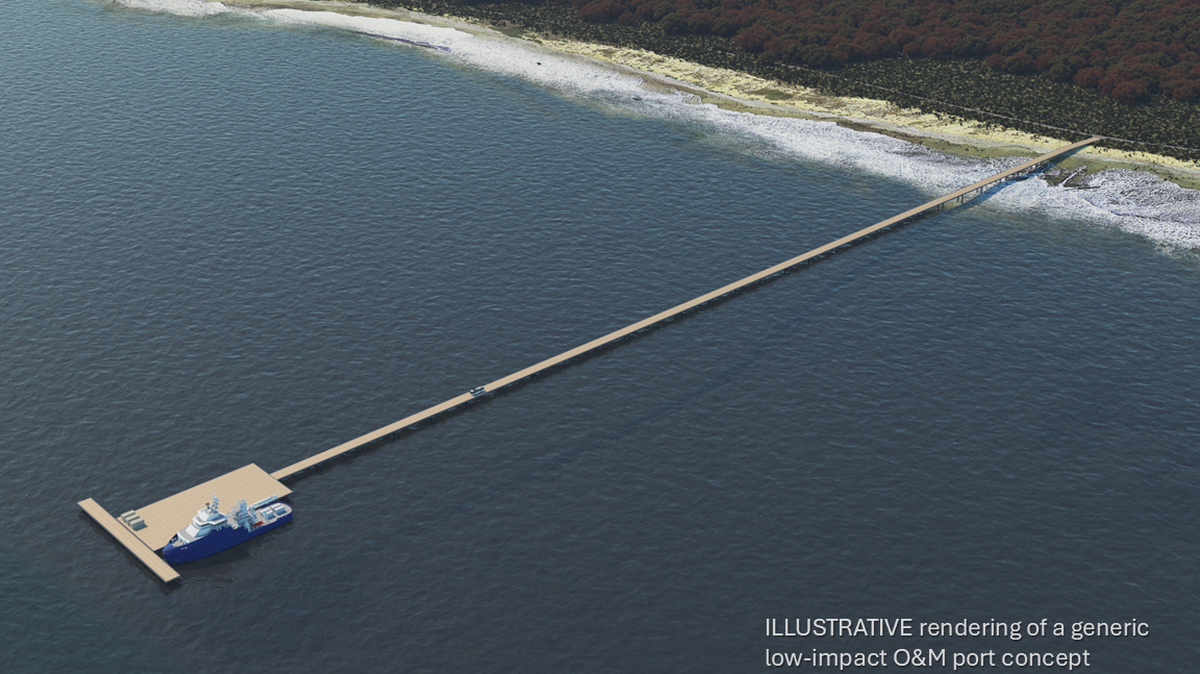
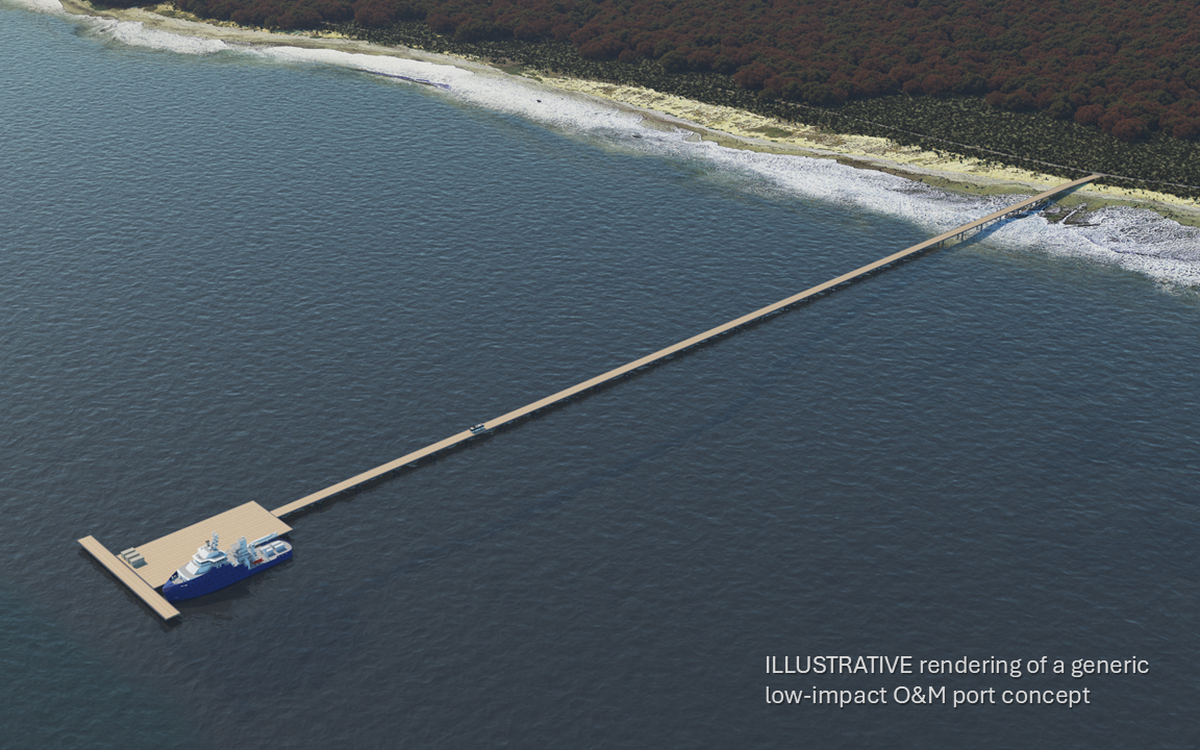
The port could include a 3,000-foot pier, matching the length of the Cal Poly Pier, Sabina said. Wind farm service operation vessels would dock in 40-foot-deep water at the end of the pier about every two weeks to restock supplies and pick up a fresh crew.
“It’s a generic, low-impact, operations and maintenance port concept that we think could be a good fit for Port San Luis,” Sabina said, noting it’s not an official design. “It’s really just to give you a sense of the scale and scope of what we’re talking about.”
The vessels would be 250 to 300 feet long and carry 65 to 100 people, he said.
During the past few years, a 255-foot derrick barge intermittently moored in the port to repair the breakwater, and it was accompanied by two, 240-foot barges, Harbor District Director Suzy Watkins said.
Meanwhile, three to five acres of onshore buildings would house a control room for monitoring the wind farm, a warehouse for spare parts, a workshop area, offices and a parking lot. Those buildings would not fit on the beach nearby and would be built within 10 miles of the port, Sabina said.
The port would not store or transport wind turbine blades or towers, it would simply transport people and supplies to and from the Morro Bay Wind Energy Area about 45 miles away.
Some speakers at the Q&A were skeptical of the design Sabina shared. They worried that Clean Energy Terminals would expand its plans and build a larger port than the presentation suggested.
“I have a problem with this whole thing,” Avila Beach resident Lisa Wagner said. “What you’re coming out with now — that could just be bogus.”
Though Clean Energy Terminals has not yet created an official design, it likely wouldn’t be much different from what he described Monday evening, Sabina said. A larger design just wouldn’t be compatible with Port San Luis, he said.
“We’re trying to really be frank and honest about what we think is a reasonable project for this region,” Sabina said in the meeting. “If we blow smoke up people’s tushes at this point, I’m pretty sure we’re not going to be able to credibly do a project with the Harbor District or the Coastal Commission or anybody else — so we have all the incentive in the world to be honest and open.”
Additionally, the Harbor District and California Coastal Commission must approve the design and any permits required for development.
Once a design is selected, Clean Energy Terminals wouldn’t be able to change the design without new permits — all discussed and voted on in public hearings, Sabina said.
Opponents grill potential offshore wind port developer
Multiple members of the local anti-offshore wind group REACT Alliance grilled Sabina about the project during the question-and-answer period of the meeting.
“I don’t want to be too in your face, Brian, but I think you need to be honest with all of us and say that you have not done any projects up to this point in time,” REACT Alliance president Mandy Davis said.
Sabina then explained that Clean Energy Terminals had not yet completed a project since it formed approximately two years ago. However, members of the Clean Energy Terminals leadership team had worked on offshore wind port projects before creating the company, he said.
For example, the company’s Chief Legal Officer Sloane Perras previously served as the vice president of Foss Offshore Wind, where she led development of an offshore wind terminal in New Bedford, Massachusetts.
“I appreciate that you are self-aware and identifying that that’s a tough way to ask a question for an informational group, but I’m happy to answer it,” Sabina said to Davis. “Clean Energy Terminals has not done a project on the West Coast for offshore wind before, but neither has any other group in the world, right? This is a new industry.”
“But CET has not done any projects,” Davis fired back.
The meeting moderator then stepped in.
“We’re going to tone it down just a bit,” she said. “Let’s have a breath.”
Wagner meanwhile asked Sabina where Clean Energy Terminals got its funding for the study. Sabina said the company’s primary investor is Homecoming Capital, a zero-emission infrastructure investor based in California.
So far, Clean Energy Terminals has not accepted any public money for the Port San Luis project, Sabina said.
In fact, the company will pay the Harbor District $9,000 to support administrative work for the project, $25,000 for the first six months of work and $4,100 for each additional month, according to public documents.
Proposed port would not include wind turbine assembly, developer says
In 2022, REACH Central Coast published a study that evaluated infrastructure needed to support the offshore wind industry.
The study didn’t propose designs, it simply showed ideas for infrastructure that would be useful on the Central Coast.
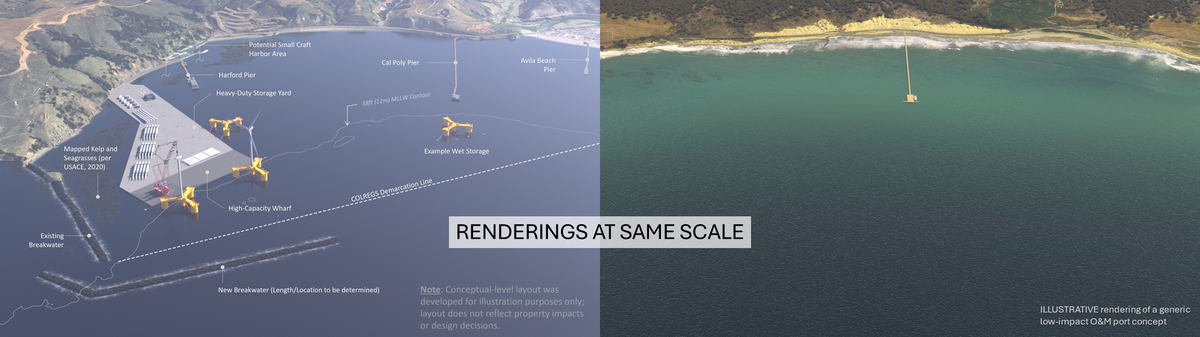
The study included a rendering of a staging and integration port for San Luis Obispo Bay. Wind turbine blades, towers and cells would be assembled at the port then towed out to sea for installation.
The design recently circulated on social media, catalyzing concerns that Clean Energy Terminals would build such a port.
“When I saw those first pictures, I just about had a heart attack,” Avila Beach resident Stephen Sheppard said. “Those original pictures would have destroyed San Luis Bay.”
Sabina assured the audience that Clean Energy Terminals would not build a port anything like the one explored in the REACH study.
Staging and integration ports, which are about 200 to 400 acres in size, are being considered for Long Beach and Humboldt, Sabina said.
“This is huge, industrial, big work,” Sabina said. “Pretty quickly, it was clear that’s not a good fit for the southern coast.”
Port San Luis is about 45 miles away from the Morro Bay Wind Energy Area off the coast of San Simeon and Cambria — making it a good fit for an operations and maintenance port, Sabina said.
Service operations vessels could travel from the wind farm to Port San Luis more quickly than to San Francisco and Port Hueneme, which are farther away, he said.
Meyers, the local Sierra Club Climate Clean Energy Committee chair, said he didn’t support a staging and integration port in San Luis Obispo Bay, but he does support studying the option of an operations and maintenance port.
“We would get access to these economic benefits without needing to become a major industrial port, and without a lot of additional vessel traffic,” he said. “It seems like we can get a surprisingly good amount of value for not a lot of impact.”
This story was originally published September 11, 2024 at 10:00 AM.