Massive port infrastructure needed in SLO County to support offshore wind, new study shows
.jpg "This rendering shows a possible conceptual design for a port at Port San Luis to support the floating offshore wind industry.")
A new study shows the massive port infrastructure that could come to the Central Coast to support proposed floating offshore wind energy developments.
The $250,000, seven-month-long study, which was released Thursday, was prepared by engineering consulting firm Mott MacDonald, commissioned by economic development think tank REACH Central Coast and funded by San Luis Obispo County, Santa Barbara County and the city of Morro Bay.
Over 170 pages, the study shows how San Luis Obispo and Santa Barbara counties could industrialize some areas of their shorelines to provide adequate ports where floating wind turbines would be assembled and maintained. The study also notes how the region could expand the Vandenberg boat dock to better support the commercial space industry.
Greater port infrastructure along the Central Coast is needed because the federal government has proposed using a 376-square-mile area of the Pacific Ocean about 20 miles off the coast of San Simeon and Cambria for floating offshore wind energy development.
In a Dec. 6 auction, three companies bid a collective $425.6 million to emerge as leaseholders for three leases.
The study focused on Port San Luis and the area just outside of Diablo Canyon nuclear power plant near Avila Beach as two particularly plausible locations for offshore wind energy port developments.
It also looked at more remote and undeveloped areas such as Nikki’s Beach and China Harbor, both located north of Cayucos.
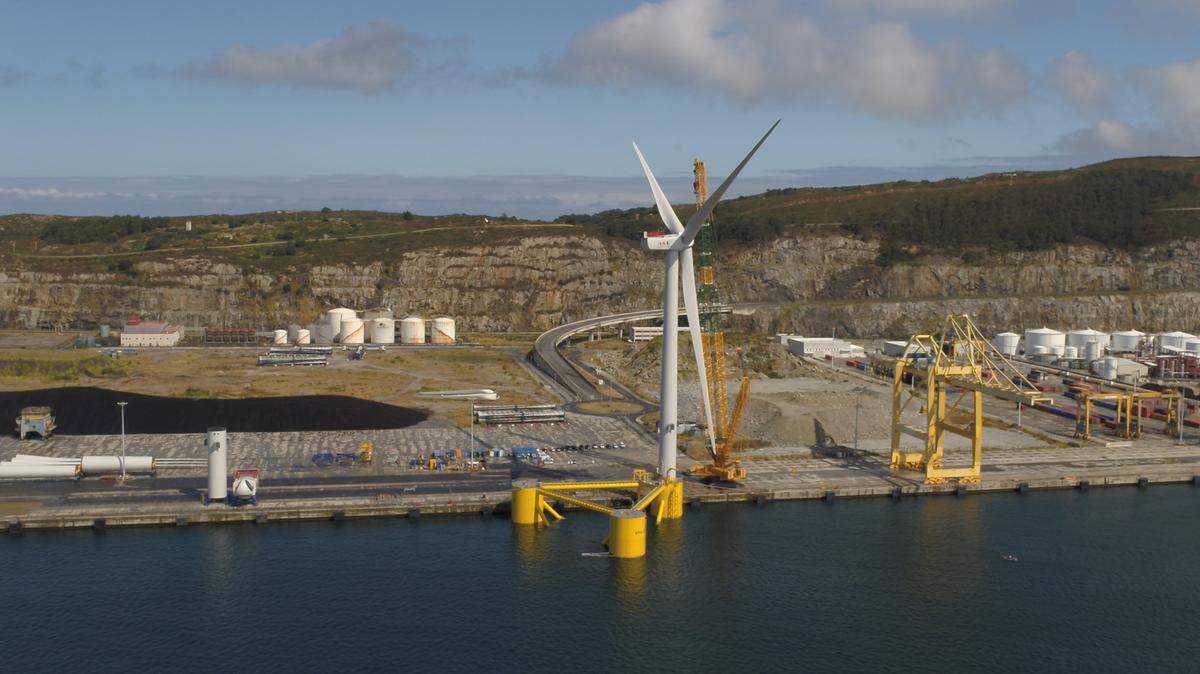
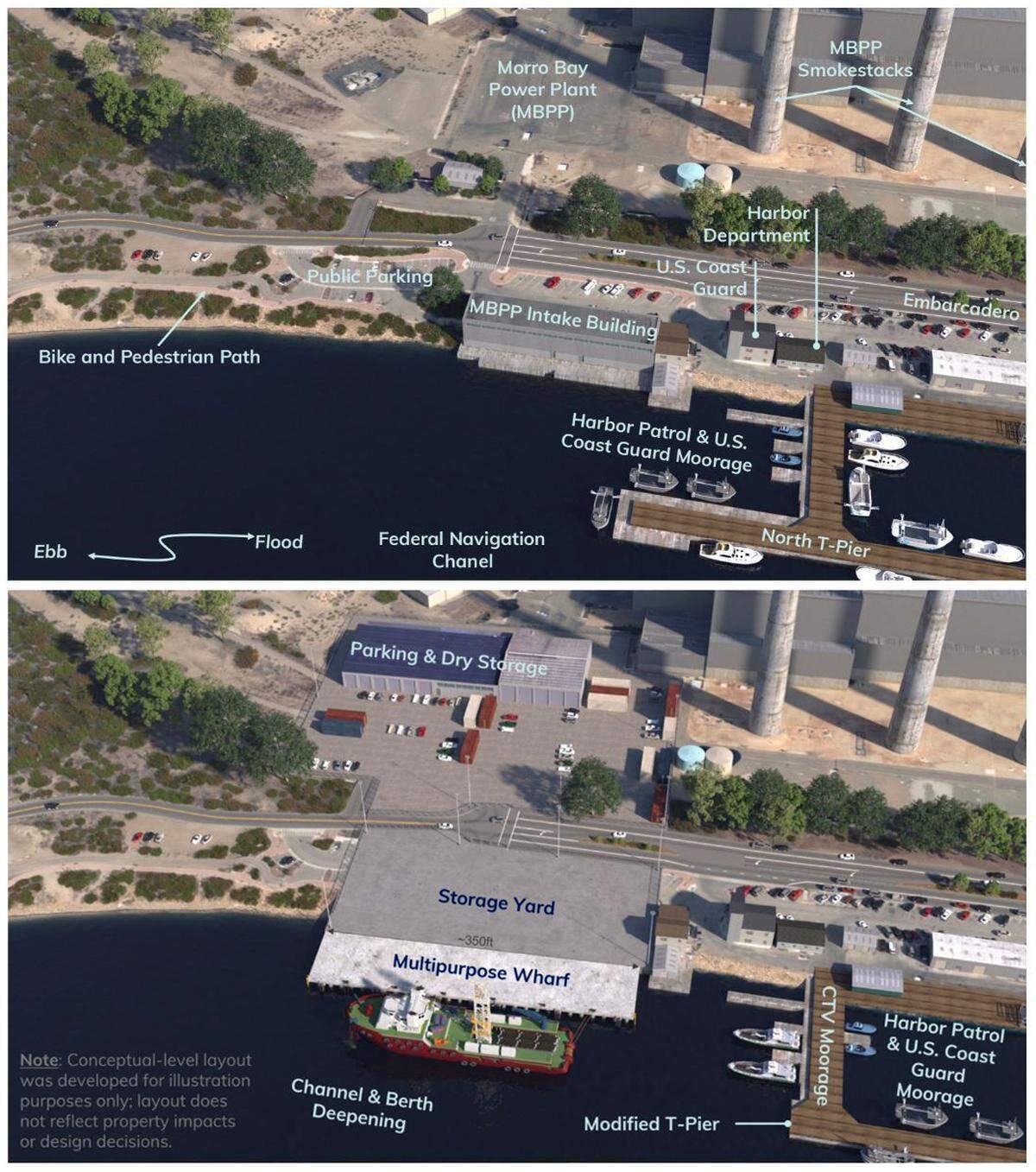
The study doesn’t propose anything, but rather shows concepts of how developments along the SLO County shoreline to support the floating offshore wind turbines might look.
Those potential developments range from a smaller multipurpose wharf and storage yard in the Morro Bay harbor to massive, large-scale ports that would cover 70 to 100 acres of the Pacific Ocean off Port San Luis or Diablo Canyon, according to the study.
Such developments could cost up to several billion dollars.
“I’m glad that there is space and interest at Port San Luis and Diablo Canyon,” District 3 Supervisor Dawn Ortiz-Legg said Thursday in response to the study. “Now, we actually can see what the options are and it will be up to the wide range of stakeholders to help us determine what actually can be done.”
.jpg "diablo canyon port rendering (1).jpg")
Central Coast facilities needed to support offshore wind industry
The study came up with essentially two categories for offshore wind port development: small facilities and large facilities.
Small facilities, such as the one Morro Bay Harbor could potentially support, would be suitable for smaller crews and equipment transport vessels with storage capacity.
It’s likely several of the smaller facilities would be needed along the coast to support floating offshore wind energy developments, according to the study.
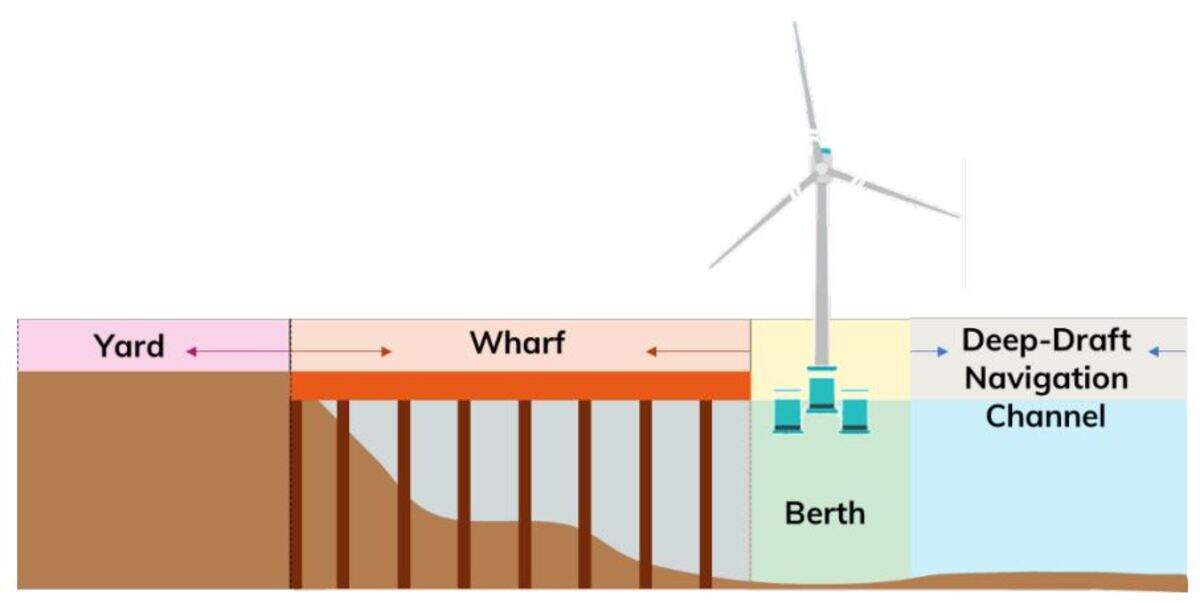
Larger facilities would be used to assemble the floating wind turbines before they are towed out to the wind energy development area, as well as any larger maintenance needs, the study says. Near these ports could be wet storage areas for floating turbine foundations.
According to the study, it’s unlikely the Central Coast would host a large manufacturing port facility for the offshore wind turbines. Instead, the parts would manufactured elsewhere and shipped to the region for assembly, the study states.
Each of the large and small facilities would likely need protection from waves, the study notes, so new breakwaters would need to be built around the ports.
Building the ports along the Central Coast is key to supporting the floating offshore wind industry, the study says.
“The proximity of SLO and (Santa Barbara) counties to the Morro Bay lease areas and the likely development of additional (floating offshore wind) off the coast of California to meet the state’s offshore energy goal may create opportunities for local, sustainable economic development if wind farm construction or maintenance activities are conducted along the Central Coast,” the study says.
The closer the port facilities are to the offshore wind energy developments, the lower the cost is and the more comfortable crews would be, the study states.
Morro Bay is about 33 nautical miles from the proposed offshore wind energy area, while Diablo Canyon Power Plant is about 36 nautical miles and Port San Luis is about 45 nautical miles from the area, according to the study.
Meanwhile, areas possibly suited for offshore wind energy port facilities in Santa Barbara County are 70 or more nautical miles away from the wind energy area, the study states.
“As we prepare to stand up an entire new industry with the development of floating offshore wind farms off California’s coast, it’s becoming crystal clear that we’ll need a network of ports and support facilities up and down the coast,” Adam Stern, executive director of Offshore Wind California, said Thursday in a prepared statement.
How much would new infrastructure cost?
The study also loosely analyzed how much it could cost to build the port facilities.
The smaller facility in Morro Bay, for example, could cost anywhere from $11 million to $40 million, the study estimates.
The larger facilities off Diablo Canyon and Port San Luis, on the other hand, could cost anywhere from $1.3 billion to $6.2 billion each, according to the study.
It would be more expensive to build these larger port facilities on the Central Coast compared to other areas of the nation because of the lack of onshore land available for construction, the study says.
The New Jersey Wind Port, which will help support the East Coast’s offshore wind energy developments, is expected to cost about $400 million in the first phase, according to the study. Although that port is comparable in size to the conceptual designs at Port San Luis and Diablo Canyon, more of the New Jersey port is being built on land.
“On the Central Coast, waterfront acreage adjacent to deep water is not available, and there are additional site considerations such as land conservation requiring more overwater construction, which is typically more expensive,” the study says.
There are a lot of factors to consider before the port facilities are officially designed.
For one, the state and federal governments are also conducting their own studies on port strategies to support offshore wind on the West Coast. Their results could differ from the REACH study.
Another factor is the public’s viewpoint and ensuring that the developments make sense for the Central Coast, Ortiz-Legg said.
“We’re trying to draw out something that is suitable for supporting the offshore wind industry and also suitable for our style of coastline, which is a beautiful pristine coastline,” Ortiz-Legg said. “We want to try to strike a balance there.”
Wind turbines expected to be in the water by 2030
Timing for building the ports is key.
The federal government through the U.S. Bureau of Ocean Energy Management (BOEM) held a lease auction on Dec. 6 for the Morro Bay and Humboldt wind energy areas, with five companies emerging as winners of leases for the ocean space.
That auction netted more than $757 million in bids from the companies, which will have about a year to submit site assessment plans to BOEM for how they want to survey their lease area.
After that year is up, the companies will then have up to five years to draw up and submit construction and operations plans to BOEM. The companies must also gain approval for those plans from state and local agencies, as well as engage local stakeholders such as the fishing industry, Native American tribes and local communities.
BOEM officials have said they want floating turbines in the ocean by 2030, which means the necessary port facilities would need to be complete by then.
“It’s ambitious,” Ortiz-Legg said. “We’ve just got to continue to move forward, and this study is just one of the first steps.”
This story was originally published December 15, 2022 at 2:40 PM.