New offshore wind turbines to float off Central Coast in Biden, Newsom energy plan
The waters off the Central Coast will soon become a renewable energy hub with plans moving forward for offshore wind turbines floating northwest of Morro Bay, according to announcements from key White House officials, Gov. Gavin Newsom and other lawmakers on Tuesday.
The federal government is fast-tracking plans that have been in the works for several years to build 4.6 gigawatts (GW) worth of offshore wind turbines near the Central Coast and Humboldt areas. That’s enough to power about 1.6 million homes, according to the Department of the Interior.
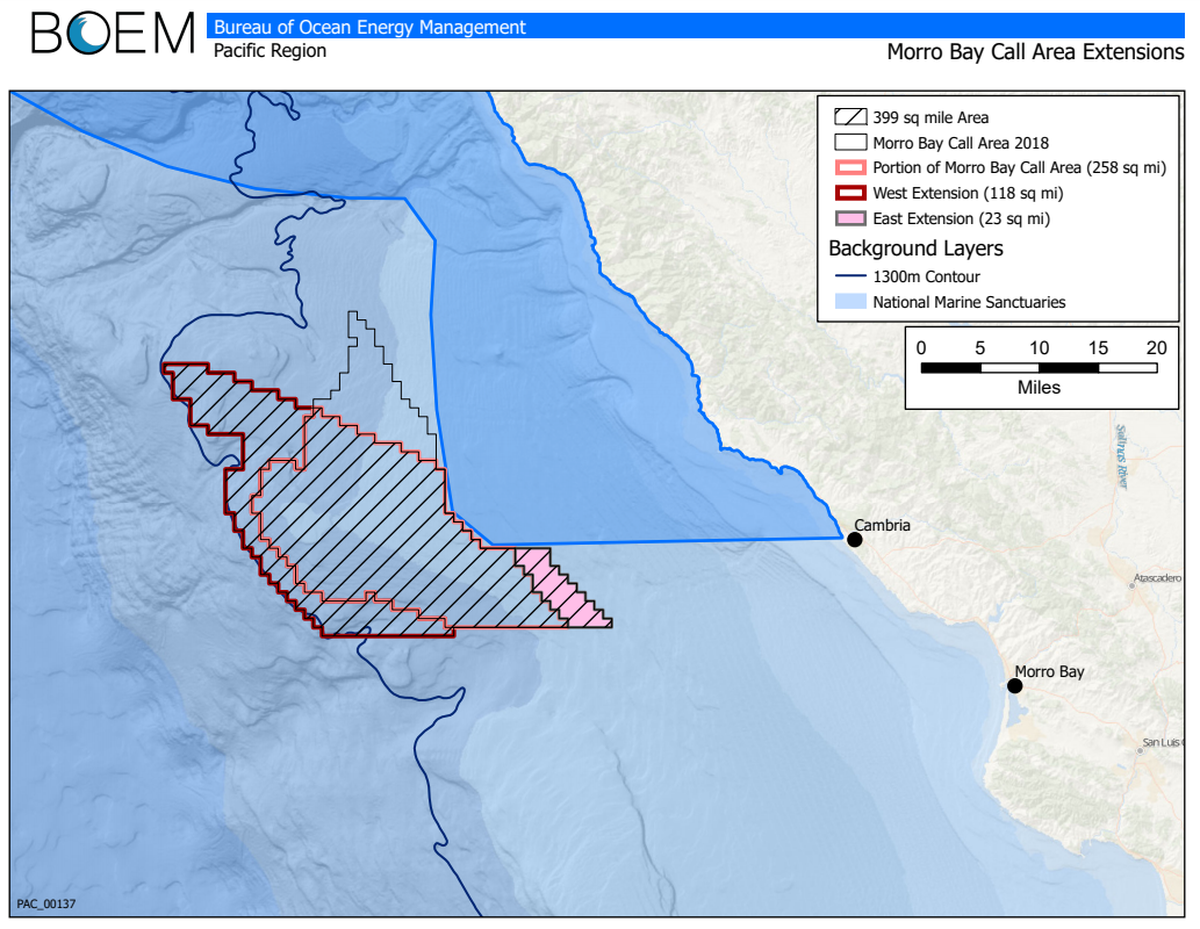
The proposed wind turbines would be built in a 399-square mile area of the Pacific Ocean northwest of Morro Bay. That wind farm, which would be located about 17 to 40 miles offshore, would generate 3GW of energy.
A lease sale auction for proposed wind turbine areas may happen as soon as mid-2022, according to the White House’s announcement.
On a briefing call with reporters Tuesday morning, Newsom said that the Central Coast is the key area for this offshore wind turbine development.
“The Central Coast of Morro Bay is really the visionary opportunity of this transition away from nuclear,” he said, referencing the decommissioning of Diablo Canyon Power Plant in 2025.
When Diablo Canyon nuclear power plant shuts down, California will likely have to rely on the proposed offshore wind farms to meet its renewable energy goals. The state aims to generate 100% of its energy from renewable and carbon-free sources by 2045.
“Existing transmission infrastructure on the Central Coast is currently available to reliably deliver the output of both Diablo Canyon Power Plant and the retired Morro Bay Power Plant,” Morro Bay Mayor John Headding said in a news release. “Offshore wind from the Central Coast is an opportunity for a source of clean energy in proximity to existing transmission infrastructure and energy consumers ... There now appears to be a pathway forward for the actual development of wind farms off of the coast of Morro Bay.”
The development of wind turbines off the Central Coast was brought about in part by ongoing efforts from Central Coast Congressman Salud Carbajal’s office over the last several years in the Offshore Wind Working Group.
That group was created in August 2019 to coordinate between federal, state and local partners. It is composed of representatives from the offices of U.S. Rep. Salud Carbajal (D-Santa Barbara) and U.S. Rep. Jimmy Panetta (D-Carmel Valley), as well as the National Oceanic and Atmospheric Administration (NOAA), the U.S. Bureau of Ocean Energy Management (BOEM), the U.S. Department of Defense (DOD), U.S. Department of the Navy and California Energy Commission (CEC).
“After years of negotiations between federal, state and local partners I am thrilled to announce we have an agreement on the size and location of an offshore wind project that serves our environmental, energy and national security interests,” Carbajal, a Democratic legislator representing San Luis Obispo and Santa Barbara counties, said in a prepared statement.
“Offshore wind holds incredible promise as a means to tackle climate change while also creating economic opportunity, and the Central Coast is uniquely poised to reap the benefits,” Carbajal said.
Negotiations over the offshore wind turbines on the Central Coast previously stalled in 2019 amid hesitation from the U.S. Navy until Carbajal offered an amendment to the 2021 National Defense Authorization Act in order to move the development forward and get negotiations back on track.
Following the amendment’s passage, Carbajal secured a written commitment from the Navy indicating a willingness to collaborate with the Working Group to identify an area for development that would meet energy production goals.
Offshore wind turbines to boost Central Coast economy
U.S. Interior Secretary Deb Haaland said developing the identified areas could help create tens of thousands of new jobs.
“America can be a leader in developing a robust, and sustainable clean energy economy, and we can do it while lifting up communities everywhere with good-paying jobs,” she said during a call with reporters Tuesday morning. “Today’s development could bring immense possibilities to the West Coast.”
The move to bring offshore wind turbine development to the Central Coast is one component of a multi-pronged strategy to transform the area into a renewable energy hub.
San Luis Obispo County is already home to the California Valley Solar Ranch and Topaz Solar Farm, and Morro Bay could soon host the largest battery plant in the world. With the addition of an offshore wind project, the Central Coast is positioned to lead the country in renewable energy construction and output, according to a news release sent out by Carbajal.
California State Assemblyman Jordan Cunningham said in a news release that the local communities in San Luis Obispo County are set up “to reap the major benefits of offshore wind: high-paying jobs for local residents; millions in additional tax revenue for local cities and counties and more locally-produced clean energy.
“I appreciate all the hard work our partners put in to get us to today, and cannot wait to see the construction process get started,” said Cunningham, who represents San Luis Obispo County and parts of Santa Barbara County. “Let’s get building!”
Echoing Cunningham’s enthusiasm for the project, Central Coast Sen. John Laird said he was “particularly pleased” that the coast off Morro Bay was identified as the primary area off California’s coast for the wind turbines.
“While there is a long road to travel for these efforts, it is important to focus on the opportunity of existing transmission infrastructure and the tremendous need for carbon-free energy production,” he wrote in a prepared statement. “Our climate and our economy will benefit immensely from purposeful actions on thoughtful offshore wind development.”
Efforts underway to expedite environmental review, auction process
The government plans to begin consultations with Native American tribes and environmental reviews on the offshore wind turbine sites, which Newsom said his administration is working to expedite.
Next year, officials plan to start auctions. Newsom said private companies are already expressing interest in bidding to develop the offshore areas.
“We expect an enormous amount of interest,” he said.
In response to a question about his plans to expedite environmental reviews of the sites, Newsom said his administration needs to work quickly to diversify its clean energy sources if it wants to meet its ambitious greenhouse gas reduction goals.
Former Gov. Jerry Brown signed a law in 2018 setting a target for California to phase out all fossil fuel-generated electricity by 2045, but Newsom has vowed to meet that benchmark sooner.
Offshore wind power could also help stabilize California’s energy grid, and provide energy when solar power supply runs low, Newsom said.
In 2020, the state saw rolling blackouts when demand for power during a heatwave outstripped supply.
The Defenders of Wildlife, a nonprofit conservation organization, said it supports the development of offshore wind turbines as long as due environmental review is conducted.
“Defenders supports responsibly sited, developed and operated offshore wind and we look forward to working with the state to ensure that renewable energy development is informed by science-based conservation measures that consider imperiled wildlife, such as the humpback whales that seasonally migrate along our iconic coastline,” Pam Flick, the group’s California program director, wrote in a news release Tuesday.
Carbajal noted that he is “committed to working with the Bureau of Ocean Energy Management and the Department of the Interior to make sure the voices of local fishermen and all Central Coast residents are heard as this process moves forward.”
This story was originally published May 25, 2021 at 1:05 PM.