Jordan Cunningham introduces bill to boost Central Coast offshore wind energy development
Although proposals to bring floating offshore wind turbines to the waters off the Central Coast have been in the works since 2016, a new bill introduced by California Assemblyman Jordan Cunningham and other state legislators may boost those plans into fruition within the next decade.
Cunningham (R - 35th District), along with assembly members David Chiu (D - 17th District), Laura Friedman (D - 43rd District) and six other coauthors, introduced the bill on Wednesday.
This bill would require the California Energy Commission, Coastal Commission, Ocean Protection Council, the Governor’s Office of Business and Economic Development and other federal, state and local agencies to develop a plan to achieve a goal of at least 10 gigawatts of offshore wind energy installed off the coast by 2040. An interim target of three gigawatts would need to be reached by 2030.
Ten gigawatts can power more than 7.5 million homes at once, according to the California Independent System Operator.
If approved, the bill would provide a plan to get the state to its goal of 100% carbon-free electricity by 2045 by supplying 10 of the 140 gigawatts of new renewable energy and energy storage developments. Currently, the state has no viable plan to reach even its 60% renewable energy mandate by 2030 after PG&E’s Diablo Canyon nuclear power plant goes offline in 2025.
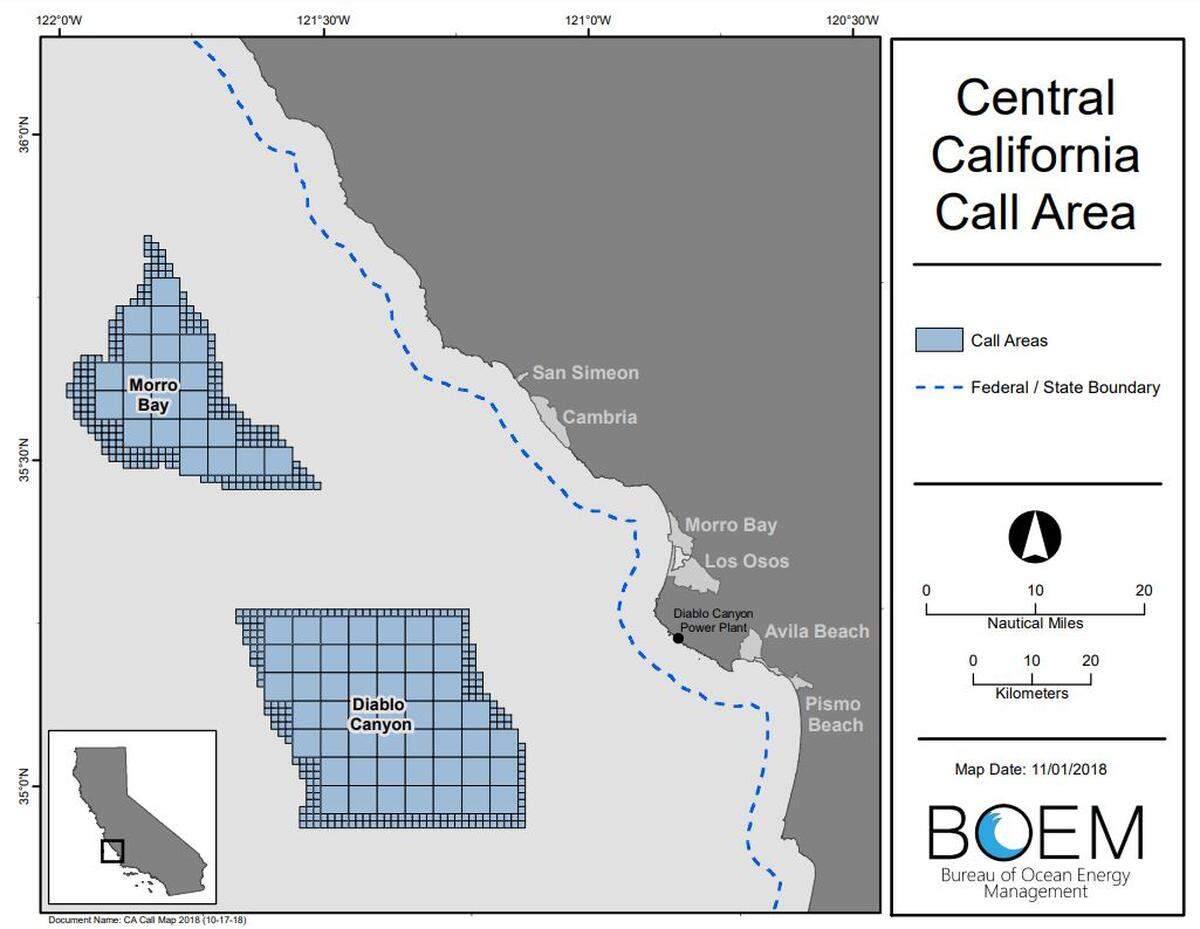
Central Coast most desirable place for offshore wind development
The move to increase in offshore wind turbines to the Central Coast, which coincides a recent proposal to build the nation’s largest battery storage plant in Morro Bay, could add thousands of jobs in San Luis Obispo County.
“San Luis Obispo County should see major economic expansion as a result of the growing offshore wind industry,” Cunningham said in a prepared statement. “Clean power, high-paying trades jobs and local economic expansion: offshore wind is a winner for the Central Coast.”
The Central Coast is the most desirable location in California for offshore wind development, according to Cunningham, because of Diablo Canyon Power Plant. The existing energy transmission lines from the plant would provide infrastructure for future renewable energy sources to utilize.
A 2020 study by Cal Poly and U.S. Bureau of Ocean Energy Management (BOEM) researchers found that offshore wind energy production is at its peak in the evening hours — when other production from renewable energy production sources such as solar power is down.
Plans for building offshore wind turbines in the ocean off the Central Coast are already underway. In October 2020, the U.S. Navy recommitted to work with Central Coast Congressman Salud Carbajal and the Offshore Wind Working Group to identify the best place to construct the turbines.
The Offshore Wind Working Group was created in August 2019 and is composed of representatives from the offices of Carbajal and Rep. Jimmy Panetta of Carmel Valley, as well as the California Energy Commission, National Oceanic and Atmospheric Administration, U.S. Bureau of Ocean Energy Management, U.S. Department of Defense and U.S. Navy.
California State Assembly bill would bring jobs to Central Coast
Cunningham’s bill would require the California Energy Commission to submit its plan to get to 10 gigawatts by 2040 by June 1, 2022.
The plan would need to identify where the floating turbines would be built, how construction would affect marine life and what the economic impact would be. It would also need to prioritize “actions that would improve port infrastructure to support land-based work for the local workforce,” according to the bill.
Additionally, the bill sets aside provisions for workers — ensuring that the plan considers wages, apprenticeships and local hiring, among other things.
Tim Cremins, the political director for the western region of the International Union of Operating Engineers, said at a press conference about the bill on Thursday that his organization is “thrilled” about and “proud” of the bill.
The bill “helps our workers who have been rocked by instability; it gives them some continuity in their careers,” he said.
According to an April 2016 study by the Bureau of Ocean Energy Management, the development of 10 gigawatts of offshore wind energy could support nearly 3,000 jobs, with a cumulative gross domestic product impact of about $16.2 billion during construction, and at least $3.5 billion in the operations phases.
California’s need for clean energy sources is exacerbated by the changing climate that has caused wildfires to down power lines and rolling blackouts due to extreme heatwaves.
“We’ve gotten a preview of the havoc climate change will wreak on our state as we have weathered heat waves, wildfires, and rolling blackouts,” Chiu said at a news conference Thursday. “At this moment, with vaccines rolling out in the summer heat months away, it’s a good time to think about how we’re going to rebuild cleaner, greener and with a focus on putting Californians back to work.”
Chiu said at the conference that the bill has bi-partisan support, and he does not expect much resistance in the legislature to passing the bill.
Cunningham, a Templeton attorney and former San Luis Obispo County prosecutor, was elected to his third term in the California State Assembly in November 2020. The Republican represents the 35th Assembly District, which includes all of San Luis Obispo County and parts of northern Santa Barbara County.