SLO woman who shot husband in the head won’t face murder charge after details emerge

A woman who shot and killed her husband at point-blank range will face an involuntary manslaughter charge rather than murder after a judge agreed Thursday that the death was unintentional because she thought the gun was unloaded.
Details about the case were revealed for the first time in court Thursday when investigators testified that the July 16 killing of Alexander Hagist occurred after he and wife Skylar Marie Marshall were “messing around” with a newly bought pistol on a living room couch after Hagist retrieved it from a bedroom.
Marshall, 24, told investigators that she — believing the firearm to be unloaded — put the barrel of the gun to Hagist’s forehead, and when he stared back at her without any reaction, she pulled the trigger.
She previously pleaded not guilty to the murder charge and has been held at the San Luis Obispo County Jail since her arrest.
Few facts surrounding Hagist’s killing had been made public. The San Luis Obispo Police Department arrested Marshall after officers were called around 9:10 p.m. July 16 to the Peachwood Complex on the 600 block of Chorro Street.
Reporting parties described a gunshot and a woman screaming, and responding officers and fire personnel located a man with a gunshot wound.
Hagist, 35, who had been married to Marshall for roughly a year at the time, succumbed to his injuries.
At the conclusion of Thursday’s preliminary hearing for Marshall, Superior Court Judge Jesse Marino called it “an incredible stretch” for prosecutors to charge Marshall with murder, which requires malice aforethought.
After hearing testimony from four San Luis Obispo detectives, Marino said that while Marshall’s actions were obviously reckless, evidence presented to him showed that Marshall had a reasonable expectation that the gun was not loaded when she pointed it at Hagist and pulled the trigger.
“I’m struggling to find evidence that she had a reasonable belief the gun was loaded,” Marino said. “I don’t believe (her actions are) tantamount to murder.”
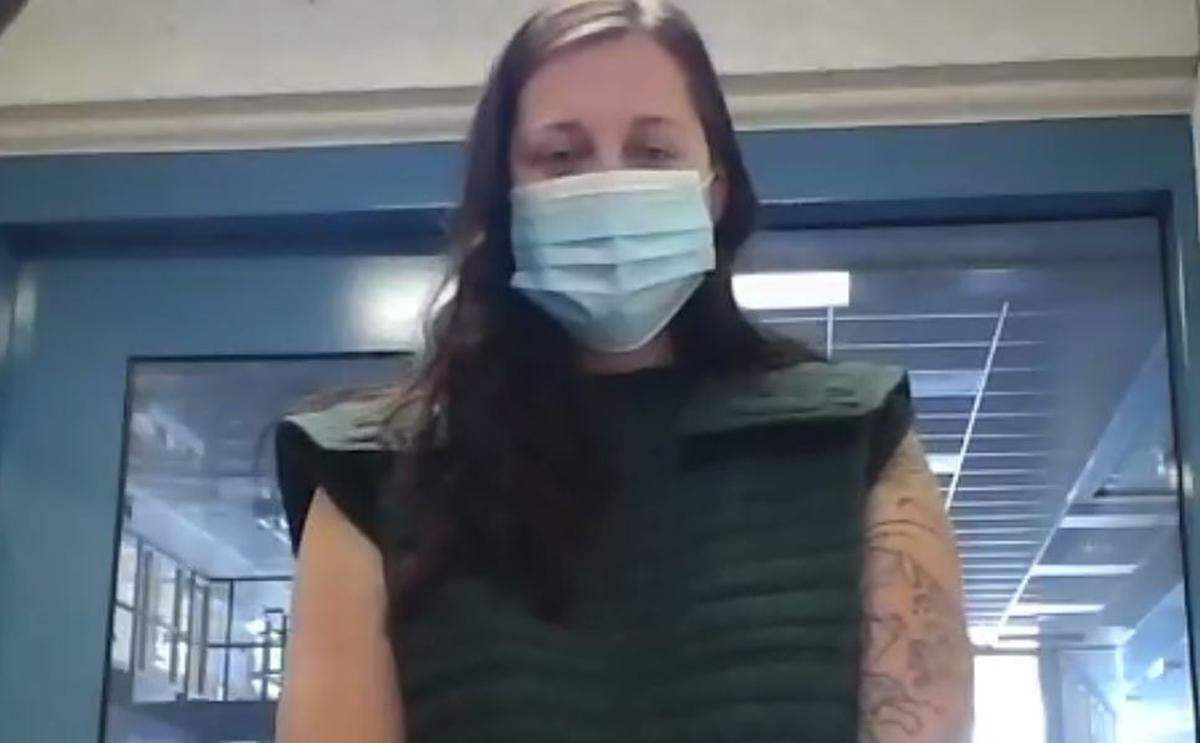
Couple was ‘messing around’ with handgun
In a preliminary hearing, a judge hears testimony, usually from the prosecution’s main witnesses, and determines whether the District Attorney’s Office has established probable cause that the crimes alleged were committed by the defendant.
Probable cause is a lower standard of proof than guilt beyond a reasonable doubt, which a jury must overcome to convict.
Judges can uphold, modify, or dismiss charges at a preliminary hearing.
On Thursday, Marino heard testimony from San Luis Obispo police Sgt. Caleb Kemp, who recalled examining the apartment after the shooting and seeing Hagist sitting on the living room couch with a gunshot wound to the middle of his forehead.
The shot was fired from close range, Kemp said.
He spoke to Marshall, who was “crying ... inconsolable, hyperventilating and in disbelief,” Kemp said. Marshall told him that they were “playing” with the gun and she didn’t know it was loaded.
She appeared genuinely concerned about his fate, Kemp said.
San Luis Obispo police Sgt. Evan Stradley, the prosecution’s main investigator in the case, testified to Marino that he interviewed Marshall at the police station a couple hours after the shooting.
Stradley testified that Marshall relayed to him that she and Hagist were in the living room when Hagist brought out the handgun, which he had purchased just two months prior.
Marshall told the sergeant that Hagist would manipulate the weapon, put it down, and manipulate it again, what Stradley described as “messing around.”
That was common in the weeks since the purchase of the gun, Marshall reportedly told Stradley, and both Hagist and Marshall would sometimes jokingly point the gun at each other.
Stradley said that eventually, Marshall admitted that the couple had a slight disagreement while Hagist had the gun out, and Marshall picked it up and pointed it at his forehead.
She was expecting a reaction from him, she reportedly told Stradley, and when he simply stared back at her, she pulled the trigger to emphasize her feelings about their disagreement.
Marshall told investigators that she and Hagist made eye contact before the fatal shot.
She told Stradley that the gun was usually kept unloaded, and that Hagist had taught her how to use the gun.
Marshall knew how to check whether a gun is loaded, the detective said, but it was Hagist who typically brought out the gun after he had checked it for ammunition.
Roommate saw the couple handling guns before
At the center of the prosecution’s murder case was whether Marshall knew or reasonably should have known the gun was loaded.
The prosecution based their argument on Marshall’s statements to Stradely, in which Stradley asked whether at the time of the shooting she knew with 100% certainty that the gun was not loaded. She said no.
“She knew that the gun had the possibility that it could be loaded and that it potentially could go off,” Stradley said.
Moreover, Stradley said, Marshall made statements when asked about gun safety that showed she knew to “treat every firearm as if it’s loaded.”
Det. Chris Chitty testified that he interviewed a roommate who was home at the time asleep in bed. The roommate recalled waking to a “pop” and hearing Marshall’s screams.
He ran to the living room, saw her standing there with the gun in her hand, and told her to put the gun away and help him with Hagist, Chitty said. Marshall and the roommate held a towel against Hagist’s head to stem the bleeding.
In an interview, the roommate described Hagist as a “prepper” who purchased the handgun and an AR-15 tactical rifle due to the uncertainty surrounding the COVID-19 pandemic.
The roommate had seen the couple handling firearms in the apartment before, including one incident in which Marshall pointed the unloaded gun at the roommate and pulled the trigger, and again while the gun was pointed at Hagist’s head.
The roommate told Chitty that he scolded the couple about the dangerous behavior.
Judge rejects murder charge
In his arguments before Marino, Deputy District Attorney Jon Kawashima said that it’s undisputed that Marshall committed the act that caused Hagist’s death.
He argued that she also showed “implied malice” when she pointed the gun, looking for a reaction, and pulled the trigger while knowing there was a possibility the gun was loaded.
Kawashima said that Marshall had to know the act was dangerous to human life, and deliberately acted with conscious disregard for human life.
Marino interrupted the prosecutor, saying the crux of the case is whether Marshall’s actual firing of the firearm — as opposed to the pulling of the trigger of an empty gun — was intentional.
“I think the evidence here is that it’s not,” Marino said.
Kawashima countered that since Marshall admitted to detectives that she “wasn’t 100% sure” the gun was empty, she “disregarded the risks by pulling the trigger.”
“She did nothing to ensure the firearm was unloaded,” Kawashima said.
Marino said that he felt Marshall’s admission to detectives “was more of a retrospective admission that she should have checked” the weapon.
“I’ve said from day one that this is an involuntary manslaughter case,” William Gamble, Marshall’s attorney, told Marino. “I think the court sees this case for what it is.”
Gamble made no arguments, and indicated that should the court reduce the charge to involuntary manslaughter, “there will be a plea down the road.”
Calling it a “very difficult case,” Marino noted that Hagist is alleged to have brought out the gun, and that Hagist’s reaction to having the weapon pointed at his head was indifference, which would give Marshall a reasonable expectation the gun was unloaded.
“I believe evidence today shows that she did not know the gun was loaded — but she was reckless,” Marino said.
The murder count now dismissed, Marino ordered Kawashima to file a new complaint for felony involuntary manslaughter by a May 25 arraignment.
This story was originally published April 29, 2021 at 6:43 PM.