SLO County NAACP president was suspended for life. Why?
AI-generated summary reviewed by our newsroom.
- NAACP's Juneteenth event canceled amid lifetime suspension of Cheryl Vines
- Leadership dispute followed contested election won by Vines by a single vote
- Local members report lack of guidance from national NAACP on chapter's future
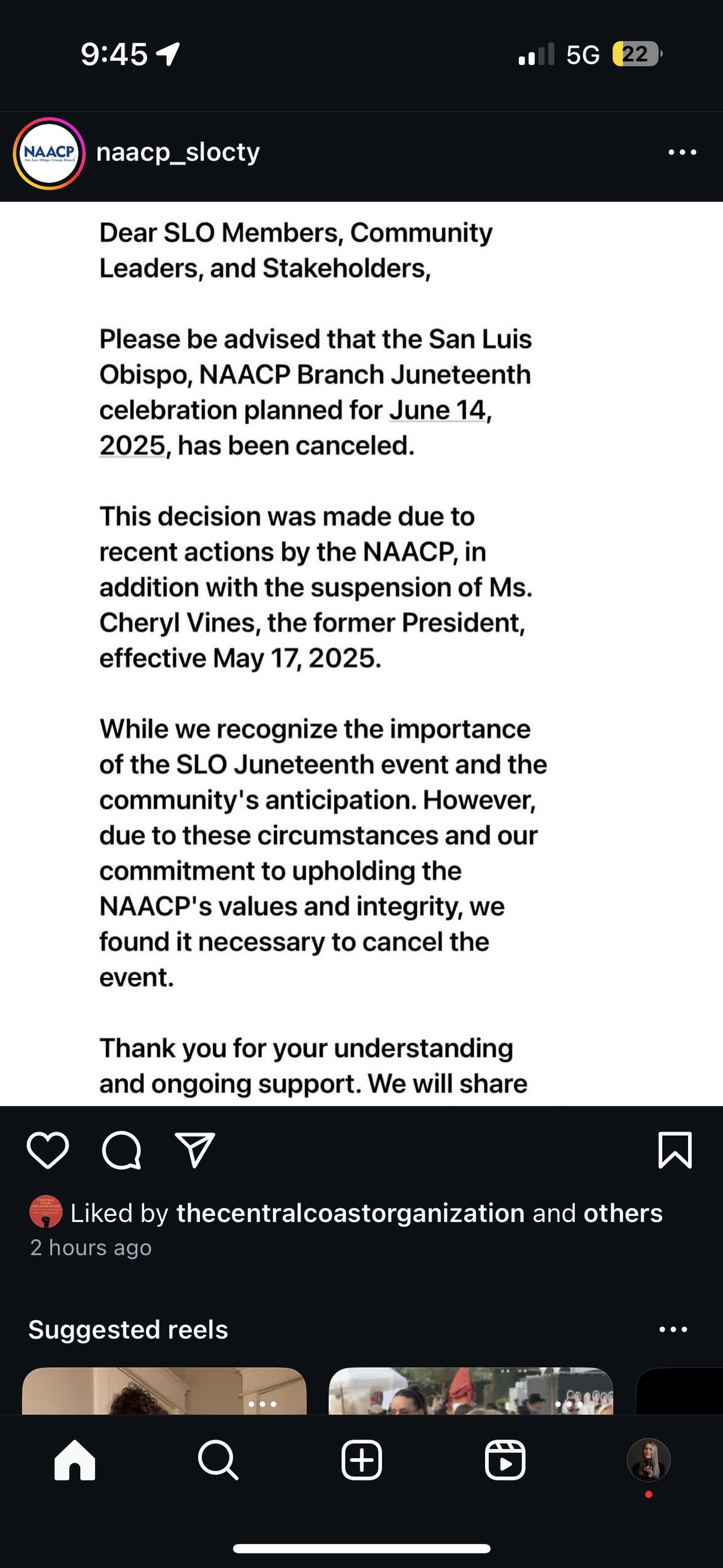
The future of San Luis Obispo County’s NAACP chapter is uncertain after the organization’s Juneteenth celebration was canceled when its former president, Cheryl Vines, was suspended for life, according to a now-deleted post on social media.
But Vines told The Tribune she believes her suspension was unfair and traces back to a divisive election between her and former NAACP President Tobin Johnson that Vines won by the narrowest of margins.
Vines’ suspension in May came after Johnson filed a complaint against her following the election in November, alleging she was hostile toward members and made a derogatory comment about his sexual orientation. Vines denies these claims.
Now, members of SLO County’s NAACP chapter are left without direction on the future of the organization.
As part of its Reality Check series, The Tribune investigated what led to Vines’ suspension and Juneteenth’s cancellation.
The Tribune reached out to several members of the NAACP. All but one of those who agreed to speak on the record came to Vines’ defense. Others referred The Tribune to the area’s regional director and the national organization, neither of which responded to multiple requests for comment.
Johnson declined to comment after The Tribune sent him specific questions.
SLO County NAACP presidential election decided by a single vote
Vines previously had served on the local NAACP executive board as secretary since she and her husband Stephen Vines founded the chapter in 2017.
Vines said she decided to run for president because she thought she could do a better job at managing the organization than Johnson, who was appointed to the post in 2023.
She said before Johnson’s tenure, the NAACP planned around 25 community activities per year, including rallies and events — a favorite of hers was the multicultural holiday celebration — but that the organization planned far fewer under Johnson.
“I wanted to make sure the community knew we were still here,” she said. “Our membership had declined, and I just wanted to make sure that someone would move the branch forward.”
When the election came around on Nov. 12, Vines won by one vote.
Johnson told her that he planned to contest the election, but under the NAACP’s bylaws, election complaints must be filed within five days of the election. For chapters with fewer than 1,000 members, like San Luis Obispo County’s, the person filing must gather at least 25 signatures.
Vines said Johnson did not file the election complaint or gather signatures within that five-day window and it is unclear when it exactly it was filed. NAACP member Bassim Wahhab also told The Tribune that Johnson admitted at a Nov. 21 meeting that he did not have the sufficient number of signatures to contest the results. .
Despite that, the NAACP’s state branch instructed that Johnson would remain president while it investigated the election in December. Vines still had not heard from the state branch on the status of the investigation for over a month, so she sent out a notice calling for a meeting to install officers at the end of January. She was then told again that Johnson would remain president for the time being, she said.
Meanwhile, on Dec. 17, Vines filed a complaint against Johnson alleging financial mismanagement after Johnson gave her a packet of financial disbursement forms to back sign after money was already distributed to vendors while she was still secretary.
Under the NAACP bylaws, the secretary and president must sign disbursement forms before checks are issued. Disbursement forms Vines shared with The Tribune showed several missing initials from the president and secretary, though Johnson did sign that he authorized each form.
Some forms showed that both Vines and Johnson received reimbursements for certain purchases and also did not have the secretary or president’s initials.
She claimed Johnson told her he did not have to submit disbursement forms “because the budget was approved” and that Johnson did not attend 75% of the organizations financial meetings. Financial documents were also absent for January, April, May, September, October and November, she said.
Johnson did not respond to The Tribune’s multiple request for comments, which included specific questions about these allegations.
On March 12 — six days after Vines was notified of a separate complaint against her alleging she created a hostile environment — Vines received a letter that Johnson decided to resign from the presidency and allow the election results to stand, despite a previous decision by the national board to rerun the election.
Why was Vines suspended?
Vines said she believes Johnson made his complaint to the NAACP both because he lost the election and because he found out she filed a complaint against him.
According to the complaint filed against Vines, which was shared with The Tribune, she was accused of not properly communicating with the chapter president (who at the time was Johnson), created a hostile environment, verbally abused members and did not properly share email lists.
Vines denies all of the allegations in the complaint.
One NAACP letter says the complaint was filed on Dec. 27, but according to an email shared with The Tribune, Vines was not notified of its existence until March 6.
Specifically, the complaint alleged, Vines made a public “derogatory comment” regarding Johnson’s sexual orientation on Sept. 29.
The complaint does not specify what was said, but Vines told The Tribune she was campaigning at church and was talking about how she believed in inclusivity and wanted to establish a religious affairs committee because it was something her opponent was opposed to. When someone asked who her opponent was, she replied, “he’s a gay Black man who doesn’t believe in God.”
Vines said she did not mean the comment in a derogatory way, but that it was more like a matter of fact.
She said that Johnson identified himself in public often as a “queer Black man” and told her he did not want to establish a religious affairs committee because he was an atheist.
“I’ve never alienated. I welcomed everybody. That’s how we built this organization,” Vines said, adding that she had previously advocated for Johnson to be appointed to vice president in 2022. “It’s really an insult for someone to say that about me when they know that I have welcomed them with open arms.”
The complaint also alleged she used the member email list as “personal property” and refused to share it with the organization’s executive team, including the president.
Vines told The Tribune that under the bylaws, the secretary cannot share or give direct access to the email list. Anyone who wants access to the list must go through the election supervisory committee, she said.
The bylaws confirm that the secretary is the only officer that has specific access to membership contact information and is required to complete a specific training prior to having access to membership contact lists.
The NAACP’s election procedures manual also says that the election supervisory committee will make the membership roster available to candidates upon written request. The committee is not allowed to copy the list but can address communications from the list or a roster of members at the candidate’s expense “within reasonable limits.” The committee can also set up times for candidates to view the list, the manual said.
The alleged derogatory comment was the focus of her hearing with the organization’s national board, Vines said. She said that during the meeting the board members would not allow her to elaborate or explain what she meant by the comment.
“I knew what they were going to do because they didn’t really give me a chance,” Vines said. “They never took into consideration my background, how long I’ve been with the organization, what I’ve done to promote the mission of the NAACP.”
“It was a kangaroo court,” she added.
The hearing did not address the other allegations in the complaint, Vines said.
NAACP members defend former president
One of the frustrating issues for Vines is that the names of her accusers are redacted, so she does not know what perceived hostility the complaint refers to.
The only instance she could think of is when she told a member they may “have a little bit of white fragility going on” when the member got upset that Vines suggested to read a different book than “White Fragility” by Robin DiAngelo for the organization’s book club. Vines said there was a little bit of back and forth, “but it was never in a way to put anybody down. I was making suggestions.”
The majority of the NAACP in San Luis Obispo County is made up of white people, she said.
“I’m a Black woman, and white people have a hard time taking direction from Black people,” Vines said.
The Tribune spoke with three NAACP members who supported Vines and said they did not witness her being hostile or verbally abusive.
Denise Yaffe joined the NAACP right after COVID, around three or four years ago, because “they were always visible” and “out in the community.” She was appointed to serve as the environmental justice chair.
She said that when Johnson became president in 2023, she didn’t feel as supported when it came to promoting NAACP events.
“I was ready to resign several times, but then Cheryl was there to help me out,” Yaffe said.
Yaffe, who was also chair of the election supervisory committee during the most recent election, said she was surprised by the allegations in the complaint filed against Vines by a “secret group” and thought conflicts should be resolved personally.
She said Johnson felt the election was not fair because Vines did not give him access to the membership list, but under the bylaws and procedures, he was supposed to reach out to Yaffe for the list in writing, which he did not do.
“Nothing happened that was out of the ordinary,” she said.
When it came to Johnson’s complaint against Vines, “everything was a lie,” Yaffe said. The only thing Yaffe could not confirm or deny was the alleged comment made in the church because she did not witness it.
Johnson canceled all meetings since January, only to resign in March during a time when Yaffe thought the NAACP should have more involvement in the community due to President Donald Trump’s administration.
Yaffe said the hostility she witnessed was not from Vines, but rather from other members toward Vines. Yaffe said she thinks people resented that Vines led planning for the majority of events.
“She was just leading it, but she wasn’t like, in control. Nobody else really stepped up,” Yaffe said. “She had the most experience because she had been doing it in the past and no one else volunteered to do it. They just gave her a hard time all the time.”
Julie Jones, who joined the NAACP in 2020, echoed Yaffe’s experience.
“I never had a problem at all with her (leadership) style. I thought it was respectful,” Jones said. “She was really someone that made things happen.”
Jones said she did not witness Vines being hostile toward anyone and she felt division within the organization started when Vines won the election by one vote.
“My feeling was, even though it was one, one vote, you know, that that was the way it turned out,” she said. “I just supported her because I felt like she had won the election and it just seemed right to me that you not contest it.”
Vines was “always gracious” if she did have disagreements with people, Jones said.
“I never heard her say negative things about other people or the other candidate,” Jones said. “She was always very careful about that.”
Wahhab also said Vines was extremely hard-working and never witnessed her being hostile toward others. He agreed that Vines did the majority of the work when it came to planning community events.
He added that he felt the national organization was not following its own bylaws and procedures when it came to handling the complaint against Vines.
Since Johnson resigned and Vines was suspended, its unclear to current San Luis Obispo County NAACP members how the organization will move forward.
Yaffe, Jones and Wahhab all said they had not received any communication from the national or state boards regarding the future of the chapter.
NAACP member claims she was muted during meetings
Brenda Mack, who was on the housing committee, told The Tribune she was one of the people who signed the complaint against Vines, but admitted she did not read the allegations that Johnson had submitted.
“I trusted Tobin,” Mack said. “He asked me to read and I said, ‘I don’t need to read it, because I already know.”
Mack described Johnson as “very open about things going on” and said he was “not sneaky” and “mended fences.”
“He gave people respect,” she said.
Johnson was also present in the community, Mack said, claiming Vines had only started showing up at community events recently.
Mack said she found Vines and Vines’ husband both to be hostile and disrespectful toward her and other members.
Mack claimed that Vines would mute her during Zoom meetings often and believed she would be muted because Vines did not like Mack’s opinions.
When asked, Vines told The Tribune that Mack could be disruptive during meetings, particularly during COVID, and spoke longer than two to five minutes. Vines said she only muted Mack after she gave Mack verbal warnings that the meeting needed to stay on track and that everyone needed time to speak.
“I’ve never been hostile toward her at all,” Vines said.
Mack said she believed the way Vines treated her warranted the suspension.
“A lifetime ban is a serious thing,” Mack said. “It was fully deserved, from my point of view.”
When Vines received the news that she was permanently suspended, she said she was at a loss for words. This was the only incident she’s been involved in during her nine-year tenure with the chapter. She was awarded secretary of the year at the California Hawaii State NAACP Conference in 2019.
She expected to be suspended after the hearing, but she didn’t think it would be a lifetime ban.
While the suspension hurts, Vines is trying to make the best of it.
“When God closes a door, he opens a window,” she said. “What hurts the most is that even though there’s people of all races involved (in the NAACP), it’s a Black organization and they treat their own people like that. I’ve never been treated so disrespectful in my life by anyone but the NAACP.”
Vines said she appealed the decision and hopes to overturn her lifetime suspension.
“I never did anything,” Vines said. “That’s just not in my personality. I wasn’t raised that way.”
This story was originally published July 3, 2025 at 9:01 AM.