Many SLO County residents can’t find a primary care doctor. What’s causing the shortage?
READ MORE
SLO County’s doctor shortage: A 5-part series
This series examines the shortage of both primary care and specialty physicians in San Luis Obispo County, what it means for patients and doctors and what can be done to improve the situation.
Expand All
Many SLO County residents can’t find a primary care doctor. What’s causing the shortage?
Insurance hurdles, long wait times prevent SLO County patients from seeing specialists. Why?
Struggling to see a doctor, SLO County patients turn to ER, urgent care — and even Mexico
Some SLO County doctors offer an alternative to basic primary care — but it comes at a price
SLO County doesn’t have enough primary care doctors. What could fix that?
Editor’s note: This is the first in a five-part series exploring health care access in San Luis Obispo County.
Lee Goldenberg has been trying to find a primary care doctor closer to his Nipomo home for nearly a decade.
He’s had so little luck, he kept his original physician outside the county.
Goldenberg moved to the San Luis Obispo County area 10 years ago, but he still sees his primary care doctor at Sansum Clinic in Santa Barbara, some 70 miles away. That’s because Goldenberg has yet to find a physician in San Luis Obispo County who accepts new patients, who he can see regularly and who he feels he can trust.
Goldenberg’s main health concern is occasional chest pains.
He says it’s nothing major, but his mom had major heart surgery and died of heart issues, and together, that was enough for him to want an opinion from a primary care physician.
If the issue continues, Goldenberg said not being able to access a nearby, high-quality primary care doctor may be enough for him to relocate away from San Luis Obispo County.
“I would be willing to move for medical care,” Goldenberg said. “At 77 years old, you start to have to be concerned about your health and the kind of services that you get.”
In theory, Goldenberg should not have any issues finding a primary care physician. He has comprehensive health coverage through both Anthem Blue Cross and Medicare and his health concerns aren’t unusual.
But he and hundreds of other local residents experience the same problem: It’s really hard to find and keep a primary care doctor in San Luis Obispo County.
Why?
Because, even though the numbers may suggest otherwise, San Luis Obispo County is currently in some form of primary care desert.
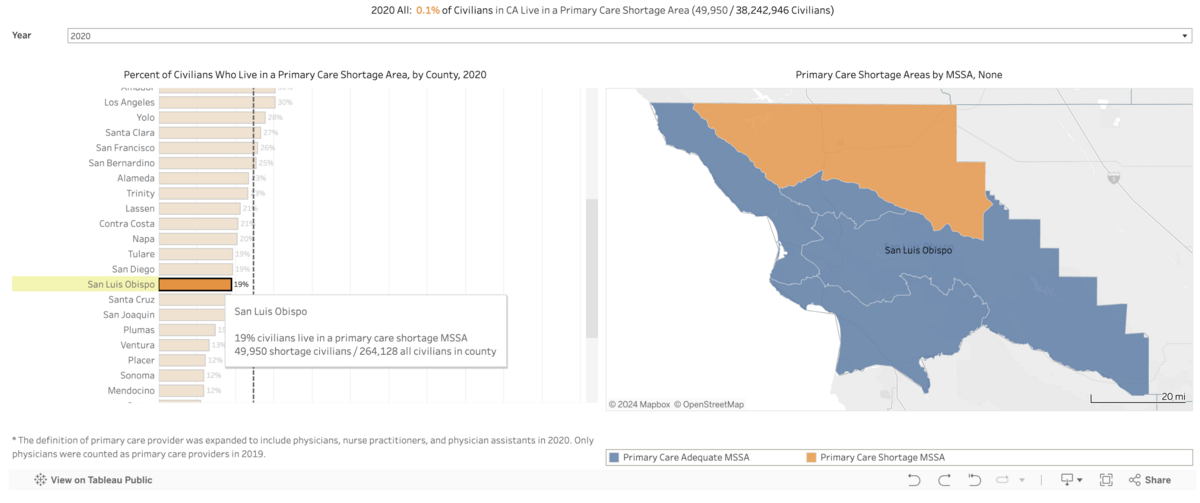
As recently as 2020, data from the California Department of Public Health showed almost a fifth of San Luis Obispo County residents, or nearly 50,000 people, lived in a primary care shortage area.
More recent data from the state has suggested the county should be seeing relief from its primary care shortage, but the rosier outlook contrasts drastically with the reality residents say they’re living in.
Dr. Scott Robertson, president and chief executive of Dignity Health’s Pacific Central Coast Health Centers, said that the need for primary care providers is urgent in order to meet the demand.
“If you look from Lompoc to Paso Robles, we’re short about 140 primary care providers, which means that we would need 140 people to start tomorrow in order to adequately meet the needs of our community,” Robertson said.
Earlier this year, The Tribune asked local residents to share any difficulties they had accessing primary care here in San Luis Obispo County. Ninety-three people responded, listing concerns from difficulties scheduling appointments to being forced to travel out of the county for emergency surgery.
This story is the first of a five-part series examining the shortage of both primary and specialty care resources in San Luis Obispo County, and how that shortage can have ripple effects on other health services.
First up: Why do people seem to have such a hard time accessing primary care here in the county?
Is SLO County in a primary care shortage?
The discrepancy between data saying the region is not in a primary care shortage and anecdotal evidence to the contrary is so notable that the San Luis Obispo Public Health Department announced last year that it was looking more in-depth at the issue.
“In its 2023 assessment, the Office of Statewide Health Planning and Development identified ‘designated shortage areas’ within SLO County for mental and dental health, but not for primary care — although we hear consistently that difficulty accessing primary care is a major pain point for our residents,” it said in its Public Health Bulletin from January/February 2024.
The Health Department — through the San Luis Obispo Healthcare Workforce Partnership, which includes a group of local healthcare, education and workforce leaders — said it was investigating “possible explanations for this disconnect,” including data on retired providers who remain licensed, providers serving patients in corrections facilities, and concierge medicine — a membership model where patients pay a flat fee to access a doctor.
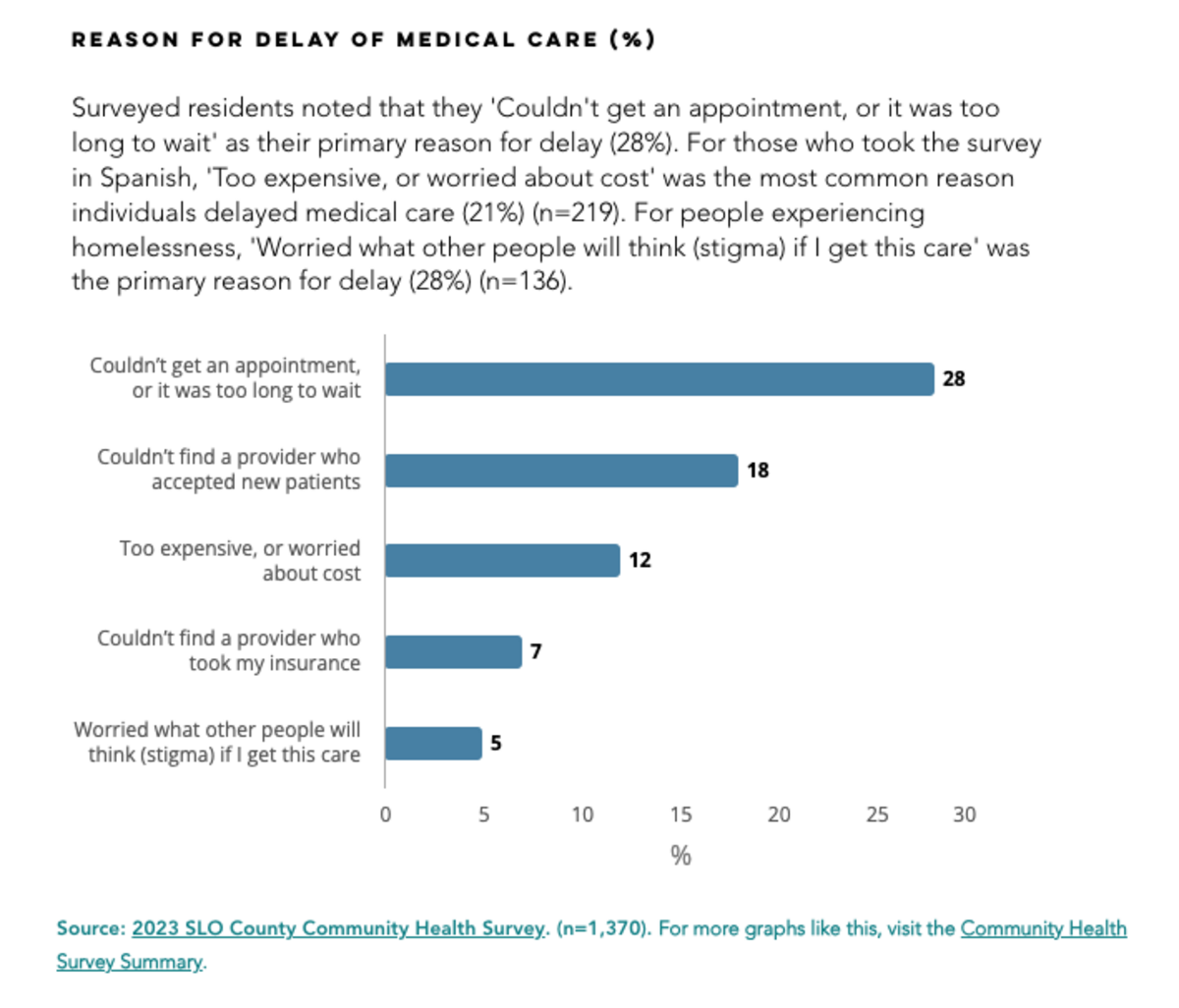
SLO Health Counts, a collaboration between community members, nonprofits, schools and health leaders that provides data analysis about health-related outcomes in the community, also looked into the challenge last year, surveying residents to understand barriers for why people delayed seeing a doctor.
It found that 28% of surveyed residents delayed medical care because they couldn’t get an appointment or the wait was too long. Eighteen percent said they couldn’t find a provider who accepted new patients. Other reasons were tied to cost, insurance and stigma.
SLO Healthcare Workforce Partnership coordinator Susan McGraw has worked with stakeholders to look at recruitment and retention data among healthcare professionals.
McGraw said workforce projections show “critical needs in the next 10 years” for addressing physician, dentist and psychiatrist shortages.
The Health Department, through the SLO Healthcare Workforce Partnership, has looked at past data on healthcare employment to project future needs of different types of providers.
In its 10-year forecast analysis for San Luis Obispo County, the group projected that an additional 53 specialty care doctor positions would need to be filled by 2032 to sufficiently meet the demand. The same analysis showed a total of 173 specialty care doctors currently working in the county in 2022, the most current numbers available.
In these same projections, the need to create more health care jobs for medical assistants, nurses and physician assistants is even higher.
By 2032, the county is projected to need 80 additional medical assistants, 59 more nurse practitioners and 24 new physician assistants.
McGraw said the partnership will continue “deepening their research” to understand medical shortage area data and why current state data suggests there are no primary care shortage areas in San Luis Obispo County.
The cost of living has gone up, turning physicians away from SLO County
One of the biggest causes mentioned for why there may be a perceived primary care shortage in the county is the high cost of living.
Dr. Rene Bravo practiced pediatrics and primary care in San Luis Obispo County for almost 40 years before retiring at the end of 2024. Bravo said physicians have turned away from living in the county once they realize they can’t afford high living and housing costs.
“They get here, they stay here for a year or two, then they realize that they can’t buy a house,” Bravo said.
Bravo said skyrocketing housing costs haven’t helped when trying to recruit doctors to the area.
Michelle Shoresman, San Luis Obispo County Health Agency division manager of health care access, said the partnership has collected workforce data — including in the health industry — to understand people’s perceptions around salaries and whether they match the cost of living in the county.
“In a recent survey the partnership conducted of key stakeholders in the healthcare sector, participants in the survey relayed that the salaries and benefits offered in the county may not always match the cost of living and the cost of housing. That’s a big concern for retention of staff,” Shoresman said.
Dr. Steven Goodman, a family medicine physician with Dignity Health, has witnessed this firsthand as the high cost of living has made it difficult to recruit physicians to the area.
Goodman said there’s a juxtaposition between the Consumer Price Index going up — it has increased by about 82% since 2000, according to the U.S. inflation calculator — and physicians’ salaries failing to keep up with price or inflation increases.
Average CPI is a good metric for measuring how much consumer prices for goods and services vary.
”When you have this discordance where it costs more to live and yet you’re making less and less money every year, there’s a disconnect,” Goodman said.
But economics is not the only factor potentially deterring doctors from practicing in San Luis Obispo County.
Goodman said another reason is an aging physician population — 45% of practicing doctors in the United States are over 55, according to a report from the Association of American Medical Colleges. Many of those physicians may consider early retirement from the weight of so many medical demands, he said.
In addition, when physicians have an average of $200,000 in medical school debt, Goodman said, even a hospital-affiliated system like Dignity is limited in what it can offer.
“We’re very competitive in what we offer our physicians and our primary care physicians, but we’re limited to what we can pay,” Goodman said.
Ron Yukelson, former chief strategy officer for Tenet Central Coast, said the problem likely had to do with the difficulty recruiting doctors given such a high cost of living.
“How are you recruiting a doctor here when $1 million buys you a 900-square-foot home?” Yukelson said.
It has also been challenging recruiting doctors here if they don’t have an initial tie to the region or if their spouse can’t find work.
“A lot of times the husband or the wife wanted to work too, but it’s really difficult to find them a job here,” Yukelson said.
Reimbursement rates are higher in urban areas than rural
One major reason doctors don’t want to come here is San Luis Obispo County’s past designation as a rural area for Medicare reimbursement rates, healthcare administrators, physicians and patients told The Tribune.
Dr. Scott Robertson, president and chief executive of Dignity Health’s Pacific Central Coast Health Centers, said that in a metropolitan, high-cost area, primary care physicians may find more opportunities for higher pay.
“If you take the peninsula of San Francisco, for example, they’re in a Medicare payment area with reimbursement rates that are about 20% higher than what we see in San Luis Obispo County,” Robertson said. “It gives you a revenue stream to pay slightly higher wages.”
Robertson said the Centers for Medicare and Medicaid Services use a complex formula to determine reimbursement rates, depending on geographic locations and medical practice expenses. The net result is higher payments for doctors in the Bay Area than San Luis Obispo or Santa Barbara.
In San Luis Obispo and Santa Barbara counties, Medi-Cal — California’s form of Medicaid — benefits are administered through a nonprofit called CenCal that works with providers.
CenCal chief executive officer Marina Owen told The Tribune that federal legislation through the Centers for Medicare and Medicaid Services changed San Luis Obispo County’s previous rural designation to its own classification. For physician reimbursements, this is called the “San Luis Obispo regional locality.”
The legislation made it so that San Luis Obispo County physicians now have their own specific payment locality, neither rural nor urban, to “better represent local costs,” Owen said.
But that change hasn’t solved the problem.
“I do not believe it’s the perspective of many that that would entirely address the local increases with medical inflation,” Owen said. “We all know the costs of care are rising at a greater level than the CMS program accounts for.”
A Centers for Medicare and Medicaid Services (CMS) spokesperson said Medicare payments are established by requirements under Medicare law. Medicare sets payment rates for providers and clinicians, and the public can comment on proposed payment rates and policies.
The spokesperson also said that according to Medicare law, payments must reflect the relative cost differences that exist in different payment localities. In other words, procedure rates must reflect relative wages, salaries or rent costs.
Given the pandemic and other factors like medical inflation, however, Owen said the “costs are just climbing faster” than what the reclassification has offered so far.
Also, the complete phase-in of the legislation didn’t happen until 2022, making it even more difficult to see the true impact of the reimbursement reclassification.
“The perspective locally that I hear is that the Medicare program rates are not always keeping pace,” Owen said. “But again, that’s something CenCal does not have control over, and we don’t administer that program. However, it matters to us what occurs in our community.”
Other primary care physicians weigh in
Primary care physician Dr. John Justin Davis, who works in Paso Robles, agreed that the cost of living has turned doctors away from the county, and has even deterred some from pursuing primary care in the first place.
Davis said part of the problem is that physicians’ salaries haven’t been updated with how population levels have increased in this county.
“We need to revisit that and calibrate the compensation model. Otherwise, we’re going to be in a physician shortage,” Davis said.
According to Census Bureau data, San Luis Obispo County’s population increased by 4.5% from 2010 to 2022, just shy of California’s 4.6% population growth rate over that same period.
It’s difficult to accurately assess physician salary estimates and understand whether they’ve been updated to reflect inflation and population increases, and Davis said his gross income is actually less than what he made 20 years ago. On top of that, he said he still has over $160,000 in medical education debt.
When The Tribune asked Davis whether it’s been burdensome for patients to try to schedule an appointment, he said the wait time and the hoops patients have to jump through are “ridiculous.”
That’s because doctors are simply carrying too large a patient load.
Davis said a doctor should expect to have between 1,600 and 2,600 patients on their roster.
“Mine is well into the mid-3,000s,” Davis said.
For him, it’s been difficult to accommodate every patient and also make scheduling changes when there are differing levels of urgency for different patients.
“Instead of being able to get that urgent person in within one to two days, you’re like, ‘Oh my god, I can’t see them until next week.’”
Davis also said the amount of busywork has grown substantially, in part because of Medicare’s value-based medicine. Davis said doctors must adhere to different reporting requirements around patient outcomes and quality of care, which can add an extra layer of administrative burden.
“I’m spending time at home, which means I’m taking time away from my family, or I’m working through lunch,” Davis said.
Dr. Julie Fallon, who works in family medicine at her private practice in Templeton and who has practiced medicine for 33 years, also agreed she has become overburdened by the number of reporting requirements over the years.
She said they’ve had to close their practice to new patients in order to accommodate existing people.
Fallon said she’s felt burnt out, largely due to the administrative burden.
She said mandates around electronic medical record systems and ordering prior authorizations for patients’ imaging or diagnostics from insurance providers are overkill.
“If anybody’s had to wait for a CAT scan to be authorized or a surgery to be authorized or medication to be authorized, that has become more and more of a problem over time,” Fallon said.
She added that it’s not just for imaging, but that prior insurance authorization extends to requesting specific medication prescriptions or asking to change medication quantity limits.
“It’s almost like begging a mother,” Fallon said of this relationship with insurance providers.
In Part 2, The Tribune will examine how the challenges finding a primary care doctor extend to specialist providers, especially because of certain insurance requirements and long wait times.
This story was originally published February 9, 2025 at 5:00 AM.