
What’s the easiest way San Luis Obispo can help save the planet? Plant a lot more trees
Planting more trees — even a trillion of them — won’t solve the world’s climate crisis.
But it will buy us some time.
Around 2.2 billion acres of land is suitable for reforestation, according to a study in the journal Science. That could capture two-thirds of human-made carbon emissions and, according to authors of the study, would be the most effective method of combating climate change.
In the meantime, one would hope we would also be able to increase renewable energy use and energy efficiency so as to reduce our current emissions to sustainable levels.
Yet in spite of city tree benefits, California’s urban canopy cover per capita is the lowest in the United States.
According to a recent study based on satellite data, undertaken by biological sciences professor Jenn Yost’s class at Cal Poly, San Luis Obispo has a tree canopy of only 13% — which ties San Diego.
But San Diego is committed to tripling its tree canopy to 35% by 2035, bringing the city into the company of Austin, Texas, with a tree canopy of 37%, and far exceeding Sacramento (AKA the “City of Trees”) with a tree canopy of 24%. (American Forests recommends 25% to 35% tree coverage for dry Western cities.)
How will San Luis Obispo do this?
We will need staff resources (far more than our three International Society of Arboriculture certified arborists or “urban foresters”) just to take care of the trees that we have.
Young trees are an important part of broadening the urban tree canopy, but success will not be achieved just by adding small new trees. Existing trees — including the 20,000 public trees in SLO that are on designated public property, need to get bigger by maintaining them better. That’s the best and fastest way to grow the canopy.
Bob Hill, SLO’s natural resources manager, called for planting 10,000 new trees by 2035. Mayor Heidi Harmon recommended bumping the goal to 15,000 new trees. But we need to plant citywide far more than the proposed 15,000 trees (where is this proposed) to meet our 2035 carbon neutrality goal.
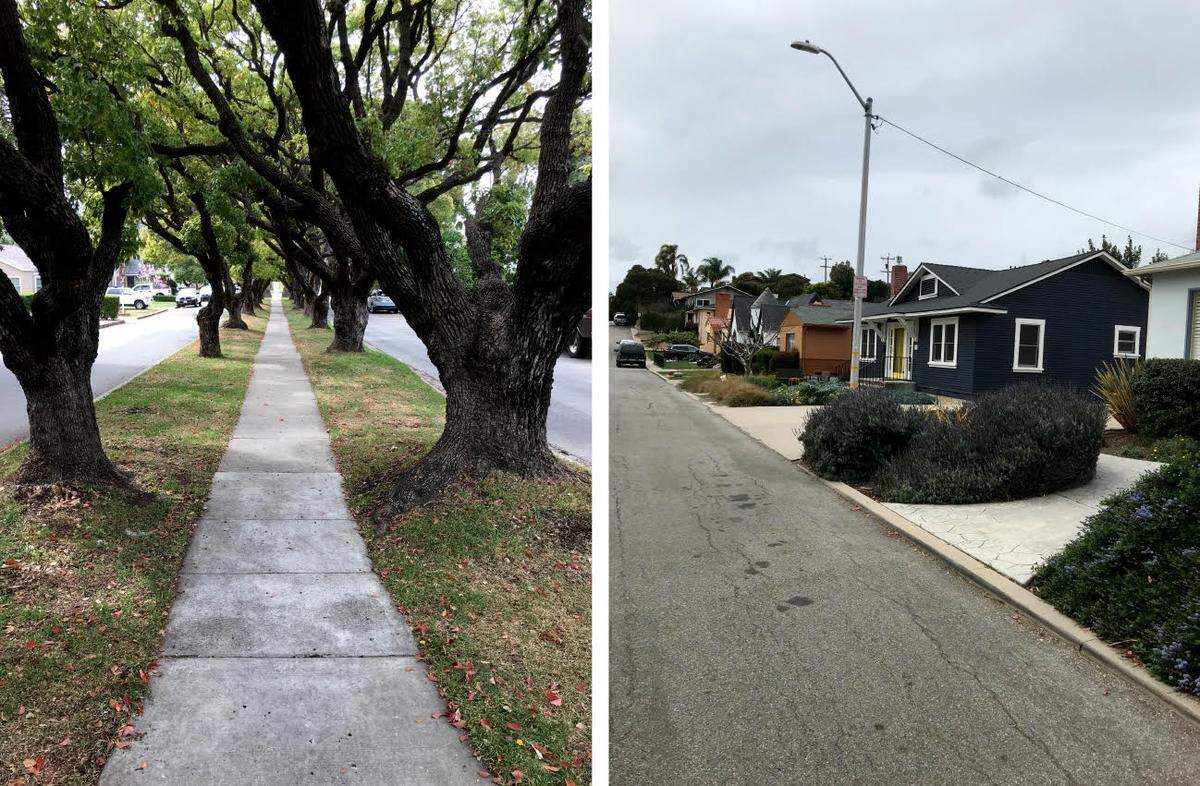
We must stop thinking of trees as expendable resources. Both above and below ground, trees are essential to the eco-systems in which they reside. Trees provide food, energy and income to help communities achieve long-term economic and environmental sustainability. Trees help prevent erosion and secure soil, influence their own climate (i.e., counteract the urban heat island effect), bring rainfall across vast areas, support many wonderful species, increase habitat complexity and provide a huge variety of resources that we make use of now, and will want to make use of in the future.Besides increasing property values, trees can also play other important roles in the community.
In an Institute of Environmental Sustainability, Loyola University study researchers looked at crime data for the city of Chicago, computing a score for each census tract. Then, they compared that to the percentage of tree canopy cover enclosed in each tract. They found that for every 10 percent increase in tree canopy cover, crime rates went down in several categories.
Most importantly, trees also filter the air and help reverse the impacts of climate change through carbon sequestration. In just one year, a mature leafy tree produces as much oxygen as 10 people inhale.
Attitude adjustment
What does this mean to each and every one of us? We need to regard each tree as a precious gift requiring care and nurturing because the benefits of trees are extraordinary.
We need a paradigm shift in our attitude toward trees. We can participate in tree planting campaigns. We can support the participation of nonprofit organizations. We can urge our Public Works Department to plant more trees along our streets, in our parks and in our parking lots.
This would mean convincing our City Council to allocate more funds to achieve this. Our city could emulate Seattle’s Annual Free Tree Giveaway Program. And developers can prevail upon the architectural community to explore more creative ways for trees to appear on the roofs and balconies of our new buildings, as is happening in many other parts of the world.
But we can also act on our own without any reliance on others. For example, instead of gifting cut flowers or chocolates in celebration of birthdays or wedding anniversaries, gift a tree sapling. We can start today to plant within our yards one tree for each member of our family. If we’re an out-of-town property owner, we have an equal obligation to do the same.
We must cease thinking that counteracting climate change requires complex solutions or reliance on the participation and involvement of large organizations and governmental entities. Each and every one of us has an obligation to look around us, be inspired by the beauty of trees, identify opportunities for the planting or preservation of trees and act now. Time is of the essence. The best time to plant a tree was 20 years ago. The second best time is now.
David Brodie of San Luis Obispo is a professor emeritus who taught at UC Berkeley and Cal Poly for over 45 years. Allan Cooper, also of San Luis Obispo, is a licensed architect, member of the AIA and a professor emeritus who taught at Cal Poly for over 34 years. Both have practiced in the fields of urban planning and architecture, and are founding members of Save Our Downtown.