
Right out of the gate, SLO County’s new board moves to reverse years of bad governance | Opinion
There’s a new sheriff in town — or rather, three new sheriffs.
Over the course of Tuesday’s Board of Supervisors meeting — the first full-fledged business meeting of the new year — the new board majority signaled its intent to undo years of bad decision-making.
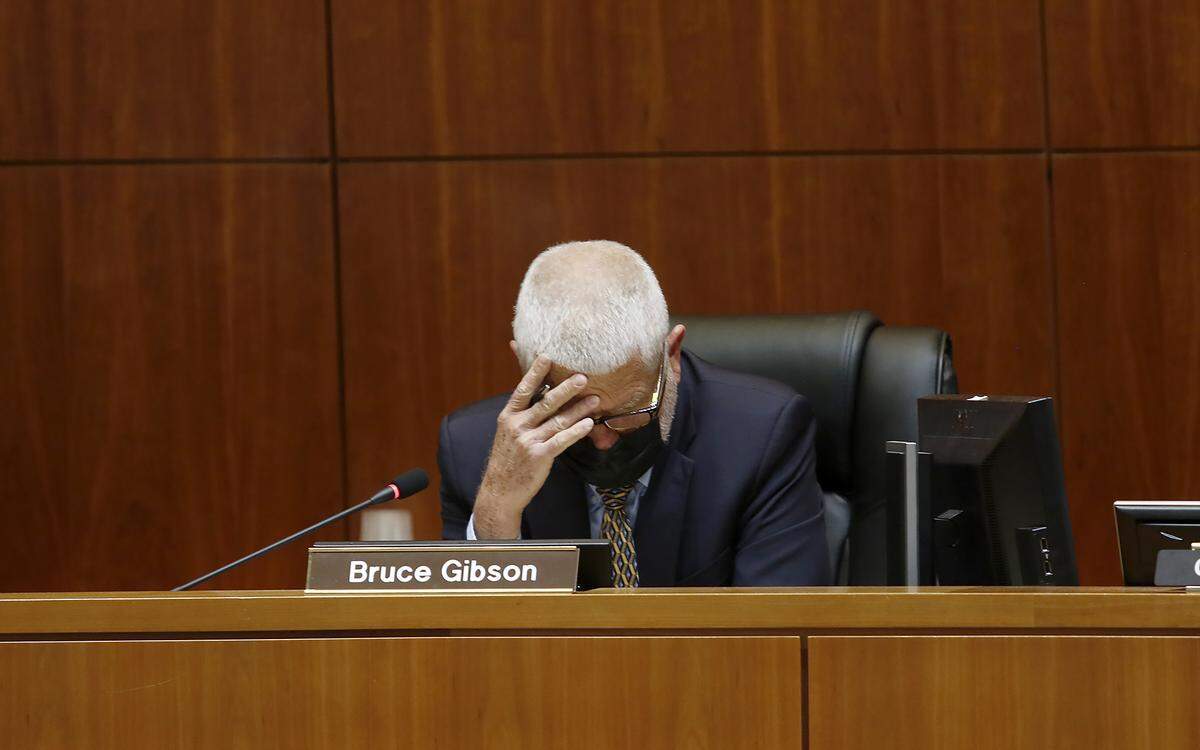
It was a remarkable event that would have played out far differently had Supervisor Bruce Gibson not defeated his far-right opponent, Dr. Bruce Jones, by a mere 13 votes.
For the most part, no final decisions were made, but the liberal-leaning majority took the first steps needed to accomplish its goals.
The board even agreed to meet on a Sunday — a possible first in county history — on account of a looming deadline to repeal a controversial planting ordinance.
Many of the actions were proposed by newly elected Supervisor Jimmy Paulding, who quickly established himself as a man with a mission. He laid out an extensive set of ambitious goals, then followed up by putting several in the form of motions.
Here’s what the Democratic majority — Paulding, Gibson and Dawn Ortiz-Legg — set in motion in a series of 3-2 votes.
Settling the lawsuit filed over redistricting: The board met in closed session — over objections from some audience members — and directed its attorneys to enter into settlement negotiations with SLO County Citizens for Good Government. The lawsuit accused the county of adopting a gerrymandered map aimed at keeping Republicans in power.
The ultimate aim of this effort is to scrap the so-called Patten map and replace it with a different version.
Repealing the planting ordinance: In early December, the board majority then in power — Debbie Arnold, Lynn Compton and John Peschong — increased the limit of water that certain growers could pump from the Paso Robles Basin from 5 acre-feet to 25 acre-feet, ostensibly to help small farmers. The increased limit applied to growers who wanted to plant new crops.
Opponents feared it would leave the overpumped basin in even worse shape. The influential county Farm Bureau opposed the ordinance, and the county Planning Commission unanimously advised against it.
Because the ordinance is due to take effect soon, this is one of the first items the new board will tackle; it will meet Sunday, Jan. 29, at 10 a.m. to schedule a public hearing on the repeal; the actual hearing will be on Feb. 7.
Changing one of the board’s bylaws: Gibson requested a rules change that would allow a simple majority to vote to continue a meeting past 5 p.m. That now requires a unanimous vote., which means one or two supervisors can “derail” a time-sensitive decision by refusing to allow a vote.
That will be on the Jan. 29 meeting agenda for final action.
Joining Central Coast Community Energy (3CE): Every city in the county has already joined this program, which allows consumers to buy energy from a nonprofit Community Choice Aggregation group rather than from PG&E. The old board majority opposed joining, in part because the three conservative supervisors didn’t like the idea that households would automatically be enrolled and would have to opt out in order to stick with PG&E. The new board majority directed county staff to report back on the proposal by March, if possible, so the county can qualify to join in 2025.
Rejoining the Integrated Waste Management Authority: The old board withdrew from the countywide agency in 2021 and put county Public Works in charge of waste management. It was a power play; the conservative majority didn’t like the fact that the countywide board passed liberal policies, such as a ban on polystyrene. Again, county staff was requested to report back on the proposal in March, ahead of a proposed rate increase.
Repealing an ordinance that set the campaign contribution limit at $25,000: The board majority wants to revert to the state limit, which is currently set at $4,900. The new limit would apply to contributions to candidates running for county offices, including supervisor, district attorney, sheriff, etc.
“I think that would have the effect of getting big money out of politics, and that should be a priority of this board in the interests of being more transparent and accountable to the people,” said Paulding, who made the motion to repeal.
The board left it to county staff to decide when to bring the issue back for reconsideration.
Identifying new sources of revenue: At Paulding’s request, the board directed staff to return with ideas for raising revenue. By way of example, Paulding suggested the possibility of putting a bed tax on the 2024 ballot. “It’s my understanding that we’re pretty low in relation to surrounding jurisdictions,” he said.
Stripping Debbie Arnold of her position on the Paso Basin Cooperative Committee: Arnold and Peschong seemed more or less resigned to their new minority position throughout much of the meeting — until it came time to dole out committee assignments.
Arnold has served on the Paso Basin committee for years and made a pitch to retain her position.
“This is a plea to my colleagues,” she said. “I really feel like I’m the best ... the supervisor best suited to represent the Paso Basin. ... Achieving sustainability for the Paso Basin has been a focus for me for over a decade.”
Gibson, who now represents parts of the North County due to redistricting, would have none of it.
“The short of it is that no progress has been made on bringing this crucial water basin into balance,” he said.
In the end, the board voted 3-2, to not only appoint Gibson to the committee but to also deny Supervisor Peschong his position as alternate representative. He will be replaced by a county staff member.