SLO County board’s liberal majority moves to settle redistricting lawsuit, discard map
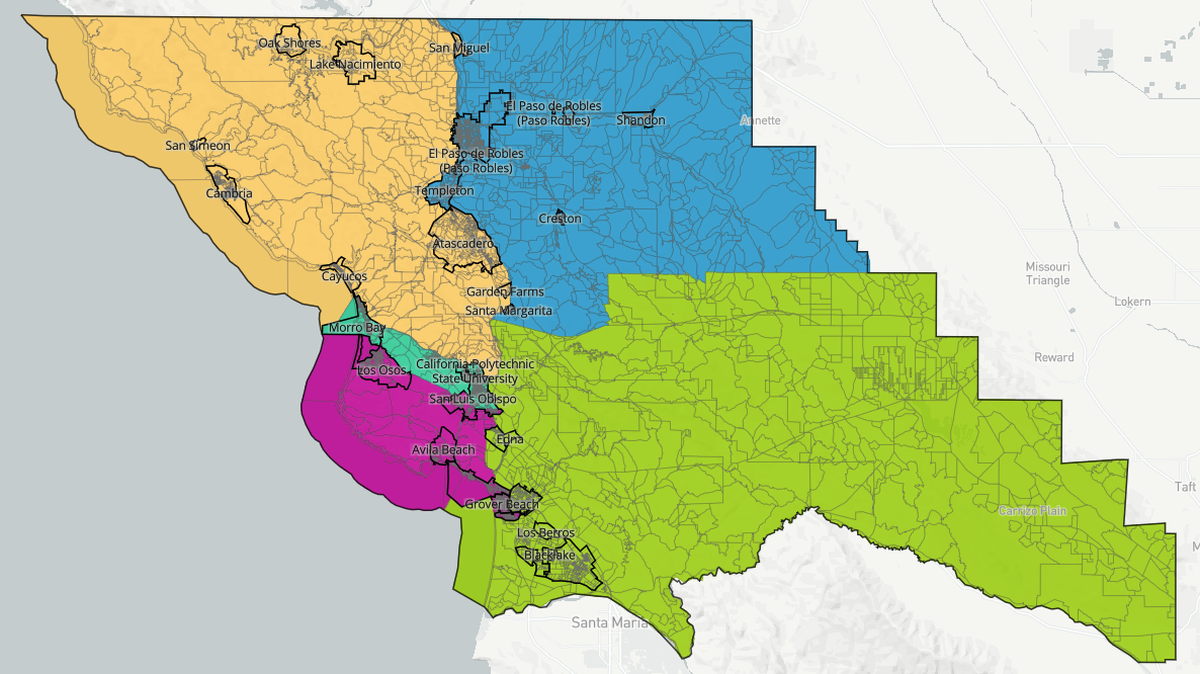
The San Luis Obispo County Board of Supervisors’ liberal majority took its first step to undo the radically redrawn district map approved by the previous conservative majority when it voted Tuesday to pursue a settlement in the legal case.
During closed session on Tuesday, the Board of Supervisors voted 3-2 to direct county counsel to enter into settlement talks for the redistricting case, county counsel Rita Neal said at the meeting.
It’s unclear at this point what options might come from a settlement or how the process would unfold, but the likely result is that a new map would be considered.
Supervisors Bruce Gibson, Jimmy Paulding and Dawn Ortiz-Legg voted to support a settlement, while supervisors John Peschong and Debbie Arnold opposed, according to Neal.
“The county did receive a request in the proposal from the petitioners to enter into settlement negotiations regarding the adopted map,” Neal said at the meeting. “I’ve been directed along with outside counsel to attempt to negotiate a settlement with the petitioners.”
Elections Code section 21503 states that the board can only adopt new district boundaries after a new census, if a court orders the board to redistrict, or if “the board is settling a legal claim that its supervisorial district boundaries violate the United States Constitution, the federal Voting Rights Act of 1965” or other provisions, Neal wrote in an email to The Tribune.
As a result, the board can redraw the district boundaries in this case as part of a settlement, Neal said.
The next court hearing for the case is on Wednesday at 1:30 p.m. at San Luis Obispo County Superior Court.
What has happened in the case so far?
In January, SLO County Citizens for Good Government filed a lawsuit to overturn the new map, which was designed by citizen Richard Patten and drastically redrew the county’s supervisor districts. The group argued that the county violated the Fair Maps Act by gerrymandering districts to benefit Republicans and breaking up communities of interest.
Last February, SLO Superior Court Judge Rita Federman ruled that the county could use the map for the 2022 midterm election, saying that pausing use of the map would disrupt the county clerk-recorder’s ability to prepare for the election and be “detrimental to the democratic process,” The Tribune reported at the time.
However, Federman wrote that the group “demonstrated a probability of success on their claim that the board did not proceed in the manner required by law when it failed to consider evidence that the adopted map favored or discriminated against a political party,” The Tribune reported.
The California Supreme Court refused to hear an appeal on Federman’s decision, and in October, Judge Craig van Rooyen was re-assigned to hear the remainder of the case.
In December, the court denied the citizen group’s motion to order the county to provide more personal emails and text messages between the supervisors and their legislative aides related to redistricting under the Civil Discovery Act.
Van Rooyen did, however, approve a motion to add allegations to the lawsuit that the county violated the Public Records Act and the California Constitution during court proceedings.
This gave the citizens group a new path to request messages sent by board members and their aides about redistricting, according to San Luis Obispo County Citizens for Good Government representative Linda Seifert.
At the Jan. 11 hearing, the county’s attorney Jeffrey Dunn said that “the parties are engaging in settlement discussions.”
Residents asked for a public discussion, but the board met in closed session anyway
Six residents urged the board to discuss the case before the public instead of during closed session.
“I oppose the Board of Supervisors engaging in a collusive legal settlement behind closed doors,” author of the map Richard Patten said during public comment. “I encourage this board to (follow) the law and discuss the legal setup in public.”
“I’m just as puzzled as anyone else about your closed session,” SLO County resident Sandy Triggs said at public comment. “What is the reason to have a secret meeting?”
Neal explained that the Brown Act requires the board to discuss most items before the public, but permits the board to discuss anticipated or ongoing litigation behind closed doors.
“This exception is used so that your legal counsel — whether it’s me or outside counsel — can discuss with the board the litigation, the strategy, the options, and have a full and open discussion without transmitting all of that strategy to our opponent — the other side of the litigation,” Neal said.
Once the county settles the case, it will be required to report the details of the settlement to the public, Neal said.
The board voted 3-2 to discuss the case in closed session, with Supervisors Debbie Arnold and John Peschong dissenting.