
Breaking up waste management agency is a waste of money, and SLO County report proves it
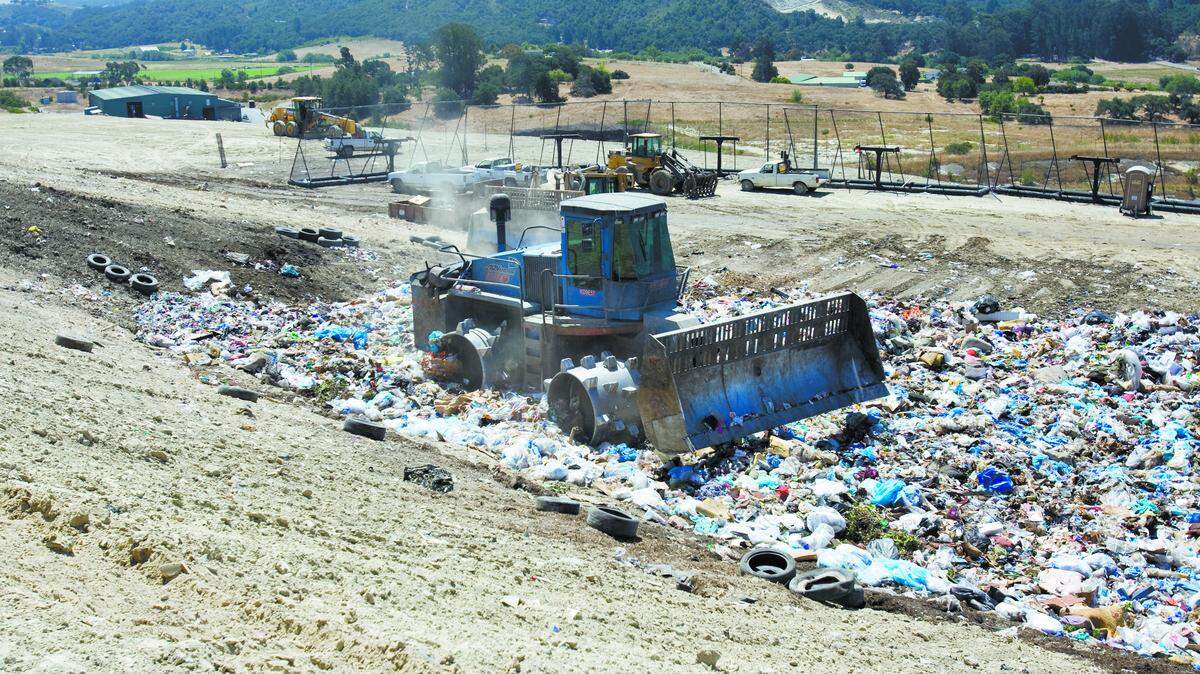
It will cost San Luis Obispo County an additional $1.5 million to $2 million per year if county supervisors go through with their threat to pull out of the Integrated Waste Management Authority (IWMA).
That’s a waste of money — and even worse, garbage customers will be stuck picking up the tab.
Depending on terms of the “divorce,” bills would increase an estimated 9% to 12% for residential customers in certain unincorporated areas, and 13% to 16% for commercial customers.
That’s according to a study that will be presented to the Board of Supervisors on Tuesday. It also concluded that the county will need to hire five more public works employees if it takes on the job of administering waste disposal and recycling programs currently under the umbrella of the IWMA.
Price-wise, the news gets even worse: There would likely be cost increases as well for agencies remaining in the IWMA, since the customer base would shrink with the loss of the county.
This ill-conceived separation is being pushed by the conservative majority on the Board of Supervisors. They’re convinced the IWMA board overstepped its bounds when it passed a countywide ban on polystyrene that took effect on April 9.
The three supervisors — Debbie Arnold, Lynn Compton and John Peschong — believe the IWMA should stick with enforcing state mandates only, and leave it to individual members to decide whether to impose more stringent requirements in their jurisdictions. (The IWMA includes the seven cities, the county and some community services districts.)
At the supervisors’ request, the county hired MSW Consultants, a firm that specializes in waste and recycling, to complete a $32,000 cost-benefit analysis of the proposed separation.
Information in the study confirms what was apparent all along: Blowing up the IWMA is a terrible idea.
Through economy of scale, the regional agency manages to lower costs for customers in cities and unincorporated areas, and it keeps on top of increasingly complex state and federal regulations aimed at protecting the environment.
In fact, new state legislation that takes effect in January mandates big reductions in the amount of organic waste going to landfills. A county staff report has described the new law as “the largest waste legislation in almost 30 years.”
And the county Public Works Department will be expected to get on top of that practically overnight?
That’s a lot to ask, and it’s a duplication of efforts to have two agencies running programs that could be administered by one.
And for what purpose?
We understand the three supervisors want to rein in the IWMA, but that’s already been accomplished. The IWMA board has agreed that, going forward, it will stick to enforcing state and federal mandates only.
As for the countywide polystyrene ban, it’s been in effect for a few months now, and there’s been no great outpouring of resistance.
This “controversy” over polystyrene appears to have been ginned up by a small minority that’s overlooked some salient points:
- The county’s polystyrene ban includes exemptions, including one for financial hardships.
- This may all be moot, since there’s a measure on the 2022 statewide ballot that would require all plastic packaging to be recyclable or reusable. In liberal California, odds that it will pass are high.
- And last but not least, polystyrene is a threat to wildlife and public health, and banning it is the responsible thing to do.
This isn’t about polystyrene. This is a battle wills, and it’s time to end it.
When more and more services are being consolidated in order to maximize efficiency and save taxpayer dollars, it’s foolish to go in the opposite direction.
Splitting up the IWMA would be a waste of money and resources. We urge the Board of Supervisors to continue the county’s membership in the Integrated Waste Management Authority.