
A Black man was beaten by 4 white racists in Pismo Beach. Would you have intervened?
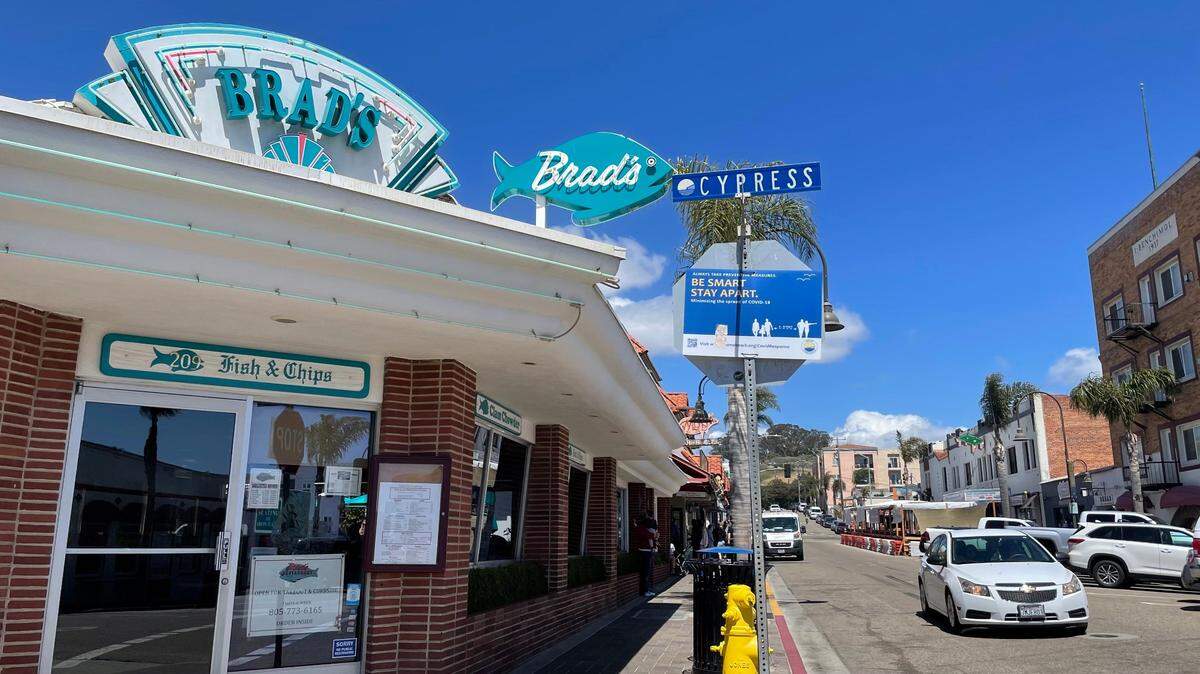
In this era of Insta-everything, it almost defied logic: A Black man in the company of his girlfriend and her father was beaten by four white men on a busy street in Pismo Beach, and it practically went unnoticed.
It wasn’t until days later when the girlfriend’s father, Ed Atkins, made a report to the police and submitted a letter to The Tribune that the incident gained wide attention.
After that, individuals and organizations — including the city of Pismo Beach — expressed outrage over what appeared to be a racially motivated attack. According to Atkins, the beating had been preceded by taunting that included a reference to the victim’s “kinky hair.”
Of the many unanswered questions this raises, here’s one of the most confounding: Why didn’t more people react in the moment? The attack occurred outside Brad’s, a popular downtown restaurant, and while a manager of the business called police, Atkins said people on the street were “casually walking by” without intervening.
“It’s hard for me to believe no one really stopped to say that they’d seen that,” Atkins told Tribune reporter Kaytlyn Leslie. “In a way, in hindsight, I just went, ‘How come nobody saw that and said so?’ I mean, it was visible.”
That brings up still more critical questions: What would any one of us do in a similar situation? Would we pass by? Or is there a way to react, one that doesn’t involve putting ourselves in danger?
Was this an isolated case?
In a word, no.
While incidents usually don’t escalate to this degree — especially on a busy street, in plain view of passers-by — who hasn’t witnessed acts of hostility or overheard bigoted, hurtful remarks right here in San Luis Obispo County?
Several cases have been documented: Anti-Semitic graffiti outside a Jewish fraternity at Cal Poly. A racial slur and drawing of a stick-figure hanging from a noose sprayed on the wall of a Grover Beach elementary school. A man exploding in a racist rant caught on video by a Black store manager in Atascadero who asked him to put on a mask.
“Hateful incidents directed at people of color are not surprising in our county,” R.A.C.E. Matters SLO said in a statement issued following the Pismo attack. “Sadly, they happen all too often. What is shocking and disappointing, however, is the lack of urgency and relative silence following the attack in Pismo Beach.
“A simple act of kindness — checking on the injured party, if the victim is willing — as well as sticking around to serve as witnesses to identify the attackers — might also have been helpful in this instance,” R.A.C.E. Matters added.
The police investigation was complicated by the fact that the victim chose not to give a statement.
But that doesn’t mean we should all just move on, as if this never happened. If we live in a bubble of denial, how can we even begin to make things better?
Keep in mind, in ugly incidents like this one, it isn’t just the victim who’s affected.
“The bystanders become victims because they must live with the guilt of doing nothing. Or if the bystanders don’t feel guilty, they become a victim because they develop the skill of looking away. When one learns to look away, one learns to shutdown in other areas of their lives, such as towards friends and family,” said Midori Feldman, a Paso Robles woman of color who has been both the target of hostility and a witness to it.
The fact that an incident “happened so fast” isn’t an excuse, she added.
That’s like saying, ‘The earthquake happened so fast. I couldn’t do anything.’ We can all do something,” she said.
Why don’t more people intervene?
It’s not necessarily because people don’t care.
Hollaback!, a New York City-based nonprofit that does bystander training, says there are several reasons.
Among the most common:
- They’re afraid they will be targeted as well.
- They believe they’ll only make things worse.
- No one else is doing anything.
- They don’t know what to do.
It’s not surprising that people hesitate because they don’t know what to do. Most of us have not had training, formal or otherwise, in bystander intervention.
That must change.
We’ve been told what to do in a traffic accident, we may know CPR, we’re even quick to intervene when a dog is in obvious distress, but when we see someone being harassed in a public space, many of us don’t have a clue.
So what can you do?
Again, we turn to Feldman, who told us she’s been in situations where she was the target of harassment and witnessed others subjected to abuse.
Here’s the advice she offers:
“First of all, we can all develop a plan. Think and plan out how you might act should you see such an event. Envision yourself across the street. Plan how you might use your phone to record the event. Learn to use the button that allows you to bypass the security code and immediately record. If you don’t have time to whip out your phone, practice using your senses. Look, listen and commit everything to writing immediately afterwards. Think about giving that and your contact information to the victim.
“Even if the police don’t take a report, think about going to the station and filing an incident report. That provides history. Do you think this will be the last attack by these four young men? It will take time and effort, but think of the emotional cost to you, of learning to do nothing.”
Several groups offer bystander intervention training that teaches techniques that can be applied to a variety of situations, if we witness someone being sexually harassed, for example, or an employee being subjected to a tirade by an out-of-control customer.
Many of the courses use some variation of the “D’s” — Hollaback!, which offers free online training, teaches 5 D’s:
Distract: It doesn’t have to be a major scene. Ask the person being harassed for directions or a restaurant recommendation. Drop something. Speak in loud voice — anything to draw attention away from the victim.
Delegate: Depending on where you are, find someone who is in a position of authority to help, like a store manager or security guard. Or, ask the person who’s being targeted if they’d like you to call police.
Document: Take a video from a safe distance and include street signs or other landmarks to establish where it’s occurring. Note the date and time. Hollaback! advises asking the target of the harassment what they would like to do with the footage; do not post it online without their permission.
Direct: Say something. Tell the aggressor they’re being inappropriate, or ask the targeted person if they’re OK.
Delay: Check in with the person who was harassed afterwards.
Of course, use your judgment; if a crime is occurring, call 911. And no, these measures aren’t guaranteed to work every time.
But the “D’s” can be useful in diffusing an incident before it escalates — and answer that age-old question, “What could I have done?”
Want to learn more?
Several organizations are offering bystander intervention training and videos online, especially in the wake of anti-Asian hate incidents.
Here are a few to check out, you can find others by Googling “bystander intervention training.”
Hollaback!: Offers a free guide and a variety of free webinars.
Asian Americans Advancing Justice Los Angeles: Offers 60-70 minute webinars, plus short videos on the 5 “D’s.”
Step Up!: A program developed for college campuses, Step Up! offers free intervention training for groups.