
What is that white stuff on top of waves? Storms stir up seafoam along Central Coast
A few readers asked if we ever had a dry March, and the answer is yes.
However, nearly all of the dry months of March were preceded by a wet January or February. This year is on track to have the driest combined January, February and March on record.
The previous most parched start to the year was in 1972, when 1.89 inches fell between the beginning of January and the end of March, followed by 2.00 inches in 1984 and 2.45 inches in 2015, according to Cal Poly’s Irrigation Training & Research Center, whose rainfall records go back since 1870.
So far in 2022, only 0.05 of an inch of rain has been recorded at Cal Poly.
The San Luis Obispo County Airport has seen 0.12 of an inch, while Paso Robles, Santa Ynez and the Santa Maria Airports have reported around 0.25 of an inch. The Lompoc Airport has seen the most rain at 0.33 of an inch.
Looking at the long-range forecast, I just don’t see any significant rain through the end of March. Truly unprecedented.
Storms stir up seafoam on Central Coast
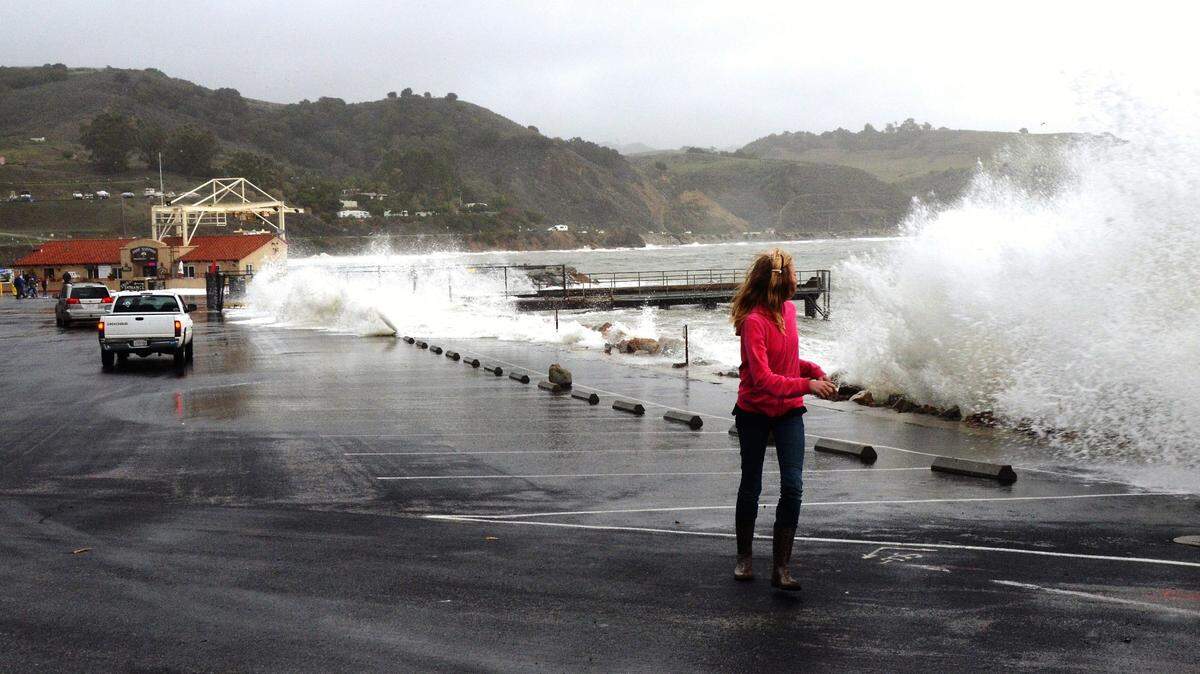
Even though the Central Coast hasn’t received the amount of rain hoped for this season, numerous Pacific storms have generated a few high-energy wave events.
As most Central Coast surfers or fishers will tell you, this year has seen some very energetic wave events.
Their observations are verified by the Diablo Canyon Power Plant’s Waverider buoy database, found at Scripps Institution of Oceanography website.
As this year’s breakers lashed the shore, they whipped up copious amounts of seafoam — common along the Central Coast, especially during high-wave events and periods of plankton blooms. Irving Berlin wrote “to the oceans white with foam” in the patriotic song “God Bless America,” made famous by Kate Smith.
Nevertheless, depending on the type of organic matter in the seawater, the foam can also take on a yellow-brownish hue.
Seafoam is formed by the agitation of seawater caused by crashing waves, especially when the water contains large amounts of dissolved organic matter.
Along the Central Coast, plankton blooms combined with decaying bits and pieces of red, green and brown algae can put a lot of dissolved organic material in the water column in the form of proteins and fats. Like fluffy whipped egg whites, the proteins in the seawater become denatured — changed from their natural state — as they are churned by breaking waves in the surf zone.
As the large-denatured protein molecules unfold in the churning seawater like origami flowers, the air-loving part of the proteins stick to the air bubbles. The air bubbles in the foam become more persistent through surface tension. That is how sea foam develops.
Seafoam not generally dangerous
Because of the persistence and lightweight of seafoam, it can easily be blown onshore by winds onto beachfront sidewalks and streets.
Overall, the majority of sea foam is not harmful to humans. In fact, it is often an indication of a healthy and productive ocean ecosystem.
However, when seafoam is made from a harmful algal bloom like dinoflagellates, also known as red tide, the aerosols from its popping sea foam bubbles can pose a health risk for asthma or other people respiratory conditions. It can also irritate the eyes of beachgoers.
The resulting sea foam can be more persistent if sewage, detergents, or oils from polluted stormwater are present.
Sometimes, when the conditions are just right, large amounts of sea foam can accumulate along the coast and conceal large rocks and voids, making hiking along the beaches hazardous.
Earth Day celebration at Montaña de Oro
After a two-year hiatus, you can join PG&E employees April 23, to celebrate Earth Day at Montaña de Oro State Park, just south of Morro Bay.
The event is one of a number of service projects sponsored by PG&E and the California State Parks Foundation.
Be sure to dress for outdoor work with long pants, a long-sleeved shirt, sturdy shoes, a hat, gloves and sunscreen. Snacks and a light lunch will be provided, but bring your own water in a refillable bottle.
Rangers will provide tools and supervision.
If you plan to join in, register at the California State Parks Foundation website at www.calparks.org/help/earth-day/earth-day-registration.html.
This story was originally published March 15, 2022 at 5:00 AM with the headline "What is that white stuff on top of waves? Storms stir up seafoam along Central Coast."