
When will rain return? Why SLO County skies have been so clear and dry in recent weeks
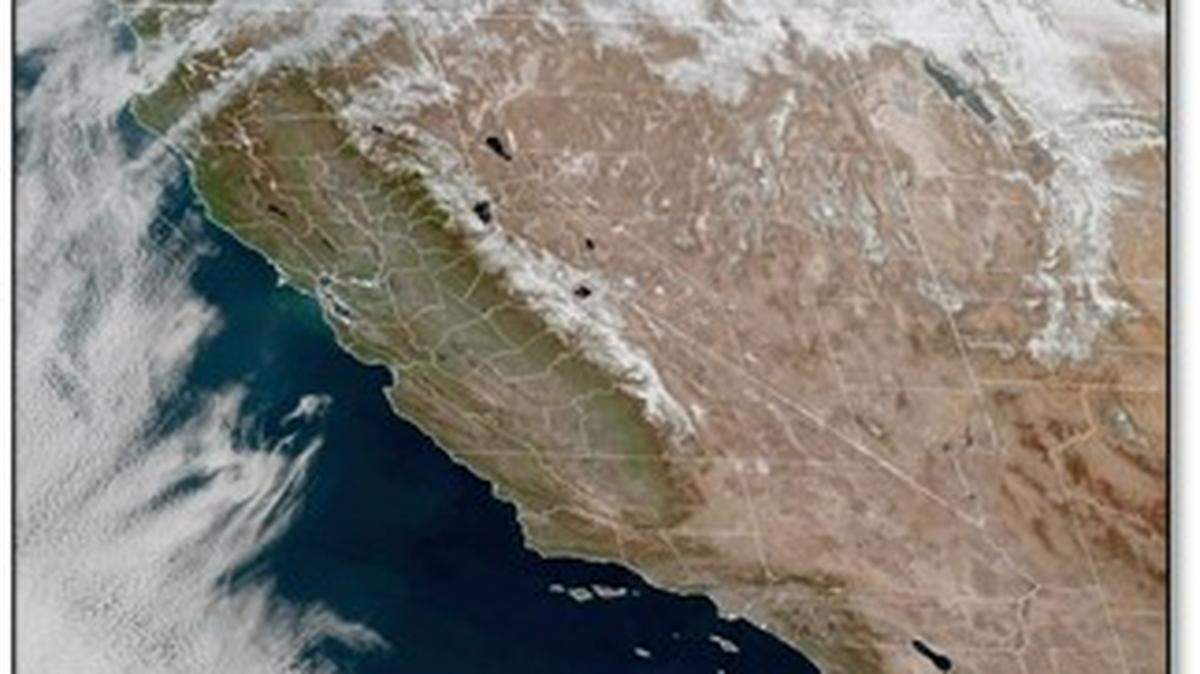
We may not see a persistent and deep marine layer until March, and here’s why.
Over the years, many Central Coast residents who live along the shoreline have commented on the reduced amount of coastal stratus clouds and the fog and drizzle they can create.
Their observations are correct: Median cloud cover data from San Luis Obispo County Airport and the Santa Maria Public Airport has shown a decrease in the marine layer over the last few decades.
Numerous factors affect coastal stratus development, such as storms, wind direction and speed. Over the last 37 days, we’ve seen plenty of Santa Lucia (offshore) winds that warmed and dried the atmosphere and pushed the marine layer hundreds of miles out to sea.
Currently, the atmosphere is locked in a dry pattern.
The Eastern Pacific High is firmly anchored off the California coastline, with transitory low- and high-pressure systems moving through the Great Basin. This condition will continue to produce gusty Santa Lucia winds and dry weather into mid-February, if not longer. Strong high pressure over California will continue to produce gusty Santa Lucia (northeasterly) winds.
Meteorologists often express air pressure in units called millibars. The standard atmospheric pressure is defined as being equal to 1,013.25 millibars at sea level. Depending on the surrounding atmospheric conditions, levels above this value may be considered areas of high pressure. Typically, strong high pressure, deemed to be 1,030 millibars and above, produces clear and dry weather.
In the United States, barometric pressure for aviation is measured in inches of mercury, or inHg. One inHg is the pressure exerted by a column of mercury 1-inch high at the standard acceleration of gravity. So that standard 1,013.25 millibars at sea level is the equivalent of 29.92 inHg.
The highest pressure reading in the United States occurred on Jan. 31, 1989, in Northway, Alaska, a town with 71 souls. On that day, air temperature fell to 62 degrees below zero, and the pressure reached 1,078.6 mb or 31.58 inHg.
That reading is literally off the scale for many analog barometers. If famed author Jack London were alive, he would probably write a story about the grounding of bush aircraft that carry mail and supplies because their altimeters could not be calibrated due to such pressure readings. You see, an accurate altimeter reading is crucial for aircraft to avoid mountains.
The highest pressure ever recorded in the lower 48 states occurred in December 1983 in Miles City, Montana, where it reached 1,064 mb, or 31.42 inHg, during a severe cold wave.
The official figure for the world’s highest recorded sea-level pressure in the world occurred in Agata, Siberia, which reached 1,084 mb, or 32.01 inHg, in December 1968. At the time of that reading, it was about 50 degrees below zero. On the flip side, and once again depending on the surrounding atmospheric conditions, levels below standard atmosphere may be considered areas of low pressure.
Traditionally, according to wind data recorded at Diablo Canyon Power Plant’s meteorological tower, winds blow about 60% of the time out of the northwest quadrant along the Pecho Coast. The winds blow approximately 12% of the time out of the northeast quadrant and about 23% out of the southeast quadrant. The other 5% of the time, the winds are spread evenly across the rest of the cardinal headings.
During dry years, northeasterly Santa Lucia winds are more common, while wet years will see more prefrontal southeasterly winds.
In January and during the first week of February, the Santa Lucia (northeasterly) winds have blown about 75% of the time; no wonder the skies have been mostly clear, with cold mornings and warm afternoons.
When the winds blow out of the northwest (onshore), they push moist marine air over the Pacific Ocean’s surface toward the California coast. This air near the ocean’s surface is cooled from underneath by the colder seawater and produces an inversion layer, which means the air at the sea’s surface is colder than the air above.
Near the top of the inversion layer, the cold air interacts with the warm air, and condensation produces clouds. Think of a cold glass of iced tea on a hot day. The water vapor in the air condenses on the outside of the cold drink.
The exact process occurs along our coastline, except the water vapor condenses on microscopic dust or salt particles near the inversion layer, producing marine stratus clouds. The colder the seawater temperature, the more likely condensation will occur.
Think of it this way: If that glass of tea were the same temperature as the air surrounding it, condensation on its surface would not happen.
Inversion layers can occur anywhere from a few feet above the ocean surface up to thousands of feet in altitude. When stratus clouds lower to the ocean surface, that’s what we call fog. If the inversion layer is high enough, the marine stratus can surge into the coastal valleys (Santa Maria). As it further increases in elevation, it can travel through the passes and gaps into the interior.
NOAA’s Climate Forecast System model advertises a chance of increasing northwesterly and southerly (onshore) winds and a wet weather pattern developing in March and April.
If this model verifies, it could be a repeat of 2020, when we had a nearly parched January and completely dry February, followed by heavy rain in March and April showers. These onshore winds may also cause a deep marine layer to redevelop along the coastline.
This story was originally published February 8, 2022 at 10:55 AM.