
What is an anvil cloud? Here’s how this weather phenomenon happens — and what it means
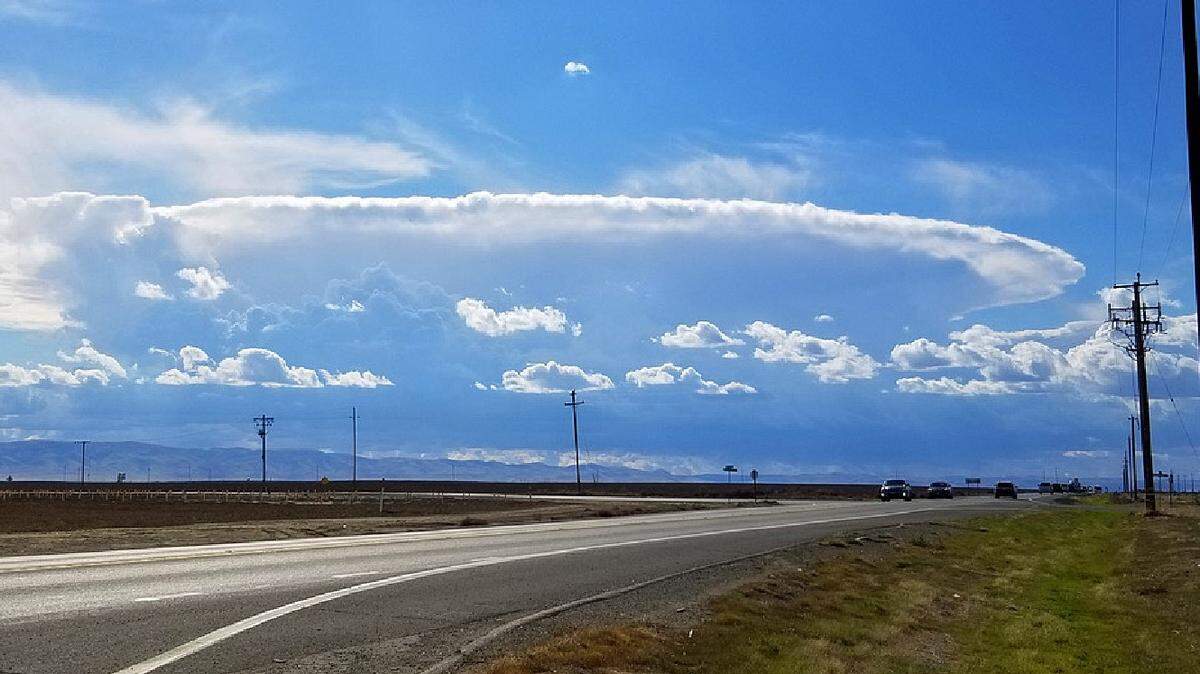
Beth Marshall, a former National Weather Service forecaster, took a photo from the Lost Hills area looking southwest of a massive cumulonimbus incus, or, “anvil cloud” on March 12.
It was apparently rotating and turning into a supercell which can produce severe storm phenomena such as lightning and thunder, hail and even tornadoes.
So, what caused this to happen?
Last week, a vigorous upper-level low-pressure system moved over the Central Coast.
It spun scattered thunderstorms that produced brief periods of heavy rainfall, gusty winds, hail and lightning counterclockwise around its center, which contained a frigid air mass. The clouds in this system were described as convection in nature.
What are convective clouds? Convection is defined as movement in a gas or liquid in which the warmer parts move up and the cooler parts move down.
On a clear day, especially as the days become longer, most of the sun’s energy is radiated through the atmosphere and absorbed by the land.
Like sitting on a bench that has been warmed by the sun, the ground heats the air in direct contact with it by a process called conduction.
Conduction is the transfer of heat within one substance — in this case, the ground — to another — the air — by molecular action.
As the air in contact with the Earth’s surface warms, the amount of motion or vibration of the gases of the atmosphere — nitrogen, oxygen, and argon atoms along with molecules of carbon dioxide and water vapor — increases.
That, in turn, produces more space between the air molecules, making the air less dense, which causes it to rise like a hot air balloon. That rising of the air is convection.
In the science of meteorology, there are two types of convection: dry and moist.
As you might guess, dry convection doesn’t produce any clouds. However, moist convection does.
The differences between these two are determined by the air’s relative humidity, temperature and strength of the updrafts.
If a thermal can rise high enough, the air will cool and eventually reach its dewpoint temperature and form clouds.
The dewpoint is the temperature at which air must be cooled for it to become saturated. At that point, the air can no longer hold all its water vapor, and some of it condenses into visible clouds, rain, or snow.
Condensation is a warming process, which is why it feels warmer right before it rains or snows. That process can sustain the convection by warming the air further and making it rise even higher.
This convection circulation can severely destabilize the atmosphere as the relatively warm air slams into the cold air above, forming a positive feedback loop that can push clouds into the stratosphere, producing cumulonimbus incus, or, anvil clouds. Anvil clouds can develop into supercells.
The troposphere is the lowest layer of our atmosphere which starts at sea level and extends upward to approximately 33,000 feet, depending on your latitude and the atmospheric conditions. Some days, this level can be higher; on other days, it’s lower.
Excluding inversion layers, as you climb higher in the troposphere, temperatures decrease with the lower air pressure. Pretty much all the weather we experience on Earth occurs in the troposphere, which contains approximately 99% of the atmosphere’s water vapor.
On top of the troposphere is the stratosphere, which extends to about 164,000 feet above the ground.
The ozone layer is in the stratosphere, which absorbs ultraviolet (UV) light from the sun and converts most of it to heat. In this layer, the higher you go, the warmer it gets.
Perhaps this is why Icarus’s wings melted.
In Greek mythology, Daedalus constructs wings for his son Icarus made from feathers and wax to escape from Crete. Daedalus warns his son not to fly too low nor too high, so wetness of the Mediterranean Sea will not dampen his wings, nor the sun’s heat melt them away.
Regrettably, Icarus ignores his father’s advice and flies too close to the sun.
As the tale goes, the sun’s heat melts the wax that holds the feathers in place, and gravity pulls the featherless Icarus into the sea.
Ironically for Icarus, the air is thin at these altitudes. Consequently, the atmosphere is stable, producing a smooth ride for jet airliners.
Most thunderstorms aren’t robust enough to reach the top of the troposphere. However, on March 12, the updrafts were strong enough to reach it.
Weather balloon data indicated that the top of these anvils was approximately 30,000 plus feet. On rare occurrences, the rising air can burst into the stratosphere and produce overshooting tops on the anvils. Those are intense updrafts indeed!
Historically along the Central Coast, the most severe thunderstorms have occurred in the spring. The only verifiable tornadoes have happened in April and May.
How to tour Diablo Canyon Power Plant virtually
Due to the COVID-19 pandemic, our team has had to suspend tours of Diablo Canyon Power Plant and the thousands of acres of pristine lands surrounding this magnificent facility.
While the tours are on hold, we made a wonderful virtual tour page of the power plant that can be viewed at https://bit.ly/3uGMK6Z.