
SLO County dry spell follows weeks of parched weather. Could polar vortex save winter?
We have entered the typical mid-winter dry spell, which historically lasts for a few weeks even during the wettest years.
A dry spell in late December and early January dry spell is quite normal for San Luis Obispo County and often produces an interesting switch in the weather pattern between the beaches and the coastal and inland valleys.
The interior valleys are frequently hot and dry in the summer months, while the beaches are socked in with fog and mist. During the afternoon, it is not uncommon to see beach temperatures more than 50 degrees cooler than the inland valleys.
However, the opposite can occur at this time of the year. As the Santa Lucia (northeasterly) winds blow through the coastal canyons and passes toward the beaches, they dry and warm the air mass, leaving behind clear skies.
On the other hand, the inland valleys are often sheltered from these offshore winds, and the force of gravity carries the cooler and denser, heavier air mass to the valley’s floor.
As the overnight temperatures decrease, water vapor condensed onto microscopic particles in the air, and the valleys begin to take on a grayish tint.
When the air has reached its dew-point temperature, the relative humidity is at 100%, and water droplets become visible to the naked eye as fog and mist. As the fog layer deepens, it starts to creep toward the ocean but never makes it.
A terrible cousin of coastal fog, Tule fog often develops in the San Joaquin Valley and can persist for days on end.
This year’s mid-winter dry spell was proceeded by a mostly dry October and November and well below-average rainfall in December.
As we approach the one-halfway mark of the highest probability of rain this year, all Central Coast locations are less than 30% of normal in terms of rainfall.
So far, both the Paso Robles Municipal Airport and San Luis Obispo County Regional Airport have the lowest rainfall percentages at only 15% of normal. The rain gauge at the Paso Robles airport has only seen 1 inch of the wet stuff, while Cal Poly, home for climatology for San Luis Obispo, is at 17% of typical rainfall.
Farther south, the Lompoc Airport is currently at 20% of usual in terms of precipitation, while the Santa Maria Public Airport has the highest percentage at 29% of average rainfall.
In a classic La Niña pattern this year, the jet stream has taken a more northerly track and has carried most of the storms that have marched across the Pacific Ocean into Washington, Oregon and Northern California.
Western Washington has seen nearly constant rain this month, with record rainfall amounts recorded in Seattle and Olympia. A significant atmospheric river is forecast to slam into Washington state with a deluge of precipitation on Tuesday and Wednesday.
Along the Central Coast, it appears that what I call the “Ridiculously Resilient Ridge of High Pressure,” made famous by the previous drought, will continue. Historically, La Niña conditions typically produce lower-than-average winter rainfall.
With that said, there have been La Niña years that have seen well above average rainfall for unanticipated and quickly changing atmospheric conditions. One of these could be developing as I write this column, and here is why.
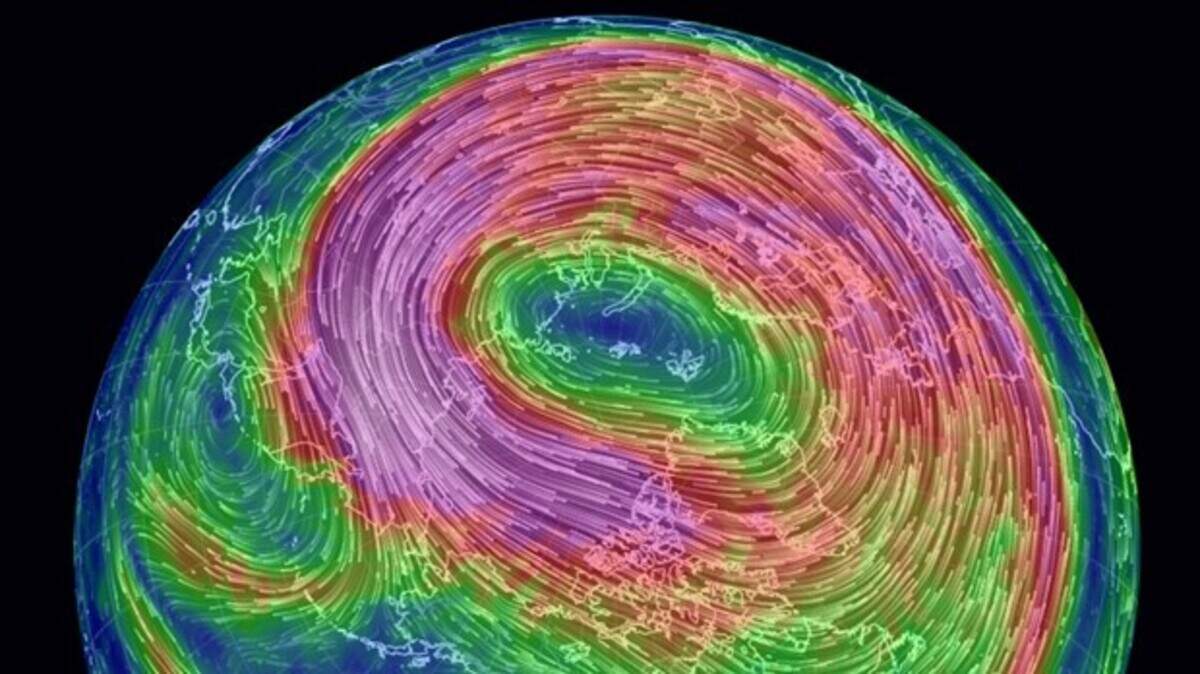
A dramatic spike in temperatures is presently occurring above the North Pole in the stratosphere. This is referred to as “sudden stratospheric warming.”
This condition can cause the polar vortex to weaken, slow down or even split, but it can take weeks to see the effects.
If it does split, there is a chance that a trough of low pressure could develop along the West Coast, which would open the door to Pacific storms with rain, frigid temperatures and low-elevation snow or a persistent ridge of high pressure. Only time will tell the story.