
What causes rainbows and what’s the best time of day to see them?
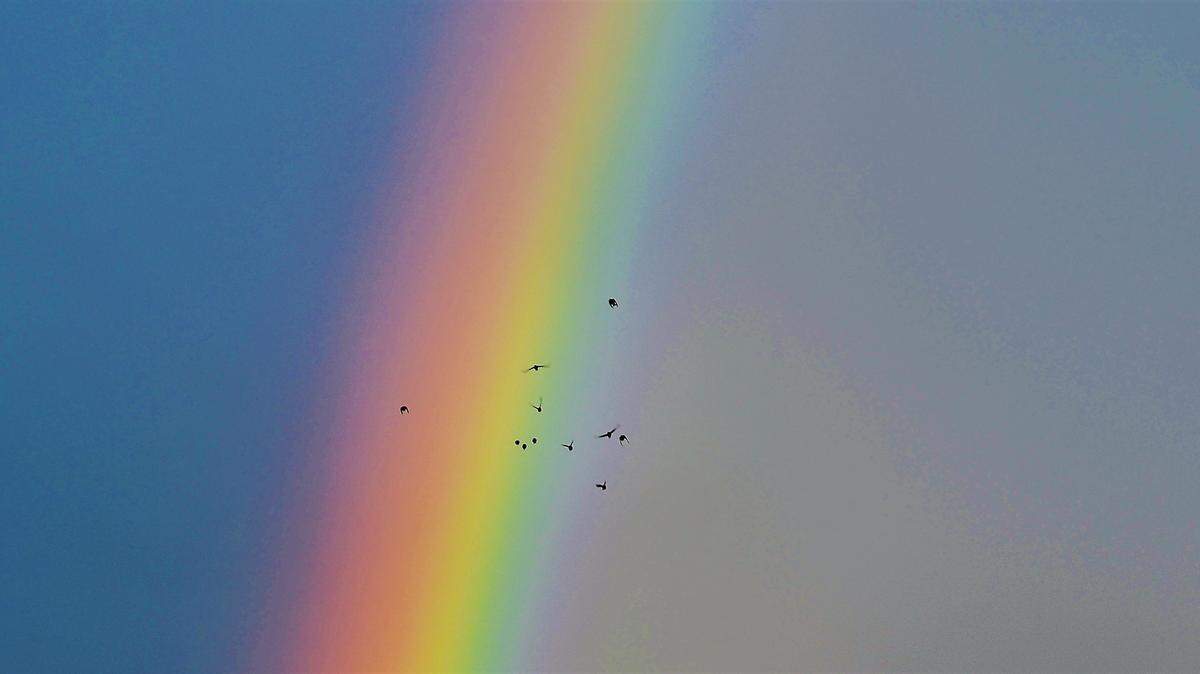
Rainbows don’t really exist.
In other words, they are not a thing or physical manifestations but are literally in the eye of the beholder.
You can chase rainbows as long as the sun shines, but you will never reach the point where they meet the ground and find the pot of gold placed by a leprechaun. They are an optical phenomenon.
Since most storms travel toward the east, the best time to see rainbows is during the afternoon or early evening. The sun is behind you right after it stops raining.
You see, when white light from the sun moves into water droplets in the atmosphere, the light bends or refracts, reflects off the back of the rain droplet and separates into primary and secondary colors or wavelengths.
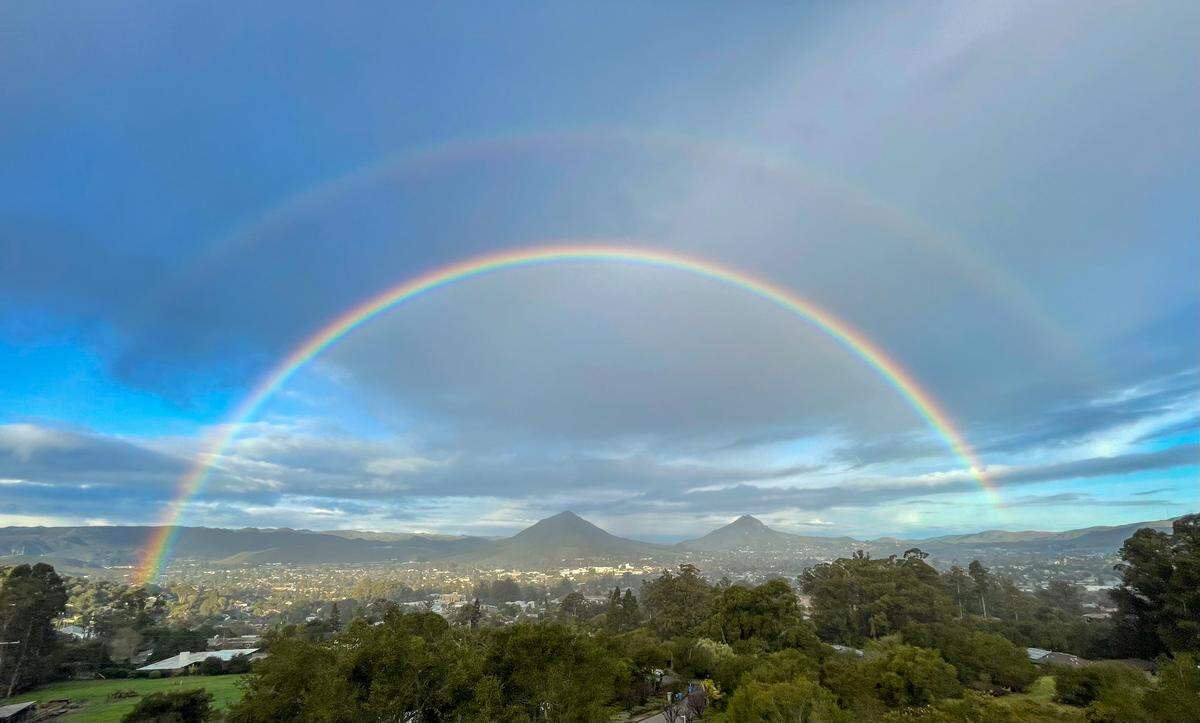
If there are enough droplets and sunlight, you can see a double rainbow. The secondary rainbow is fainter than the primary, and its colors are inverted, with violet on the top and red on the bottom.
From aircraft in the right conditions, rainbows form a complete circle, but there is more than meets the eye as many other types of bows can be seen.
Before the start of the aviation era, the sight of a glory — one of the more striking optical phenomena in meteorology — was rarely seen except by mountain climbers.
A glory is a phenomenon featuring rings of colored light, mostly magenta and yellow, that surround an aircraft’s shadow against the top of clouds or a fog bank — resembling a saint’s halo.
If you look down on a cloud from an aircraft or even from a very tall structure when the sun is out, you can sometimes spot one.
Like a rainbow, a glory appears opposite the sun with the viewer in the middle. The colors are produced by tiny water droplets in low-level clouds that act as small reflectors of the sunlight.
As you fly along in an aircraft, the glory size will change depending upon the water droplets’ diameter in the cloud. As the size of the water droplets decreases, the diameter of the glory will increase.
According to Cliff Mass, an atmospheric scientist at the University of Washington, glories can be produced using the equations that describe electromagnetic waves and their interactions with droplets.
According to Mass, a glory can be created when the diameters of atmospheric particles are similar to the scattered light’s wavelengths — known as Mie scattering.
Currently, however, the scientific description of glories is the subject of much debate.
Charles Thomson Rees Wilson, a Scottish physicist and meteorologist, worked as a temporary observer at the Ben Nevis weather station on the highest mountain on the British Isles at 4,409 feet.
Motivated by the sight of a glory and other meteorological phenomena from this weather station, he built a sealed container for creating clouds at Cavendish Laboratory in Cambridge.
This led to the cloud chamber, a device for detecting ionizing radiation.
In 1927, Wilson and his colleague Arthur Compton were awarded the Nobel Prize in physics.
The clouds must contain water droplets, not ice crystals, found in colder and higher-level cirrus or cirrostratus clouds to produce a glory.
.JPG "IMG_0377 (2).JPG")
While ice crystals don’t work well in creating glories, they’re perfect for producing sundogs — halos that surround the sun — or other phenomena such as silver-blue night-shining clouds or circumhorizontal arcs called fire rainbows.
Even though they have nothing to do with fires, they are caused by light waves bending around the crystals.
The colors can be brilliant, much like the feathers on a hummingbird.
Like observing the brilliant blues-greens and magenta flashes of Anna’s hummingbirds, you need to be at the correct angle to see the brightest colors.
For example, the circumhorizontal arc cannot be seen in locations north of 55 degrees of latitude, covering a big chunk of Canada and nearly all of Alaska or south of 55 degrees toward the south pole.
Due to the earth’s axial tilt of 23.5 degrees, which produces the seasons, the sun needs to be higher than 58 degrees above the sky’s horizon that occurs between late March and late September at our latitude.
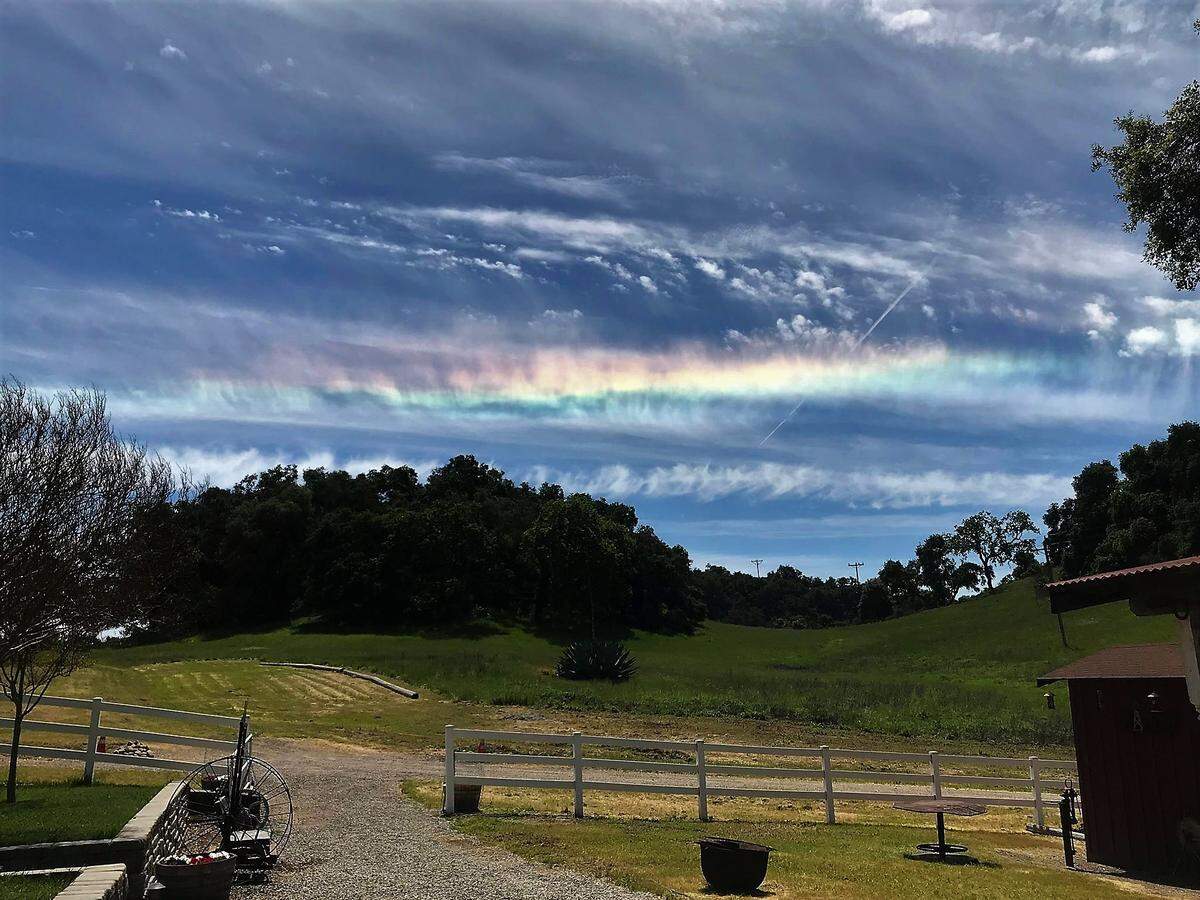
A few years ago, Bob Bowles took a beautiful photograph at Suey Creek Road about five miles east of Nipomo.
“It was a horizontal rainbow, never seen anything like it. It hung out in the sky to the east of us and changed colors for about an hour,” he said. “I don’t know if we were the only ones that got to enjoy this; didn’t hear anything.”
At around the same time, Teri Hunter tweeted a similar image of a weird rainbow from Nipomo High School.
Looking at Bowles’ photo, I was astonished by its mother-of-pearl-like iridescence. It was almost like looking at the inside of an abalone shell.
On the day that the photo was taken, a weak cold front moved southward along the California coastline and produced gentle southerly winds and, more importantly, increasing mid- to high-level clouds.
One of the most common types of clouds that develop at high altitudes is cirrus. These clouds are frequently blown about into feathery strands called “mare’s tails.”
Cirrus clouds usually develop at 17,000 feet and higher over most of the United States.
They occur at temperatures near minus 40 degrees Celsius or Fahrenheit (Fahrenheit and Celsius are equal at minus 40 degrees) or colder and consist almost entirely of hexagonal-shaped ice crystals. The ice crystals often descend slowly, and these rainbows of colors can persist for hours.
How to avoid scams
Scammers can be convincing and often target those who are most vulnerable, including seniors and people in low-income communities. They also aim their scams at small business owners during busy hours. Learn how you can detect and report these predatory scams at www.pge.com.