Do SLO County voters want a new Board of Supervisors majority? Maybe, maybe not
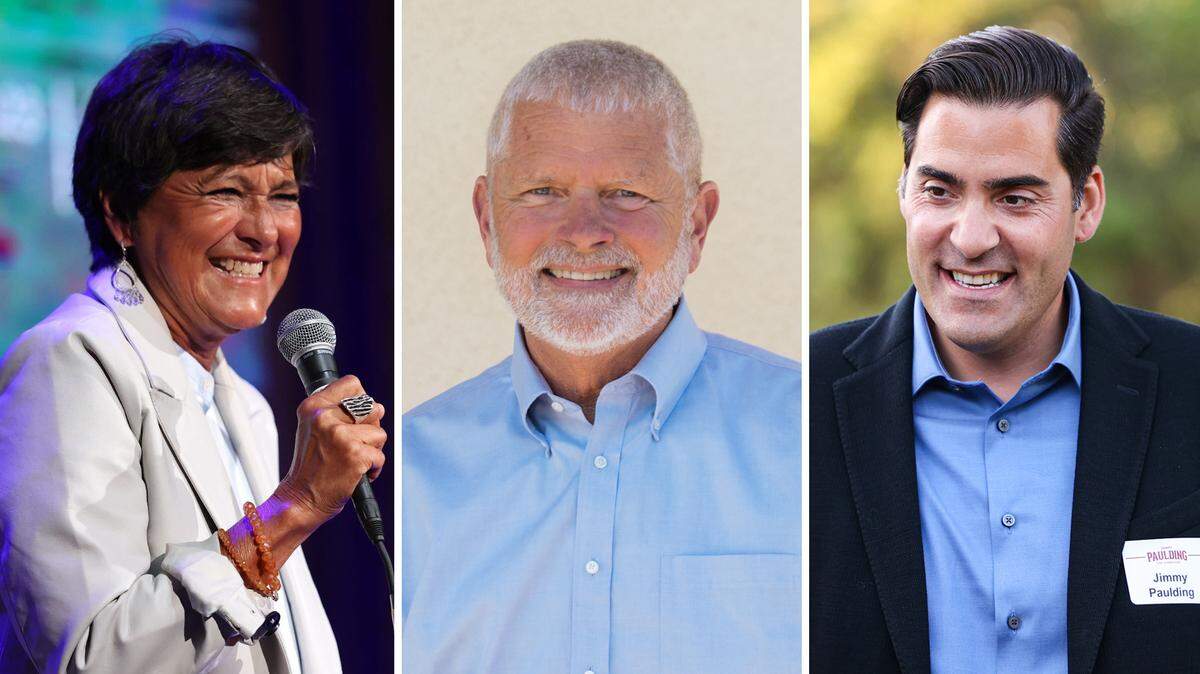
All of the ballots are tallied for San Luis Obispo County’s Board of Supervisors races, and the deciding vote as to which side holds control will indeed have to wait till November.
That’s because the liberal-leaning candidates took two of the three seats up for grabs in June while the third — the newly redrawn District 2 — will advance to the general election in a showdown between incumbent Bruce Gibson and challenger Bruce Jones.
So what should voters take away from the primary results?
Was incumbent Supervisor Lynn Compton’s 639-vote loss to Arroyo Grande Councilman Jimmy Paulding a referendum on the board majority’s performance? Or was it merely a statement about one race?
It depends on who you ask.
Cal Poly political science professor Michael Latner said the results indicate that citizens may be unsatisfied with recent policy passed by the board majority, capped by the contentious redistricting process.
Others disagree, with Supervisor John Peschong pointing to what he believes are more narrow reasons for the flipped seat in District 4.
Jimmy Paulding won District 4. Were voters sending a message?
The biggest headline out of the election — the results of which were finalized by the Clerk-Recorder’s Office on Thursday — was that come January 2023, Paulding will replace Compton, one of the three conservative members who often united to form an unbeatable majority.
Paulding ended up winning with 51.5% of the vote to Compton’s 48.5%.
Latner said that Paulding’s campaign was better organized than Compton’s, but that there also could be more to his victory, which was a turnaround from his slim 60-vote loss four years ago.
Compton was the only member of the sitting board majority up for re-election, and the last year saw her at the heart of multiple controversial decisions, such as pulling out of the Integrated Waste Management Authority and approving a new district map now facing a lawsuit on accusations of gerrymandering, Latner said.
If constituents are unhappy with the board majority’s decisions, they may have chosen to vote Compton out for a change of direction, Latner said.
“If there’s dissatisfaction with the incumbent, the answer is to throw the bastards out,” Latner said. “That’s sort of the American way. She was the only member of the governing majority up for re-election.”
With five members, the Board of Supervisors is run by majority rule, Latner said. The majority will govern the way that it chooses, and it doesn’t need minority members’ support as long as the majority sticks together.
If the public is unsatisfied with the majority’s decisions, its recourse is to vote in new representatives, Latner said.
“Then you get to see a different kind of governance,” Latner said. “The basic idea of democracy is that you let a majority govern and if you don’t like what they’re doing then you replace them.”
District 1 Supervisor John Peschong, however, did not think the June results were so definitive.
He said he didn’t think that District 4 voters wanted to overthrow the board majority, adding that Latner has “a very active imagination.”
“That was a race against two people, not the entire board,” Peschong said.
Peschong said he thinks that Paulding won because he raised more money than Compton. He was then able to spend that money on direct voter contact programs like yard signs, mail pieces, radio and television advertisements, and more, Peschong said.
The District 2 is in a runoff that will decide the new board majority
Out of election night, there was a chance that the three liberal supervisors could pull of a sweep and upend the conservative majority in one fell swoop.
Dawn Ortiz-Legg finished off her race in easy fashion, nearly doubling the turnout for Stacy Korsgaden, but Gibson lost his early lead, falling below the 50%-plus-1 threshold required to win the seat outright.
Gibson ended up winning 47.6% of the vote while Jones followed in second with 19%. Geoff Auslen and John Whitworth were voted out of the race with 17.4% and 16.1% of the vote, respectively.
As the top two vote-getters in District 2, Gibson and Jones will compete for the seat in a runoff in November, and that result will determine the new board majority.
“The consequence of the Second District race is a big deal, and it’s about what kind of government this county is going to have,” Gibson previously told The Tribune.
Latner said the primary revealed that the new District 2, which added Atascadero and San Miguel in place of Morro Bay and Los Osos, is competitive, and he doesn’t expect Jones or Gibson to win the runoff by more than 5 or 6 percentage points in November.
Unlike Compton, Latner said he thinks Gibson benefited from his incumbency in the primary — as he had strong name recognition and could raise more money than Jones.
Latner said he thinks Gibson has the potential to win the runoff, but it will be a close race.
Voter turnout in primary elections tends to be lower and more limited to older voters and “ideologues” committed to their political party, so “primaries are not that representative of the electorate as a whole,” Latner said.
He said Gibson could succeed in a runoff because he appeals to moderate voters who are more likely to show up in the general election.
“I think Gibson stands a good chance of doing better among swing voters and moderate voters who will look at his experience and his voting record, and make decisions based on those issues more than on sheer partisanship,” Latner said.
But that result is far from a sure thing at this moment.
Alternatively, Latner noted, there are more registered Republican voters in District 2 than Democrats, giving Jones an advantage.
“Jones is going to be heavily supported by the Republican Party. They really want this seat, especially given Paulding’s win,” Latner said. “He’s leaning into the partisanship, whereas Gibson was trying to make a broader appeal.”
However the District 2 race shakes out, District 5 Supervisor Debbie Arnold, who has seen her area of representation shift radically with the new map, said she hopes the new board prioritizes reduced government spending.
“It’s important to me that the board in its entirety continues to fight against higher taxes and fees being placed on working families,” Arnold said.
If Bruce Gibson is elected to the District 2 seat, she’s uncertain that the new majority would demonstrate such priorities.
She pointed to the June 22 Air Pollution Control District Board meeting as an example. There, Paulding, Ortiz-Legg and Gibson all voted to increase fees, she said.
“If that’s an indication, then we might change from a board that tries to hold the line on those things to one that would be more amenable to raising fees and taxes on folks,” Arnold said.
Jones previously told the Tribune he will advocate for policy that aligns with his “conservative values,” like reduced fees, taxes and government spending, along with support for police and businesses.
If re-elected, Gibson said he will be committed to finding solutions to SLO County’s main issues, such as homelessness, affordable housing, broadband internet connection and water security.