SLO County supervisors officially adopt contentious redistricting map
The San Luis Obispo County Board of Supervisors on Tuesday officially adopted a Republican-leaning redistricting map that will significantly change longstanding representation boundaries.
The board voted 3-2 to adopt a five-district map drawn by Arroyo Grande resident Richard Patten and backed by the local Republican Party. It’s also known by its technical title, “Map 74786.”
Supervisors Bruce Gibson and Dawn Ortiz-Legg cast the two dissenting votes.
The map adoption is the final step in the redistricting process. Following the meeting, SLO County Citizens for Good Government, a local group of residents who oppose Patten’s map, announced its intent to file a lawsuit to overturn the map.
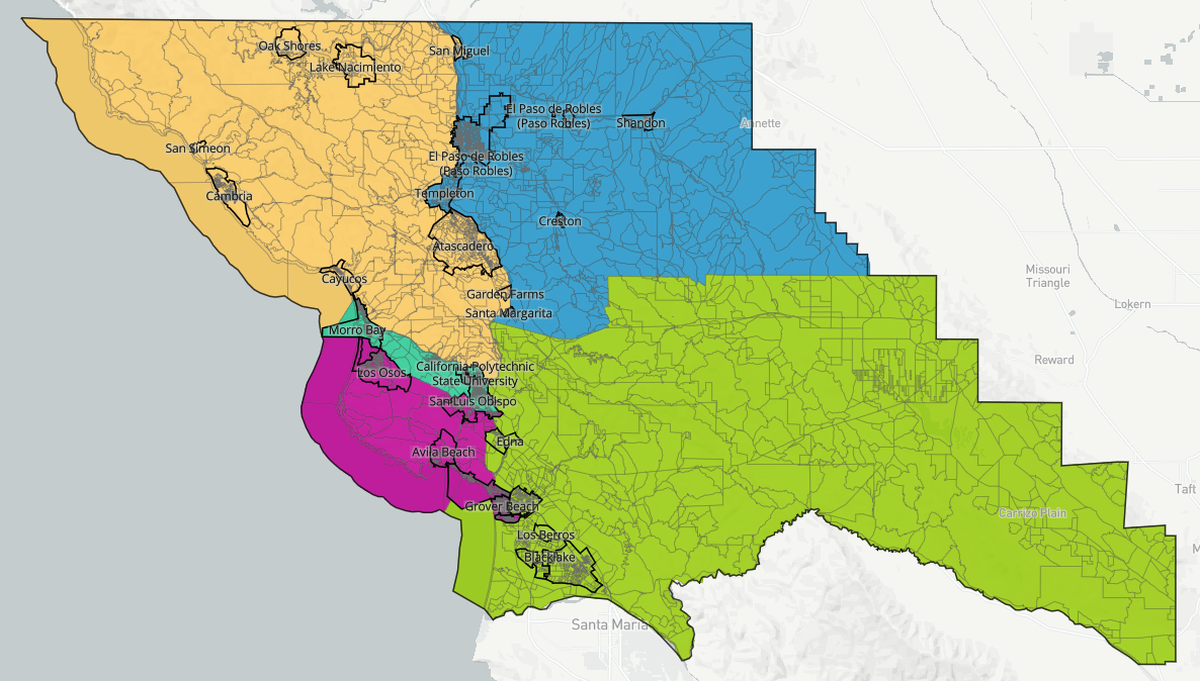
View a zoom-able version of Richard Patten’s map here. Click ‘data layers’ and select ‘municipalities’ to view city boundaries.
Patten map supporters, opponents speak at final hearing
The vote came after a few hours of comments, both from supporters of Patten’s map and those who say it’s a blatant example of gerrymandering.
Those in favor of the map continued to insist it adheres to California’s Fair Maps act and rights the wrongs they think supervisors committed during the county’s last redistricting effort in 2011.
“By (adopting Patten’s map), you eliminate legacy gerrymandering from our county,” Tom Dawson said.
Some supporters said they like that it puts Atascadero in a different district than San Luis Obispo, as they don’t feel connected to a college town. Others said they like that Patten’s map splits Oceano from Nipomo, because the coastal community belongs in a district with Grover Beach.
.jpg "Image from iOS (8).jpg")
Residents against Patten’s map were upset that it breaks the North Coast into three districts and moves Oceano out of District 3.
This means residents in Los Osos, Morro Bay and Oceano — previously voters in Districts 2 and 4, which are up for election in 2022 — now won’t get to vote for in a supervisor election until 2024.
“Silencing voices, packing districts and taking away votes is oppression,” Dona Hare Price said.
One Los Osos resident described the situation as “not (having) a vote.”
Eric Greening asked supervisors to explain the overriding benefits of changing the district map so drastically.
“What justifies the unnecessary harms to those communities?” he asked.
Supervisors hold their positions on Patten map
Gibson and Ortiz-Legg continued to decry Patten’s map, as they have throughout the entire redistricting process. But Supervisors John Peschong, Debbie Arnold and Lynn Compton continued to say the map is the most beneficial for the county.
At the beginning of the hearing, Peschong asked Paul Mitchell of Redistricting Partners, the county’s redistricting consultant, whether Patten’s map complies with state redistricting laws.
Mitchell said the map did meet all the criteria he could address. However, there are some elements of the laws that are subjective, and only supervisors can decide which direction to take, he said.
That response was affirmation enough for Peschong.
“As you know, I did ask our consultant if the map that we’re talking about, 74786, meets the requirements set forth in the election code ...” Peschong said before the vote. “And there’s five things that he went over that I used as, as my map to be able to figure out whether this map met the legal requirements and what the state wanted us to do. I believe it does. I believe that we have a fair and equitable and legal map that we’re going to push forward today.”
Ortiz-Legg said she’s in favor of following state redistricting rules, but “there’s a lot of interpretation of those rules.”
She said Patten’s map “has bludgeoned neighborhoods that have been together for 100 years,” referring to the North Coast, the Santa Margarita area and Atascadero and Carrizo Plain National Monument.
Ortiz-Legg also brought up Los Osos, Oceano and Morro Bay, where residents’ representation situation is unclear, and they will not be able to vote for supervisors until 2024.
“What kind of public leaders just leave communities in the lurch?” she asked. “I’d have to venture to say that this has nothing to do with what’s best for our communities. And there’s something very significant behind this. I could speculate, but right now, all I know is it just feels very wrong.”
Ortiz-Legg also read into the record a letter from the Latino Caucus of California Counties — of which she is a member — to state Attorney General Rob Bonta. The letter asks his office to intervene in San Luis Obispo, Merced and Butte counties’ redistricting processes.
Gibson said it’s obvious the board majority continually rejected efforts to obtain data that would show the political impacts of Patten’s map because it advantages Republicans. He cited a partisan impact study commissioned by Citizens for Preserving District #4, as well as an analysis by The Tribune.
“The intent to favor the Republican Party is not hard to infer,” Gibson said. “First of all, the Patten map that’s before us is a radical redrawing of districts that do not need to be redrawn. ... Second of all, the map was put forward by Richard Patten, who’s a Republican. The Patten map was promoted by the local Republican Party in a coordinated effort.”
He also observed the board majority has rallied around Patten’s map, even dating back to an early redistricting hearing on Oct. 26.
“So the various opinions on whether this map is compliant seem destined for further argument, and that’s just simply understood from what we’ve heard,” Gibson said, potentially alluding to the possibility of a lawsuit. “I think that’s necessary. There are a variety of factors that need to be considered, and it goes back to, at its heart, priorities listed in (election code).”
Compton spoke in favor of the map, saying she simply thinks it’s the superior plan.
“I find it interesting that if you’re on the opposite side of any argument nowadays, that’s what people say — it’s, ‘you’re evil, whatever,’” Compton said. “I mean, we’ve been called every name in the book. Maybe it’s possible we think this is the best map. ... Actually, if you just look at the maps, it’s the best looking map that’s broken up very evenly than all the other ones. There’s not pockets going down and dipping into other areas.”
How will Patten’s map impact SLO County?
A Tribune analysis of public voter registration data shows Patten’s map will increase the electoral advantage Republicans already have with the existing map — even though Democrats outnumbered them by 6,000 voters in 2021.
Patten’s map packs Democratic voters into two coastal districts, diluting the voices of those living in other areas.
It does this by turning District 3 into a narrow, dog bone-shaped area that includes Morro Bay, a large chunk of San Luis Obispo and a handful of unincorporated residents who live along the Highway 1 corridor between the two cities.
Patten’s map also shifts District 5 to the coast, with Los Osos as the northernmost community. That district picks up Oceano as its southernmost community, separating it from District 4.
District 2 includes North Coast areas from Cayucos to San Simeon, but it becomes more conservative as it shifts inland to pick up Atascadero and San Miguel.
District 4 — now without the Democratic community of Oceano — picks up Republican voters in the Edna Valley and San Luis Obispo Country Club areas, which were previously part of District 3. District 1, already a Republican stronghold, remains largely the same.
This story was originally published December 14, 2021 at 4:05 PM.