SLO County to adopt new map that increases Republican advantage, Tribune analysis shows
The San Luis Obispo County redistricting map supervisors are poised to adopt on Tuesday will increase Republicans’ advantage at the ballot box, further solidifying the conservative majority’s control of the board, a Tribune data analysis shows.
After the conservative majority failed to do a party analysis of its own, The Tribune looked at voter registration data and found that the new five-district map — drawn by Arroyo Grande resident Richard Patten and backed by the local Republican Party — stuffs more Democrats into a couple of districts and bolsters Republican support in a couple of others.
The end result: Three districts that favor Republican candidates and two that favor Democrats — in a county where Democrats outnumbered Republicans by 6,000 voters in 2021, up from 4,500 voters in 2020.
The purple county’s Democratic leanings are borne out by the results of the last two major elections. President Joe Biden won the county in November 2020 with 55% of the vote, according to the final results from the Clerk-Recorder’s Office. In October, about 53% of residents also voted against recalling Gov. Gavin Newsom.
Yet, conservatives hold a majority on the Board of Supervisors, thanks to the way local districts are drawn.
The Tribune’s political analysis uses 2020 voter registration data from California’s redistricting database. It matches voter registration precincts to both the old and new supervisor district boundaries and compares the differences between the two maps.
The analysis comes with an important caveat. While most registration precincts fall entirely within a supervisorial district, a few precincts overlap districts. In those cases, The Tribune used the center point of each precinct to place all of its voters in a particular district.
“It’s a really pivotal point, I think, in the county’s political history,” Michael Latner, a Cal Poly political science professor, said of the redrawn map. “... I’ve talked to people that have lived here for 30, 40, 50 years, and no one that I know has ever seen this sort of just a nakedly partisan attempt to seize power. And the voters of San Luis Obispo should be concerned about this, whether they’re Republicans or Democrats.”
View a zoom-able version of Richard Patten’s map here. Click ‘data layers’ and select ‘municipalities’ to view city boundaries.
Patten map remakes Districts 2, 3 and 4 to pack Democrats, advantage Republicans
The biggest shift between the current map and Patten’s version — technically known as “Map 74786” — occurs in Districts 2 and 3.
The dramatic redrawing of District 2, which puts chunks of the North Coast region into three separate districts, shifts it from a safe Democratic seat to one that now leans Republican.
Under the old boundaries, Democrats make up about 46% of registered voters in District 2, while Republicans make up 26%. Under the new boundaries, Democrats make up 34% of voters and Republicans make up 39%.
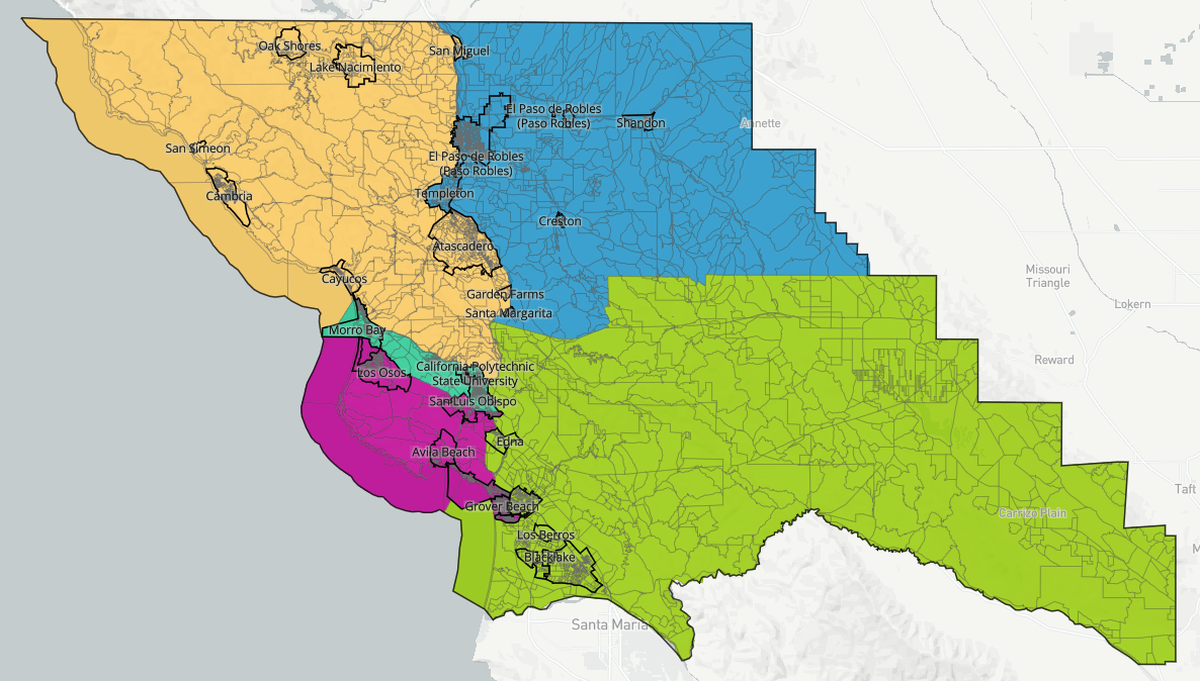
Patten’s map achieves this by shifting Morro Bay and Los Osos — Democratic-leaning North Coast communities that have long been part of District 2 — into Districts 3 and 5. It also moves the District 2 boundaries inland to pick up more conservative North County cities and communities, including Atascadero, San Miguel and residential areas around Lake Nacimiento.
Many Democrats who spent the last decade voting in District 2 will now find themselves in District 3 — along with a lot of other Democrats.
Under Patten’s map, that district becomes a dog bone-shaped area that includes only Morro Bay, a large chunk of San Luis Obispo and few unincorporated residents along the Highway 1 corridor between the two cities.
District 3 previously encompassed a portion of San Luis Obispo, along with Edna Valley, Avila Beach, Pismo Beach and Grover Beach. Under those boundaries, Democrats made up 42% of voters in District 3, while Republicans made up 29%. Under the new boundaries, Democrats make up 49% of voters and Republicans make up 21% of voters.
At the same time, District 4 — which board Chair Lynn Compton narrowly won in 2018 — leans more Republican under the new boundaries. Under the old boundaries, 35% of voters in the district were Democrats, and 38% were Republicans. Under the new boundaries, 33% of voters in the district are Democrats, while 40% are Republicans.
Patten’s map accomplishes this by removing Democratic-leaning Oceano from District 4 and putting it in a newly formed District 5. That area is now a coastal district that includes Los Osos, a portion of San Luis Obispo, Avila Beach, Pismo Beach, Grover Beach and Oceano.
District 4 also gains conservative voters by picking up Edna Valley and the San Luis Obispo Country Club area, which were previously part of District 3.
Both districts set for 2022 elections now lean Republican
As it happens, District 4 and District 2 are the two areas up for election in 2022.
Putting more Republicans in those districts greatly increases the chances that Republicans will maintain control of the Board of Supervisors through 2026, since Republican District 1 Supervisor John Peschong won re-election in 2020, as did Republican District 5 Supervisor Debbie Arnold.
Looking forward, District 2 Supervisor Bruce Gibson — a Democrat who’s represented the North Coast since 2006 — now must run in a district that Patten’s map completely remade to put him at a decided disadvantage.
On the other hand, District 4 Supervisor Compton — a Republican who’s represented the South County since 2015 — will run in a district Patten’s map set up to give her a partisan boost.
Compton won re-election by just 60 votes in an extremely tight 2018 race against current Arroyo Grande Councilman Jimmy Paulding.
As that outcome shows, even a small number of new Republican voters could decide the results of the 2022 race, which is setting up to be a rematch between Compton and Paulding.
What about Districts 1 and 5?
The Tribune’s analysis shows the partisan makeup of District 1 in the North County doesn’t change much — it still remains solidly Republican even after losing San Miguel and the Lake Nacimiento area to District 2.
About 29% of voters in both the old and new maps are Democrats, while about 44% are Republicans.
Conversely, District 5 has undergone a complete geographic makeover. The old District 5 included a large chunk of the North County, including Atascadero, Santa Margarita, Creston and Pozo.
Patten’s map has turned the former Republican-leaning inland district into a mid-coastal one, and the shift has made it solidly Democratic.
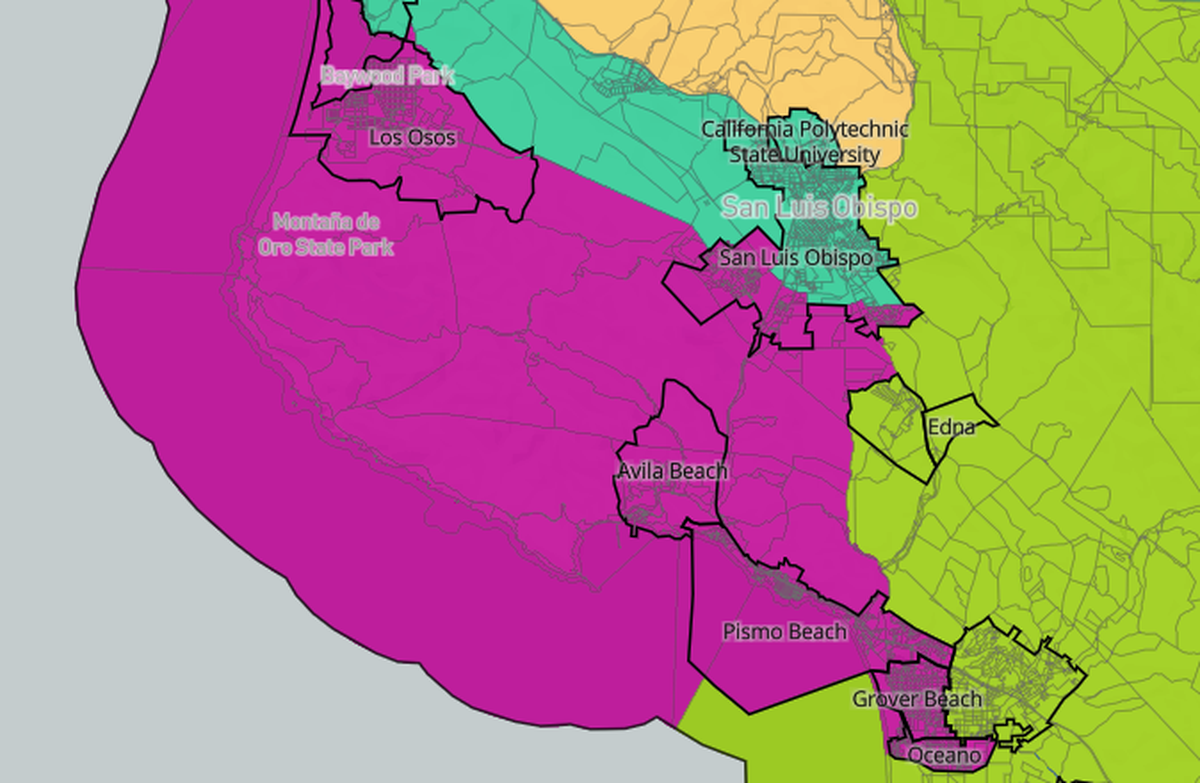
Under the old boundaries, 35% of voters in the district were Democrats, and 37% were Republicans. Under the new boundaries, 43% of voters in the district are Democrats, while 28% are Republicans.
District 5 clearly plays a role in packing most of the coastal Democratic voters into two districts. Although there are still large numbers of Democratic voters in District 2, their votes would be heavily diluted with the addition of inland communities.
Why hasn’t the county done its own partisan analysis of the map?
The Board of Supervisors’ conservative majority has repeatedly voted down requests from District 3 Supervisor Dawn Ortiz-Legg and Gibson to have Redistricting Partners, the county’s redistricting consultant, analyze the Patten map’s political impacts.
At the Nov. 30 redistricting hearing, Compton and Gibson got into a bitter argument over his insistence on presenting an analysis of the maps’ party breakdown commissioned by Citizens for Preserving District #4, a group devoted to keeping Oceano and Nipomo in the same district, among other goals.
Gibson eventually refused to vote until he could read the results of the analysis into the record.
County counsel Rita Neal told The Tribune that supervisors are allowed to possess partisan information about the redistricting maps.
“The existence of the partisan information and its inclusion in the record is not prohibited,” Neal said in an email. “However, the Election Code (section 21500(d)) prohibits the board from adopting supervisorial district boundaries for the purpose of favoring or discriminating against a political party. Thus, adoption of district boundaries cannot be based on political affiliation.”
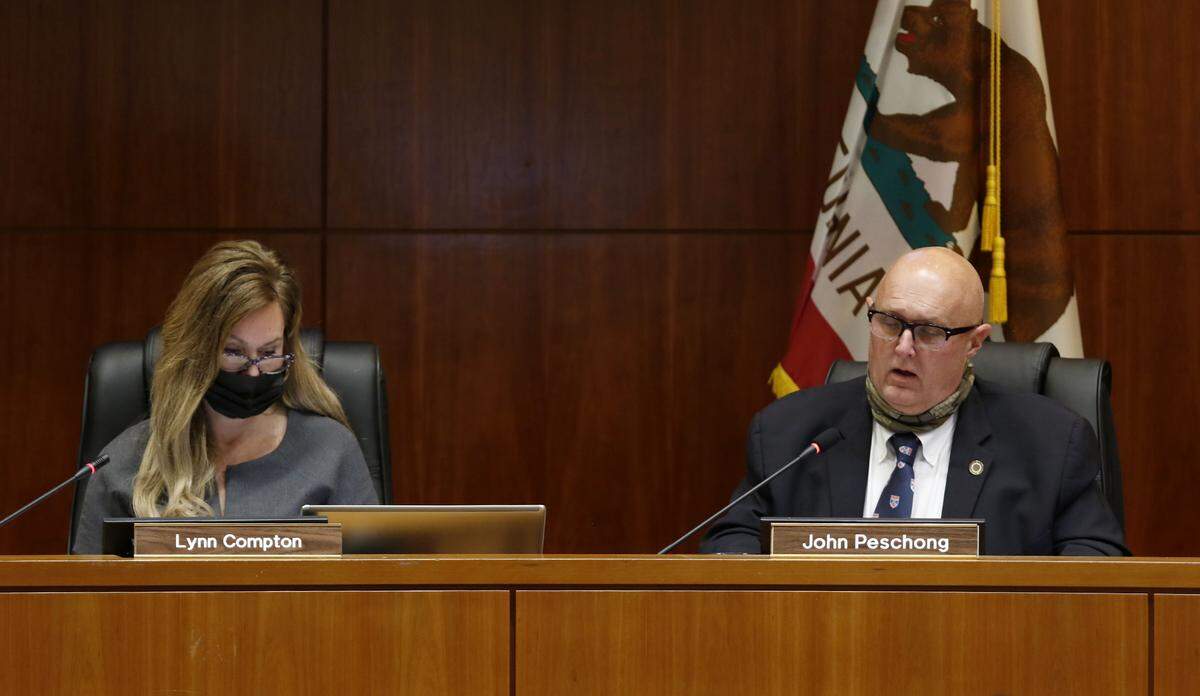
However, Peschong continues to falsely claim that California’s Fair Maps Act — also known as Assembly Bill 849 or AB 849 — makes it illegal for the board to consider partisan data when drawing new districts.
When asked about The Tribune’s data analysis, he maintained the same stance he’s expressed during board meetings.
“My interpretation of AB 849 is that I’m not allowed to use political data supporting any map,” he said. “And so I’m not.”
There is no language in the law that prohibits simply obtaining or reviewing political analyses for the purpose of drawing a nonpartisan map.
Section 2500 (d) of the law says: “The board shall not adopt supervisorial district boundaries for the purpose of favoring or discriminating against a political party.” In addition, Section 2500 (c)(2) says: “Communities of interest do not include relationships with political parties, incumbents, or political candidates.”
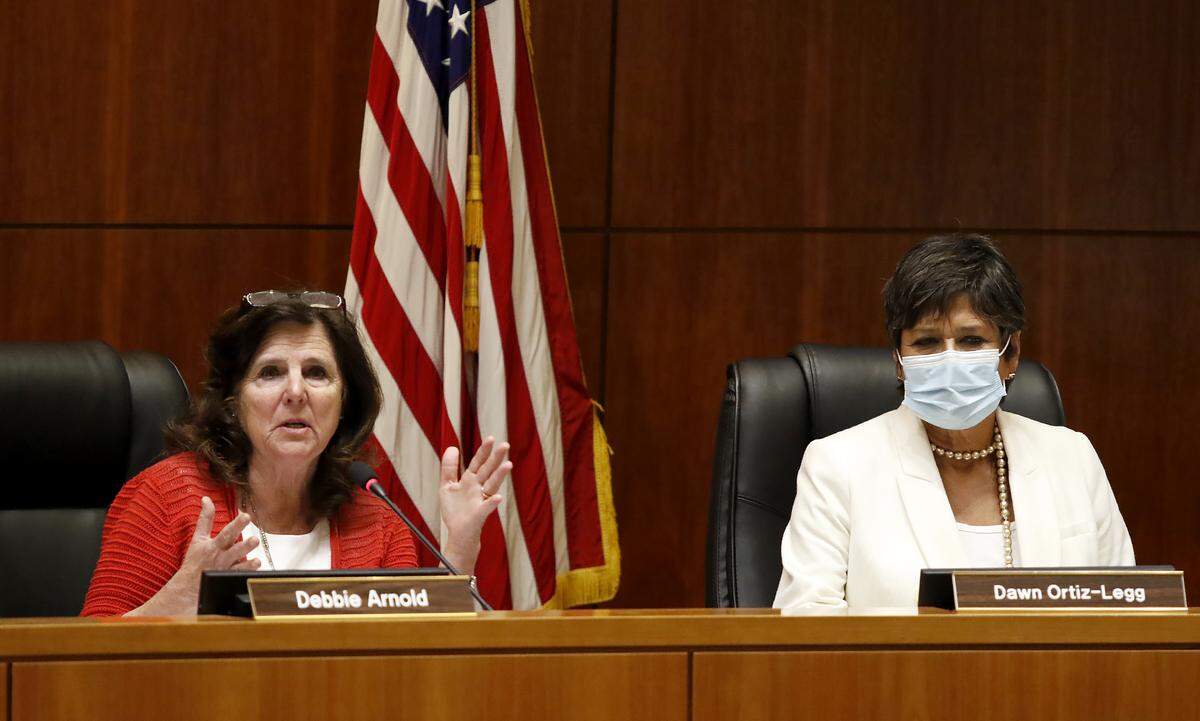
Still, Arnold also shares Peschong’s viewpoint, as she told The Tribune when asked about the data analysis.
“I feel like what they’re telling us is that you’re not supposed to use that kind of information to draw the lines,” Arnold said. “And so I’m looking at that as I’m not using that information to draw the lines. I’m going to the top priorities, which are communities of interest, cities, and population equality. And that’s what I’m doing.”
“And by studying that kind of data, how can you not be taking it into consideration?” Arnold added. “So my protection against that is I am not engaging in that.”
Compton did not respond to The Tribune’s repeated requests for comment.
Election expert, liberal supervisors push for partisan analysis
Latner, the Cal Poly political science professor, disagrees with the board majority’s argument that it can’t consider partisan data when selecting a redistricting map.
“Yeah, it’s complete bullshit,” Latner said. “They’re saying that so as to imply that they haven’t actually looked at the data, which implies innocence and lack of intent to discriminate.”
“Now, in addition to it being bullshit, the idea that John Peschong, who owns a political consulting firm, doesn’t access and look at political data is sort of ridiculous on its face,” Latner added. “... The law is there for us all to read. And indeed, the criteria requires that a districting plan not discriminate or advantage a political party, and there is no way to determine that without the political data.”
Gibson also told The Tribune he believes Compton and Arnold — who’ve both run for office multiple times — have very solid understandings of the political makeup of the county based on their previous campaigns.
“Compton and Arnold know exactly where Republicans live, because communities in each of their current districts have voted overwhelmingly against them,” Gibson said. “That’s San Luis Obispo, in the case of Debbie, and Oceano, in the case of Lynn. And it’s been well understood that those are Democrat-heavy areas.”
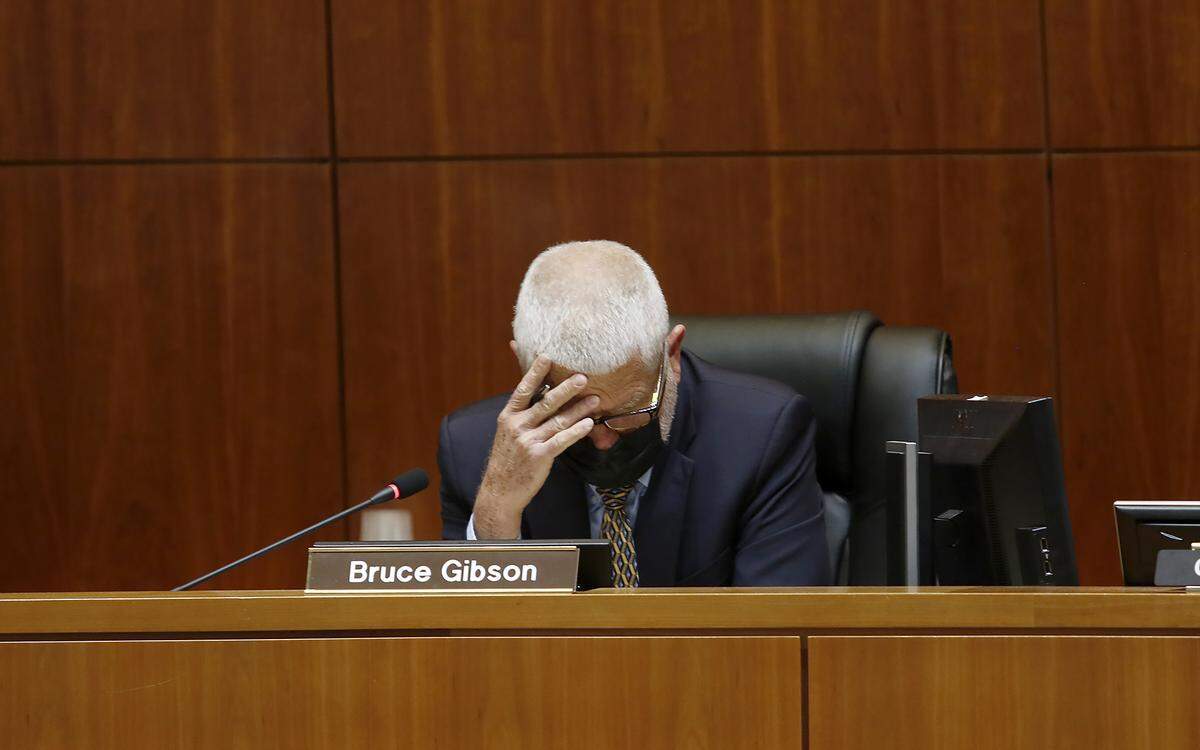
“And so they are explicitly ditching Democrats to pick up Republicans because they don’t compete well in those districts,” Gibson added. “So whether or not they looked at the data, trying to be blind to the data that’s in that memo, they know exactly what they’re doing when they choose to adopt the map that’s in front of them.”
Ortiz-Legg told The Tribune she’s pushed to see a political analysis because “it just helps us to set the record in regards to what we have here.”
“Until we see the data, we don’t know — maybe it favors Democrats,” Ortiz-Legg said of the map. “It helps take one piece of the conversation off the table. You know, I don’t want to make it a political conversation. I want to make it about a representation conversation. To me, that’s the most important part. Are people going to be equally represented in our county and have an equal chance to have that voice that they need at the county level?”
She said she wants to see a map in which all five districts have a blend of voters with different politics, since the county has always been a mix of Republicans and Democrats.
“I do think it’s important for us to have districts that are balanced, because our county has always been somewhat of a balanced county,” Ortiz-Legg said. “You know, we’ve had competitive races in the last years. And I think that’s because we’ve always been known as purple. And in my opinion, that’s what the districts should represent — a purple.”
This story was originally published December 12, 2021 at 5:00 AM.