3 candidates are running for SLO County clerk-recorder. Here’s how they’d handle elections
With the primary election just days away, voters are gearing up to cast their ballots for a variety of offices, including San Luis Obispo County clerk-recorder.
The clerk-recorder manages three divisions of the county: the clerk’s office, the recorder’s office and the election office, according to current county clerk-recorder Elaina Cano.
The clerk’s office handles public documents such as birth certificates, marriage licenses and death certificates.
“We’re with people from womb to tomb,” Cano said.
The recorder’s office handles other public records, including documents related to buying a home, she said.
The election office is responsible for managing the county’s elections, from mailing ballots to voters and setting up precincts to counting ballots.
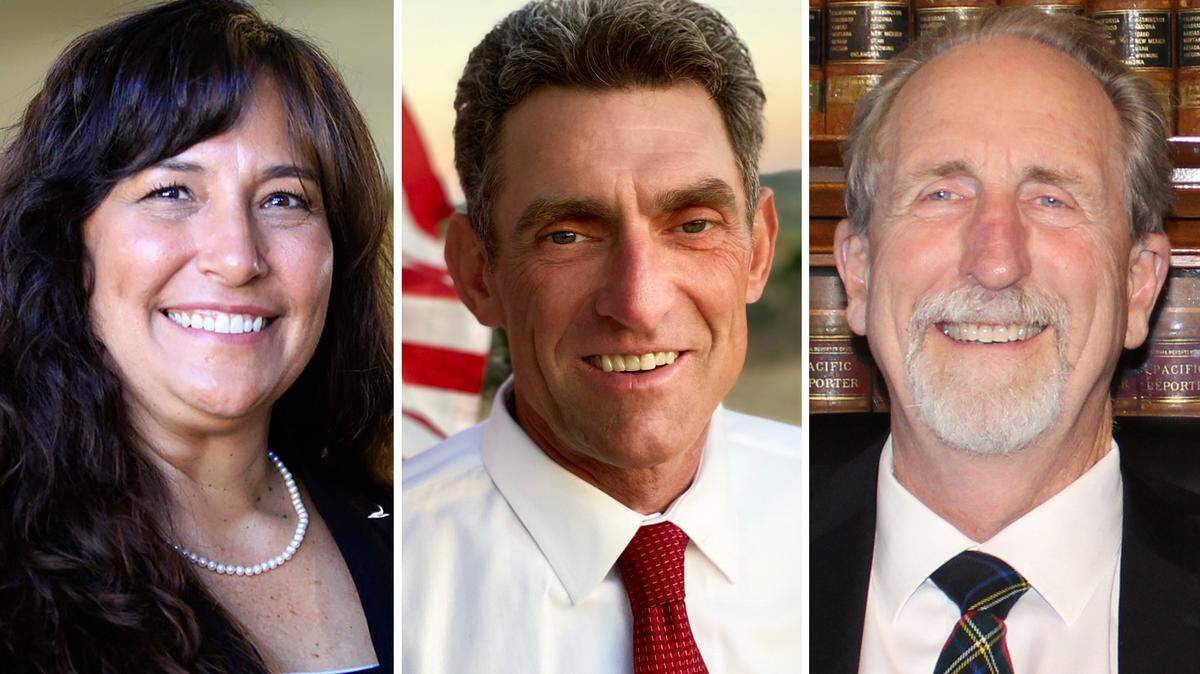
Cano is competing against two other candidates for the San Luis Obispo County clerk-recorder position: U.S. Army veteran James Baugh and lawyer Stew Jenkins. Here’s how they plan to run the office if elected on Tuesday.
Who is running for SLO County clerk-recorder?
James Baugh served in the Army for 23 years. By the end of his military career, he said, he had been responsible for 391 soldiers, 28 jobs and millions of dollars of equipment — giving him the leadership experience necessary for clerk-recorder.
As a soldier in 2005, Baugh helped run Iraq’s constitutional election. There, the Army set up polling stations and security checkpoints; managed traffic and made sure that people only voted once.
American service members also worked to help different groups trust the results of the election, he said.
Baugh also managed the county polling station during the 2021 recall election, he said.
If elected, Baugh said he will conduct fair, transparent elections in the county and address voter fraud concerns. Baugh also wants to open a satellite clerk-recorder’s office in Atascadero to support North County residents.
Elaina Cano served as the city clerk for San Luis Obispo and Pismo Beach, and worked as the elections division manager for Santa Barbara County. She was appointed to the county clerk-recorder post by the San Luis Obispo County Board of Supervisors in October, after Tommy Gong resigned for a job in the Bay Area.
Cano said she loves working in local government so she can serve her community.
“I’m a public servant in and out,” Cano said. “What I do — it’s for my friends that I know, people I run into at the grocery store. It’s for a community.”
Cano noted that work done at the clerk-recorder’s office is personal, and she appreciates overhearing her staff celebrate with a new mom when she picks up her child’s birth certificate, or mourn with a widow when she picks up her spouse’s death certificate.
She said she wants to bring positivity to her office and the community, especially when it comes to elections.
“If not me, then who? Who’s going to bring that sparkle of change and a reality check that we’re still in this together?” Cano asked. “I’m on everybody’s team.”
Stew Jenkins is an election law lawyer in San Luis Obispo County. He represented county Supervisor Lynn Compton when she sued former county Clerk-Recorder Tommy Gong.
When people vote by mail, they have to sign the outside of their ballot. There are two kinds of errors that occur: there’s no signature on the envelope, or the signature on the envelope doesn’t match the voter’s records at the clerk’s office.
The law requires the clerk to send written notice to voters if their ballots didn’t have signatures, but not to voters with mismatched signatures, Jenkins said.
Gong decided to give written notice to voters with either of the errors — giving voters with no signature eight days to cure their ballot, and voters with mismatched signatures 29 days to cure their ballot. Compton sued to require the clerk-recorder to give the same amount of time to both sets of voters.
“The registrar of voters made a serious constitutional error by violating equal protection rights,” Jenkins said.
The court threw out the case, but Jenkins said it “shined the light on this problem,” and California changed its laws to require the same amount of time to cure both signature errors by the next election.
Jenkins has also volunteered at polling places and gone door-to-door to register voters in the county. He said he wants to ensure fair elections, and restore the public’s trust in elections.
How would candidates increase trust in elections?
To increase the public trust in elections, Baugh said he will invite people to observe the ballot-counting process, and answer their questions on how the process works.
He also wants to create a volunteer task force of retired teachers to educate high school students about how to vote.
“Just get out and educate people on how the process works,” he said.
Baugh also would change the county’s ballot-counting process, he said.
In San Luis Obispo County, ballots are counted by machine, and then workers manually count some of the ballots to check the machine’s accuracy.
During the 2021 recall election, the clerk-recorder’s office only manually counted 1% of all the ballots cast at the 93 precincts, Baugh said.
Baugh, however, thinks the county should do a 1% manual tally for every precinct.
He also said he wants to update the voter rolls — making sure everyone’s addresses are up to date and folks who have died are removed from the voter list.
Baugh said he has concerns about election integrity. He told talk radio host Dave Congalton that he didn’t think Joe Biden won the 2020 presidential election.
Even though concerns about voter fraud make the news frequently, Cano said most people trust the election process.
“I’ve spoken to thousands of people, and they trust — they know our systems aren’t fraudulent,” she said. “It’s a very small minority of people that have a lack of trust. A small, but very vocal minority.”
Still, reaching out to those groups to address their concerns is crucial, Cano said, and she’s happy to answer people’s questions and allow them to watch the ballot-counting process.
Cano was Santa Barbara’s elections division manager during California’s 2021 recall election.
On election night, she said a group of 12 people demanded to enter her office and watch the ballot-counting process. She had recently watched television coverage of insurrectionists attacking the U.S. Capitol that January, which made the scene more frightening.
“To look outside my elections office and see this group coming towards me, chanting and yelling, certainly I was frightened,” Cano said.
With the assistance of three Santa Barbara County Sheriff’s Office deputies, Cano calmed the crowd, and 45 minutes later they all entered the office.
For about four hours, community members watched Cano count ballots while she answered their questions. At the end of the night, all but one person shook her hand and thanked her profusely, she said. One even wrote her a letter of appreciation.
She said it was important to be patient, honest and answer their questions in good faith.
“That’s what people want: Time to be heard,” Cano said.
Because Cano is running for election this year, she’ll abstain from any ballot handling — from counting ballots and adjudicating them to sending reports on the ballot count to the secretary of state, she said.
Jenkins said he would recruit folks from both political parties to participate in election process, including inviting them to observe the ballot-count.
He said he would also re-establish the Deputy Voter Registration Program, and send those folks to high schools and door-to-door in the community to register people to vote.
He said the clerk-recorder has “the only significant responsibility to investigate potential voter fraud,” and he would listen to folks when they raise concerns about voter fraud.
Jenkins said he takes voter fraud seriously. In the 1980s, he said, he helped assemble evidence that convicted a man who committed voter fraud to win office.
Where does politics belong in voting process?
Baugh is endorsed by the Republican Party, but said he will not let his political beliefs impact his work as county clerk-recorder.
He noted that he served in the military under both Republican and Democratic presidents, and executed their policy regardless of their political party.
Cano said there’s no room for partisanship in the clerk-recorder’s office. She said the clerk takes an oath to serve all county residents, regardless of their political party.
Cano used to be a registered Democrat, but switched to voting as an Independent.
“It is important to remain non-biased and non-political in this role,” she said.
Jenkins said he would be non-partisan in the office.
“I think non-partisanship means to recruit and bring in all sides of the political discussion to actually participate in the conduct of the election,” he said. Which looks like working hard to recruit both Democrats and Republicans to vote in an election.
“All of these folks, whatever their partisan bent is, are important citizens for helping to conduct our elections,” Jenkins said. “The elections belong to the people, including the folks who are partisans, including the independents.”
Though the clerk-recorder position is non-partisan, it’s still political, Jenkins said.
“For instance, protecting voter rights is a political act,” he said.
This story was originally published June 5, 2022 at 9:45 AM.