
SLO County supervisor candidates have raised nearly $1.8 million. Where’s it all going?
What does it cost to run a political campaign in San Luis Obispo County?
Mountains of cash, judging by the contributions reported by candidates for county supervisor.
Collectively, eight candidates in three races have reported receiving nearly $1.8 million in contributions and loans over the past several months.
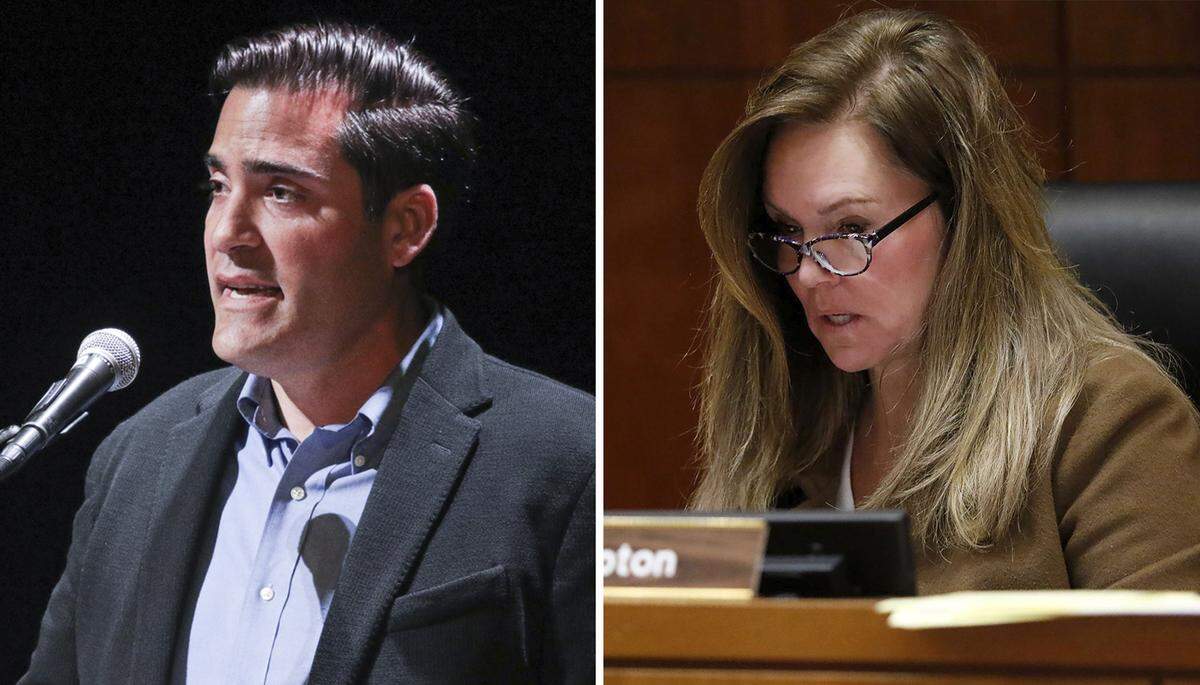
The District 4 race between Lynn Compton and Jimmy Paulding has attracted the most money — just over $820,000. Paulding has raised $500,000 to Compton’s $320,000, according to financial statements filed in 2021 and 2022.
In the District 3 election, Dawn Ortiz-Legg has pulled in approximately $288,000, and Stacy Korsgaden has raised $192,000. (A third candidate in the race, Arnold Ruiz, did not file any financial statements.)
Bruce Gibson is out in front in District 2, with $217,000; followed by Geoff Auslen with $116,000; Dr. Bruce Jones, $95,116; and John Whitworth, $34,000.
Keep in mind, this is the primary. If one or more of the races goes to a runoff, the grand total will easily exceed $2 million.
Where’s the money going?
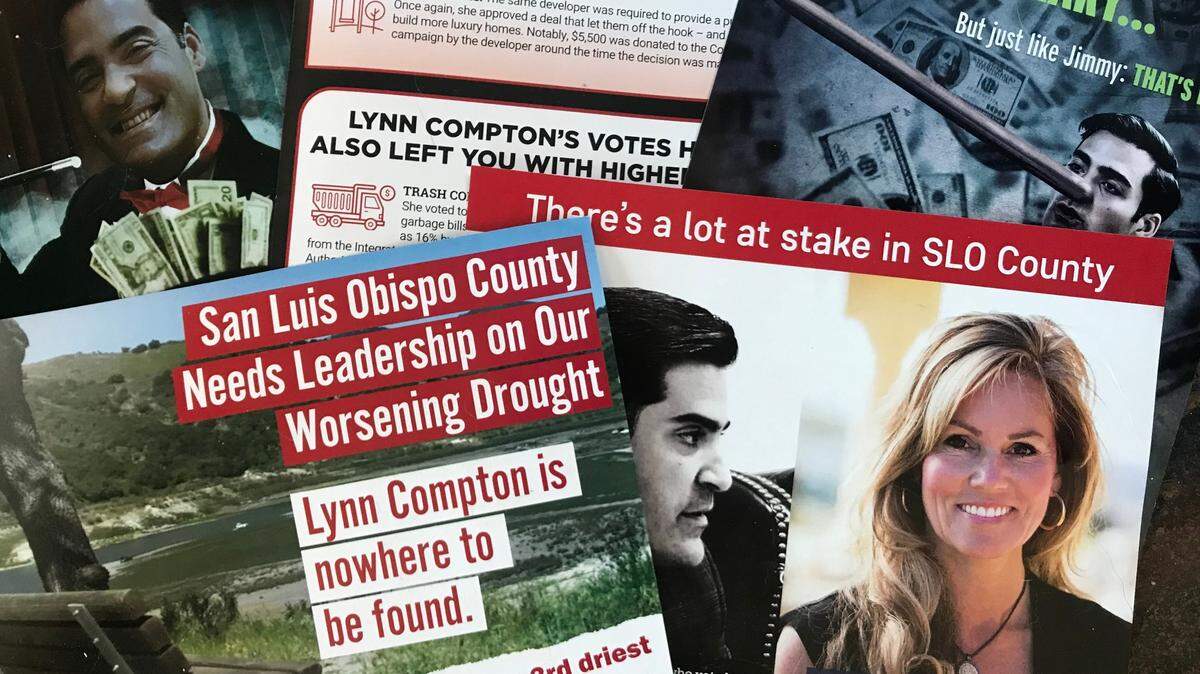
Local candidates are buying TV and radio ads, advertising in print and online media, bombarding voters with mailers and in some cases, hiring expensive consulting firms.
Compton and Korsgaden have paid tens of thousands of dollars to Axiom Strategies, the Kansas City-based political consulting firm that represents Republican candidates — one of its claims to fame is developing Sen. Ted Cruz’s “tough as Texas” campaign.
Candidates also are paying for surveys and social media advisers and photographers and event coordinators.
Unfortunately for the voting public, not all the money has been wisely spent.
For instance, sending out three or four fliers a week with the same, oftentimes deceitful messaging isn’t effective. It’s annoying.
Photoshopping opponents to make them look like pirates or shady magicians isn’t clever. It’s immature — the equivalent of drawing a mustache on your fourth-grade teacher’s class photo.
And those banners as big as mini-billboards? Give us a break. We aren’t going to vote for a candidate based on the size of their signs.
Contribution limits
The Board of Supervisors had a chance to rein in campaign contributions in the fall of 2020, when counties were given the choice of setting their own limit for contributions to candidates for county office or defaulting to the state limit then set at $4,700.
The board majority wound up capping donations at $25,000 — ignoring more than 700 speakers who objected, calling that amount “abominable,” “absurd,” “insane,” “ridiculous” and “obscene.”
Many predicted that a $25,000 spending limit would lead to a huge infusion of cash from special interests.
So far, that hasn’t been the case.
In this campaign, no candidate for supervisor reported a contribution anywhere near $25,000, though several contributions of $5,000 and more were listed.
The local Democratic Party, for example, contributed $11,600 to each of the three Democratic candidates this year and $2,500 last year.
The Lincoln Club of San Luis Obispo County, a conservative political organization, contributed $7,000 to Compton, and the Santa Ynez Band of Mission Indians gave $10,750 to her campaign.
Candidates also reported receiving some large donations from a handful of private individuals, some of whom are identified as “retired” or “homemaker.”
Special interests like labor unions and developers have, for the most part, kept their contributions to candidates under $5,000, though collectively their donations add up to much more.
That’s led to the usual campaign accusations that this or that candidate is “in the pocket” of their big donors — especially in the Compton/Paulding contest. Compton is accusing Paulding of being a tool of labor unions, while Paulding is calling out Compton for taking money from developers.
It’s a catch-22 for candidates; they need money to win, but if they take too much from certain interest groups, they risk being tainted.
Whether it’s justified or not, voters often assume a candidate is beholden to large donors, and will vote accordingly. Welcoming mega-donations only adds to that perception.
While it’s no panacea, limiting campaign donations is a reasonable and easily achievable reform.
It could alleviate the fear that special interests can “buy” elections.
It could help level the playing field for candidates.
And it just might elevate electioneering by forcing candidates to spend their dollars more wisely, rather than pouring it into big-money ad campaigns that spread half-truths and out-and-out lies.
What’s the best way to achieve that?
Demand that candidates support campaign spending limits in order to earn your vote.
This story was originally published June 5, 2022 at 6:00 AM.