SLO County to cut over $38 million — and nearly 170 jobs — to avoid budget crisis
AI-generated summary reviewed by our newsroom.
- SLO County proposes $38.3M cuts and 168 job reductions to balance 2025 budget.
- Health services face deepest cuts, losing $9.1M and over 100 roles across programs.
- Public input begins June 9; county must pass balanced budget by June 30 deadline.
San Luis Obispo County is struggling to balance its budget before it faces unprecedented deficits in years to come.
To course correct the budget, the county has proposed to cut 168 jobs — many of which are already vacant — and over $38 million from its general fund obligations this year. This would close a gap more than double last year’s $15.6 million deficit.
Without course correction, the county could face a potential deficit of $67 million by 2029.
The total proposed budget for fiscal year 2025-26 tops $1.1 billion.
This is a 9% increase from last year’s budget, but budget cuts are also larger. Even though revenues grew, expenses grew more, and though many county departments’ overall budgets increased, the general fund support allocations shifted such that some programs will see increased support while others will see decreased support.
The fiscal year 2025-26 recommended budget — including recommended cuts — was presented to the SLO County Board of Supervisors on Tuesday.
“Our revenue growth simply isn’t keeping pace with overall inflation and cost increases,” SLO County budget director Lisa Howe said at Tuesday’s meeting.
Meanwhile, imminent changes to the state and federal budgets, which collectively fund 50% of SLO County’s budget, mean the county isn’t out of the woods yet.
“Unknown state and federal reductions are looming and may have a drastic effect on our important programs and services,” Howe said.
At the state level, California must close a $12 billion budget deficit, which California Gov. Gavin Newsom blamed on economic uncertainty caused by President Donald Trump’s policies, tariffs and potential cuts to Medicaid.
Newsom’s most recent state budget revision excludes any funding for local efforts to address homelessness or increased criminal justice and behavioral health costs as a result of implementing Proposition 36, which passed last year.
Howe said changes to medical funding are expected to impact the county’s In-Home Supportive Services Program.
“So even though our service providers did a good job, we’re getting lumped in with everyone else,” Supervisor John Peschong said at Tuesday’s meeting.
After a budget review process, the next step is a public hearing to be held starting at 9 a.m. on June 9 in the Board of Supervisors chambers. The county has until June 30 to close the deficit, at which time it is legally required to adopt a new, balanced budget for the new fiscal year starting July 1.
“There’s some tough decisions we’re going to have to make, and those decisions are going to — they’re going to hurt,” Peschong said.
How many jobs and dollars are proposed to be cut from each department?
At a time when the so-called Department of Government Efficiency, at the direction of billionaire Elon Musk, is firing government employees en masse and slashing federal dollars left and right, the idea of making budget reductions at a county level can scare some people, SLO County Administrative Officer Matt Pontes said.
But he told The Tribune that the county’s deficit reduction strategy is “literally the opposite in every way,” to Musk’s sweeping cuts.
As opposed to taking a one-size-fits-all approach to budget cuts, Pontes said the county looked at the specific needs of each department to identify areas to trim.
“This year is really different. ... Some departments didn’t take very many cuts, or any cuts at all, and that’s because we know, in some of those departments, we’re expecting them this next year to do a whole lot more than they’re doing,” Pontes said.
In total, the county recommended expense reductions to the tune of $38.3 million in general fund support and 168 full- and part-time positions, which represents 5.7% of current county staff.
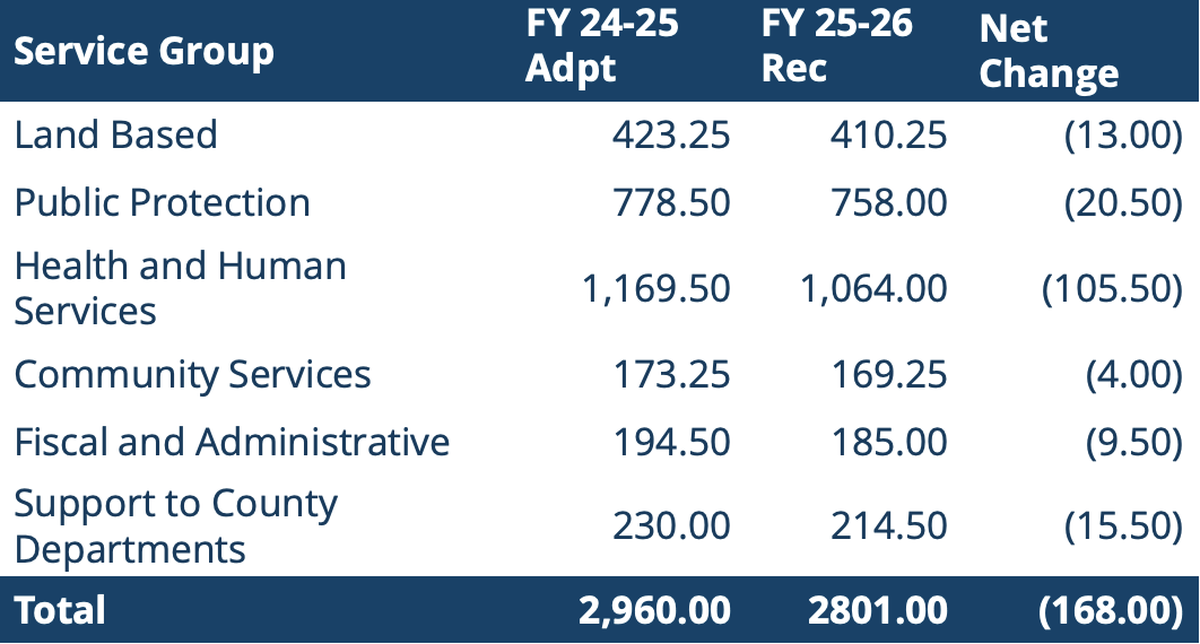
This figure represents the net reduction in jobs. While there are some proposed role additions, they are outweighed by the number proposed to be cut.
Pontes also highlighted that the majority of the roles are currently vacant. Of the 168 jobs to be eliminated, only 48 were currently filled. The other 120 roles were already empty.
That means the county has issued layoff notices to those 48 employees in filled positions that are being eliminated.
The reductions will help to lower the county’s current 15% vacancy rate, Pontes said. Other vacant roles could be filled by internal hires, he said.
“If they have the right kind of skills, knowledge and training and education and stuff, we’re doing our best in-house to try and find homes for all those folks, as much as we possibly can,” Pontes said.
The jobs range from low- to mid-level roles like custodians and admin analysts to second-in-command, supervisor and manager positions such as part-time deputy county counsel and a program manager for the Sheriff-Coroner’s Office.
Some of those positions were added back in other titles, like a full-time deputy county counsel, behavioral health clinician and sheriff deputy director.
Recommended budget cuts were made to individual county departments, which were then grouped into similar categories called service groups.
The county’s health and human services departments were hit the hardest, facing a 15% or $9.1 million loss in general fund support and 105.5 jobs. The decimals represent part-time roles. While these departments will lose significant general fund support, their expense budget will increase by 3%, or $10.3 million.
Of the proposed job losses, 42.5 with come from public health departments, 36.75 from the behavioral health group and 23.5 from administrative positions across all health agencies. Ten nurses and 10 behavioral health clinician positions are proposed to be cut.
These cuts will impact all county-funded health agencies and programs, from child support, veterans and homelessness social services to the Behavioral Health Department and emergency medical services, as well as related nonprofits that receive funding from the county.
After that are the county’s land-based departments, which include all public works departments that manage SLO County’s roads, regulate agriculture, oversee weights and measures and preserve agricultural and open space.
These departments face a combined 8% reduction of $1.4 million in general fund support and 13 positions. The departments’ expense budget would drop by $1.8 million, or 3%.
Four roles and 4% of general fund support — or $254,000 — are proposed to be cut from the community service departments, which includes the Fish and Game, Parks and Recreation, Wildlife and Grazing, Library and Airports departments. The service departments’ expenditures would be reduced by 1%, or $388,000.
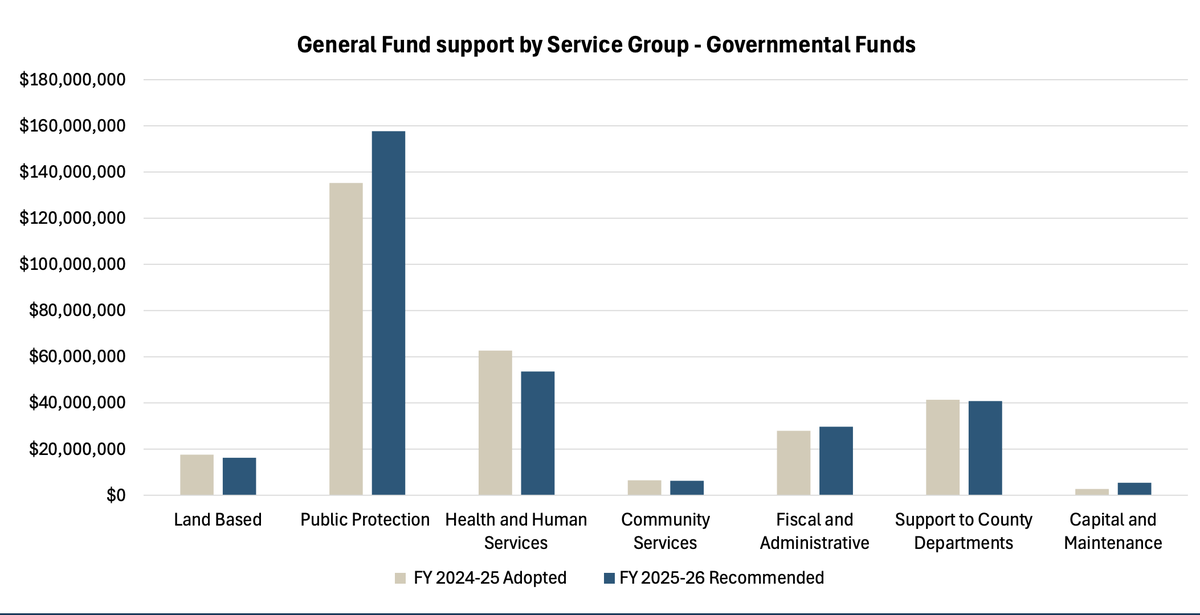
Some departments saw increases in general fund support, even as jobs were proposed to be cut.
The most significant recommended increase was seen by the public protection group, which includes county fire, the District Attorney’s Office, the Probation Department, the public defender’s office and the Sheriff’s Office.
General fund support was recommended to be increased by 17% — or $22.4 million — even while a net 20.5 jobs were proposed to be reduced. The expenses budget would increase by $26.5 million, or 12%.
Among the positions to be cut are a sergeant, six deputy sheriffs, six correctional deputies, a senior sheriff’s deputy, a deputy probation officer and seven animal control officers. A few of those roles would be added back under different titles like correctional deputy and sheriff deputy director.
Supervisor Heather Moreno said the increased funding levels for public safety departments should not come as much of a surprise.
“We don’t have a bunch of outside sources of funding,” she said. “There’s occasionally grant funding that’s ... occasionally for personnel, often for equipment. So general fund is what funds public safety, sheriff, fire, all of that. So that would be natural, that most of their funding and discretionary funds goes to public safety.”
Other departments that saw general fund allocation increases in the proposed budget were the fiscal and administrative departments — which includes the Board of Supervisors, the Clerk-Recorder’s Office, the Administrative Office, the County Assessor’s Office and the Auditor-Controller-Treasurer-Tax Collector’s Office — and funding to capital and maintenance projects.
General fund support to the fiscal and administrative departments would increase by $1.7 million, or 6%, and see a reduction in 9.5 jobs under the recommended budget. Funding to capital and maintenance projects would increase almost 100%, or $2.7 million.
Support departments like human resources, county counsel and information technology are looking at a recommended general fund reduction of only 1%, or $568,000, with expense budgets growing 5% by $2.3 million. Human resource’s talent development department will be entirely defunded.
County-funded mental health, homelessness and foster youth programs face massive cuts
Though mental health and homelessness are among the county’s first tier priorities, many county-funded programs that help address these issues in the community were recommended to be cut with the newest budget.
This is partly due to trickle-down impacts from the state budget decisions, which cut all funding to local homelessness efforts, Howe said. Next year, the county’s Homeless Services Division is looking at a $7 million funding gap.
State funding makes up 35% of SLO County’s budget, with another 15% coming from federal funding sources.
“As those monies are coming in, they’re not keeping up with the cost of providing those services,” Pontes told The Tribune ahead of Tuesday’s budget hearing.
He also said many of the programs proposed to be cut were supported by grant dollars that have since gone away, either as a result of normal grant expiration or widespread federal grant reductions under the Trump administration.
“When the grant money went away, we kept those programs going, and so now some of those programs are being reduced,” he said.
One of the nonprofit programs on the chopping block is the Growing Grounds Nursery, a Transitions-Mental Health Association program that provides paid employment, soft job skills, therapeutic activity and social opportunities to adults with severe and persistent mental illness.
The county has proposed to eliminate all county funding toward the program in June of next year, which totals $289,000 and represents 16% of the program’s operating budget.
Another is SLO Court Appointed Special Advocates for Children’s (CASA) foster youth mentor program, which provides support to foster teens navigating young adulthood and helps them avoid high risk scenarios like homelessness, human trafficking and joblessness.
The county has proposed to entirely eliminate its $80,000 contract — which is 100% of the program’s funding and pays for one full-time staffer role, CASA President Rudy Bachman told The Tribune.
“These kids, they deserve a chance,” CASA volunteer mentor Kirsti Tcherkoyan said during public comment at Tuesday’s meeting. “They deserve to have one of me standing next to them, walking with them, getting them into college.”
Other budget cut proposals included closing Martha’s Place Children’s Center and the Paso Robles Public Health clinic, which will cut six jobs and leave the North County community without vital reproductive health and family planning services that help reduce unwanted pregnancies, abortions and sexually transmitted infections, Rita Casaverde, the Director of the Diversity Coalition who spoke at the meeting on behalf of the Paso Robles clinic, said.
On Tuesday, the county considered the possibility of having Community Health Centers absorb the clinic’s services to ensure continued care for the community, as well as keeping Martha’s Place open for another year.
Health Agency Analyst Sarah Hayter told the board the Paso Robles clinic serves about 1,300 patients annually as the only county reproductive health clinic in the North County.
“Even a transition starting today means people will not be served at the same capacity for at least one year,” Casaverde told The Tribune. “When it comes to health for immigrant and Spanish-speaking communities, trust is huge and a change like this could mean hundreds of missed diagnoses.”
El Camino Homeless Organization President Wendy Lewis told The Tribune the organization stands to lose 40% of its funding under potential federal, state and county cuts.
“As we move through this, we’ve had to make some very difficult choices. Choices that, quite frankly, none of us have wanted to make. I want to acknowledge the real concern and the heartbreak,” Moreno said.
“These are services that touch people’s lives that help people have better lives, and I really feel the weight of what is being asked, I do get that,” Moreno said. “But we also have to remember that these decisions are not being made lightly and they’re not being made in a vacuum.”
What happens next?
The county has until June 30 to close its deficit, when it must by law adopt a new budget for the new fiscal year starting July 1.
A public budget hearing will be held starting on June 9 to consider community input and incorporate the board’s revisions to the recommended budget.
This story was originally published May 21, 2025 at 1:25 PM.
CORRECTION: This article has been updated to reflect the name of the CASA volunteer who is quoted is Kirsti Tcherkoyan.