Potential layoffs loom as SLO County faces budget deficit of up to $33.4 million
Budget season is back for San Luis Obispo County, and so far, the numbers are not boding well.
The county is currently looking at a $15.3 million status quo deficit for the fiscal year 2025-26, but that gap is expected to widen by more than double as increased salaries and new expenditures are taken into account over the next few months of the budgeting process, according to SLO County budget director Lisa Howe.
One estimate from the county puts the potential gap in government funding at $33.4 million for the upcoming fiscal year — more than doubling this past year’s deficit of $15.6 million.
“We are looking at a pretty significant budget deficit,” Howe told the SLO County Board of Supervisors at a March 25 board meeting. “Revenues are just not keeping pace with expenditures.”
Future projections show the budget only getting worse in the coming years: if the county holds steady on its current course, it faces a projected deficit of $67 million by fiscal year 2028-29, according to the staff report for the budget item.
In order to course correct the budget, significant cuts totaling up to $40 million will be necessary this year, and the possibility of layoffs is not off the table, Howe told The Tribune.
The news of local budget cuts comes on the heels of the nationwide slashing of federal funds.
At the instruction of Elon Musk, the strategy of the Department of Government Efficiency (DOGE) has been to take a chainsaw — figuratively, and once literally — to the United States’ budget and workforce, costing many federal employees their jobs and cutting funding across the board to government agencies, non-profits and research programs.
To make local matters worse, the effects of those federal decisions are expected to trickle down into SLO County’s budget. About 35% of the county’s budget — approximately $246 million — comes from state funding, and another 14% — around $100 million — from federal funds, making the county sensitive to changes in either, Howe said.
As to exactly what those impacts will be, it remains “too early” to know, Howe told the Board.
“For those of you in the community who are worried about the federal budget, the state budget, I hear you,” Supervisor Heather Moreno said at the March 25 meeting. “This is not status quo at all.“
Although budget cuts are certainty in order, the county has promised to take a more precise approach to closing its multi-year deficit than DOGE’s “chainsaw” strategy.
“This is definitely not like any of the cuts going on at the federal level,” SLO County Administrative Officer Matt Pontes told The Tribune. “This is a very strategic process focused on minimizing the impact to the community.”
This message was echoed by the county supervisors.
“We’re looking at everything line by line, program by program, to make sure we are as effective as we can be,” Moreno said at the March meeting.
This level of scrutiny over budget reductions “hasn’t been done in at least a decade,” Supervisor Dawn Ortiz-Legg said at the meeting.
The county has until June 17 to balance and adopt the budget, which will take effect at the start of the next fiscal year on July 1.
“We’re going to… lose a few pounds in a couple of years here, but we’re not going to stop providing quality services,” Ortiz-Legg said.
Why is SLO County facing a larger-than-normal budget deficit?
The county is currently estimating a $15.3 million budget deficit on par with this past year’s, but that figure doesn’t tell the whole story.
The estimated $15.3 million deficit represents what is called the “status quo” budget deficit. This figure accounts only for the cost of continuing all current funding levels into next year and does not represent any additional staffing or salary increases that went into effect after November, though these expenses will play a factor in the final adopted budget.
While the county’s current status quo budget estimates a deficit consistent with the 2024-25 fiscal year budget, the projected deficit for the upcoming fiscal year is more than double that, sitting at at least $33.4 million.
“Our biggest chunk is going to go into salaries,” Supervisor Bruce Gibson said at the March meeting, but added that “we aren’t sure what our salaries are going to be next year.” Salary contracts expire in July and need to be renegotiated before they can be factored into the new budget.
The county is currently in the process of those negotiations, so the exact increases in labor costs are not yet known, but the county estimated those values by projecting a 4.3% annual expenditure increase.
The projection puts the county at a $33.4 million deficit next year, with the gap growing larger each year to come. By 2029, the county is projected to face budget gaps of up to $66.8 million.
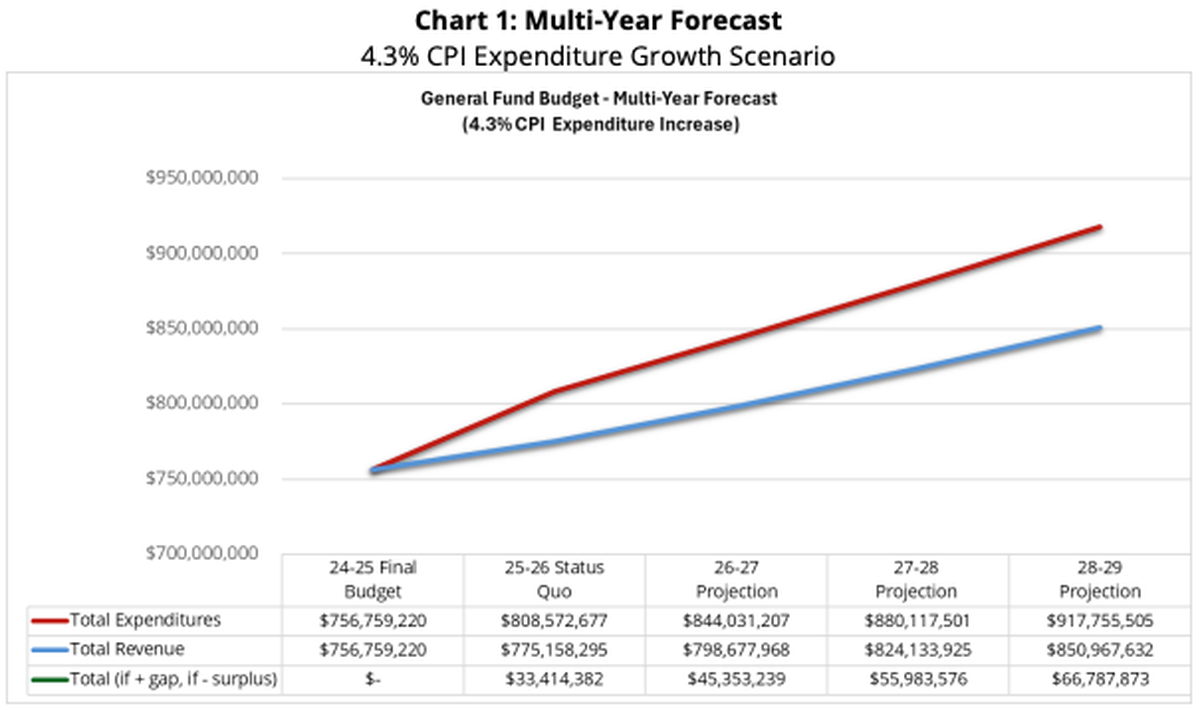
Howe said this can be attributed to a few key factors, namely the county’s expenses outpacing its revenue sources and constraints on state and federal funds.
At the same time, the county aims to pay competitive wages and benefits in order to recruit and retain the talent needed to provide high-quality county services.
In the past, the county has been able to use one-time funding pools — such as federal emergency disaster, Diablo Canyon nuclear power plant decommissioning and COVID funds — to balance the budget or pay the wages of limited-term positions, but those sources have since run out, Pontes said.
Even though SLO County has a “large” vacancy rate of 15%, it will likely still need to conduct layoffs in order to close the deficit, Pontes told The Tribune.
The county will do so by trying to fill vacancies internally while cutting lower-priority roles, but Pontes said it is not yet clear if, or how many, layoffs will be necessary.
Notifications will start to go out mid-April to any county positions that might be impacted by reductions, and potential layoffs would take effect on July 1, Howe told The Tribune.
How will SLO County close its multi-year budget deficit?
In order to close the gap, the county has proposed a “financial rebalancing and resilience initiative” to cut between $35 and $40 million and course correct the budget.
“This strategic rebalancing is intended to adjust spending in the longer term to prevent recurring deficits and avoid the need for annual budget cuts,” Howe told the Board at the March meeting.
In order to do so, all county departments were asked to submit reduction lists with a target of 15% of their fiscal year 2024-25 budget, totaling $66 million across all departments, Howe said.
A few departments were asked to submit additional cut lists above the 15% goal, totaling another $10 million, she said.
“All departments will participate, however, the intent is that the administrative office will not recommend across-the-board cuts,” Howe told The Tribune. “Instead, staff will adopt a strategic, case-by-case approach that aligns with county priorities, ensuring essential programs and services are preserved.”
The budget decisions are supposed to align with the Board of Supervisors’ priorities, including public safety, homelessness, mental health, economic development, emergency infrastructure and housing.
“One of the things that’s really important to us in the county is that the departments are able to carry out their missions, and their missions are really different,” Pontes told The Tribune. “We’re not compromising the county’s missions or the county’s overall mission.”
To responsibly balance the budget, Pontes said the county is considering “how do we carefully, very carefully, pull back” from certain programs and “look for efficiencies” rather than enact sweeping cuts.
“We’re really taking our time with this process,” Pontes said.
The county and Board of Supervisors will continue to carry out its budgeting process over the coming weeks, with a recommended budget due to be introduced at the May 20 board meeting. Budget hearings will take place June 9 through 11, and the finalized budget will be adopted on June 17.
“It will be tough — it will be,” Moreno said at the March meeting. “But we will make it through.”