Paso Robles church sends political questionnaires to candidates. It’s third in SLO County
A Paso Robles church sent a political questionnaire to North County school board candidates, probing their stances on hot-button issues such as gender identity, LGBTQ+ rights and abortion.
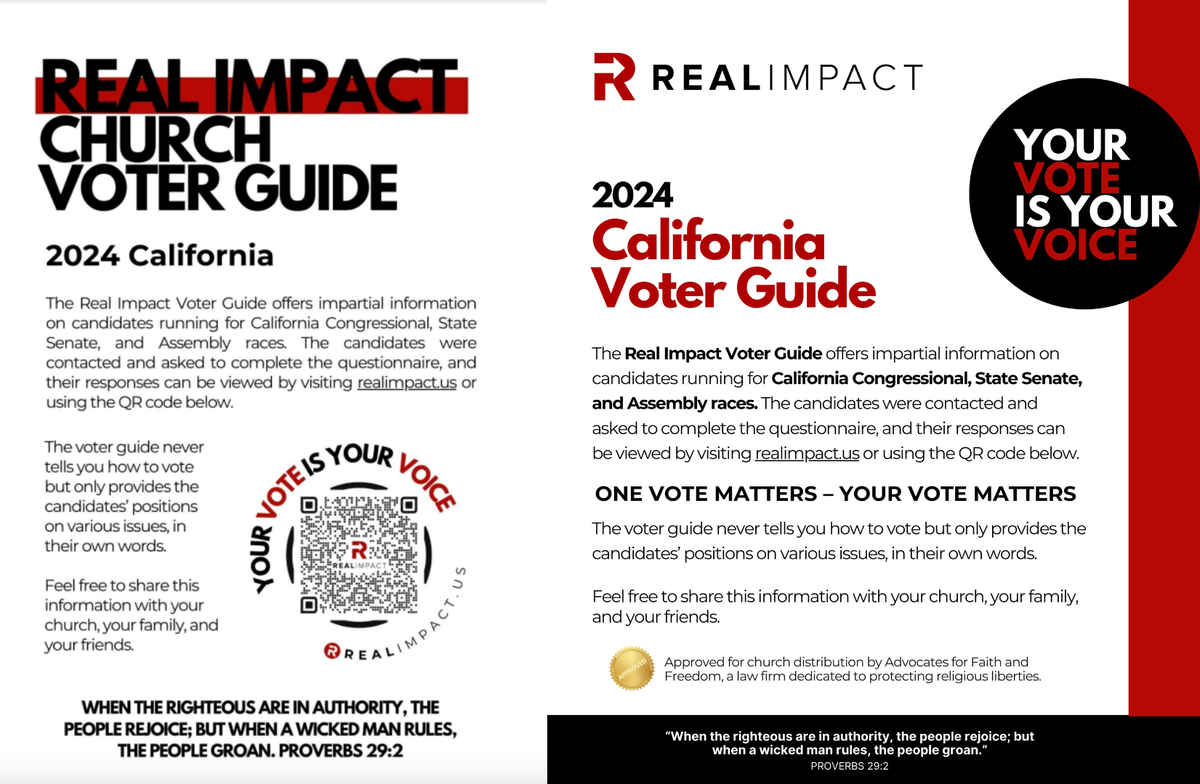
At least three candidates running for the Paso Robles Joint Unified School District Board of Trustees and at least two running for the Atascadero Unified School District board were sent questionnaires in the mail by Calvary Chapel in Paso Robles and an organization called Real Impact.
The survey requested that responses be returned by Sept. 16 to be published in a voter guide for the church and northern SLO County community.
It’s the latest example of nonprofit religious organizations in San Luis Obispo County walking a fine line on what is and is not allowed in terms of political activity.
Calvary Chapel is at least the third SLO County church that has distributed political surveys to candidates for county races, The Tribune learned, raising questions about whether this kind of political activity is permitted by religious nonprofits.
Two other low-profile ministry groups affiliated with Harvest Church and Grace Bible Church in Arroyo Grande sent questionnaires to candidates for the Arroyo Grande City Council and Lucia Mar School Board races, respectively.
Internal Revenue Service tax law prohibits charities and churches from engaging in political campaign activity, defining a tax-exempt nonprofit as an organization “which does not participate in, or intervene in (including the publishing or distributing of statements), any political campaign on behalf of (or in opposition to) any candidate for public office.”
But are these churches breaking the law?
After investigating two churches in South County for similar activity, The Tribune looked into Calvary Chapel’s questionnaire as a part of its Reality Check series.
What can churches do politically, and what can they not do?
Real Impact’s website lists its surveys as approved for church distribution by Advocates for Faith and Freedom, a “law firm dedicated to protecting religious liberties.”
While religious nonprofits are strictly prohibited from explicitly or financially endorsing or opposing candidates, there are certain political actions that do not constitute campaign intervention — including distributing nonpartisan candidate questionnaires.
However, these questionnaires must follow a strict set of rules. Most notably, they must consider a broad range of issues and ask unbiased questions that are relevant to the office that candidates are running for.
A legal expert who specializes in the regulation of political activity by religious nonprofits analyzed the surveys sent by Harvest Church and Grace Bible for The Tribune and concluded that they “push the envelope on the campaign intervention prohibition” and require deeper examination by the IRS.
Veronica DeCoster — an Atascadero school board candidate who received one of Calvary Chapel’s questionnaires in the mail — said it was “nearly identical” to the other surveys.
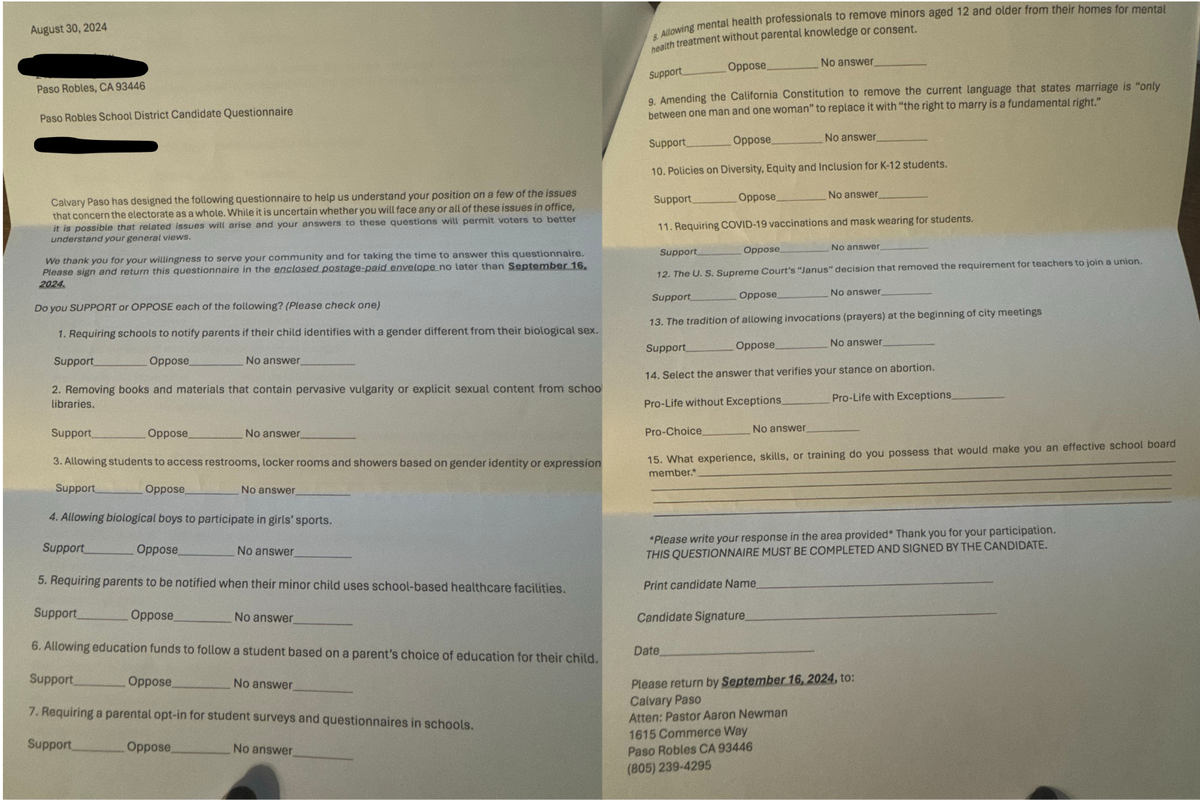
Many of the questions on Calvary Chapel’s survey appear to be drawn verbatim from those sent by Grace Bible to Lucia Mar school board candidates, with language including “allowing students access to restrooms, locker rooms, and showers based on gender identity or expression,” “requiring schools to notify parents when their child identifies as a gender different from their biologic sex,” “removing books and materials that contain pervasive vulgarity or explicit sexual content from school libraries” and “allowing biological boys to participate in girls’ sports teams.”
Similarly to the other survey, multiple questions considered issues of LGBTQ+ rights, and two of them were not related to schools or students at all, asking candidates their stances on abortion and the definition of marriage as being “only between a man and a woman.”
Calvary Chapel’s questionnaire also asked candidates’ positions on diversity, equity and inclusion policies for students, requiring COVID-19 vaccinations and masks in school, and teachers unions.
DeCoster did not complete the survey, finding some of these questions irrelevant and “slanted,” she told The Tribune.
“A couple of the questions dealt with issues that a school board would never, ever have to face,” she wrote in an email.
“The questionnaire certainly didn’t read as impartial to me, and although the cover letter claimed the answers would be used to ‘assist voters in understanding your overall perspectives,’ the objective was clearly to lump the candidates into a particular camp,” she said.
Atascadero school board incumbent Matthew Pennon said he also received a survey but did not complete it, as did Tracy Dauterman and Nathan Williams for Paso Robles school board.
Another candidate for Paso Robles school board, Hunter Breese, said he completed and returned the survey.
Atascadero candidates Corinne Kuhnle, Joey Arnold and Jodi Taylor, as well as Paso Robles candidates Laurene McCoy, Tim Gearhart, Leo Castillo, Adelita Hiteshew and Kenney Enney, did not respond to The Tribune’s attempts to reach them.
The only options candidates were given for responding were simple “Support,” “Oppose” or “No Answer” check boxes, with no opportunity to elaborate on what DeCoster considered to be nuanced issues.
“Most of the questions involved issues where there are definite gray areas that make it difficult to land on one side or the other,” she said.
She also said that the questions failed to take into account the fact that some issues are governed by laws that a school board must comply with regardless of an individual board members’ personal beliefs — mainly Title IX laws pertaining to gender and sexuality rights and protections for students.
This also includes a question about “requiring schools to notify parents when their child identifies as a gender different from their biologic sex,” which California’s Attorney General Rob Bonta cautioned is a violation of the state’s Constitution. Bonta has also challenged legislation that prohibits students from using restrooms and other school facilities that correspond with their gender identity, another issue that was raised on the survey.
“I think it brings cultural wars into the school board, and they don’t belong there,” DeCoster said of the survey.
The Tribune reached out to Calvary Chapel for comment, but did not immediately receive a response.
.jpeg "74882046241__576FEDE0-6876-4598-909D-2B4B2B7F1B56 (1).jpeg")
The expert who analyzed the other surveys for The Tribune highlighted these qualities — that is, asking a narrow set of questions and limiting candidates’ responses — as possibly indicative of illegal campaign intervention by church groups distributing questionnaires.
Ultimately, any ruling of legality is up to the IRS, but DeCoster said she’s not sure it even matters.
“Whether or not it’s legal, I’m just not sure it’s ethical,” she said.
This story was originally published October 1, 2024 at 10:00 AM.