2 church groups sent political questionnaires to SLO County candidates. Are they legal?
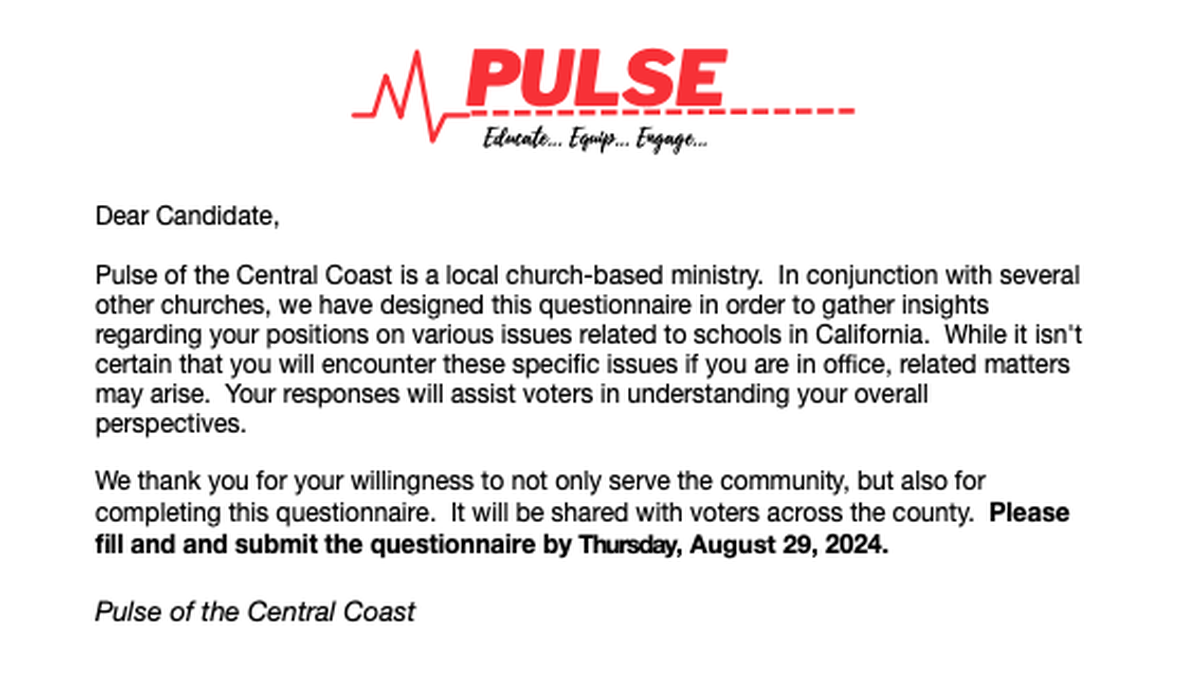
On Aug. 21, incumbent Lucia Mar School Board candidate Don Stewart received a political questionnaire from a group called Pulse of the Central Coast that identified itself as “a local church-based ministry.”
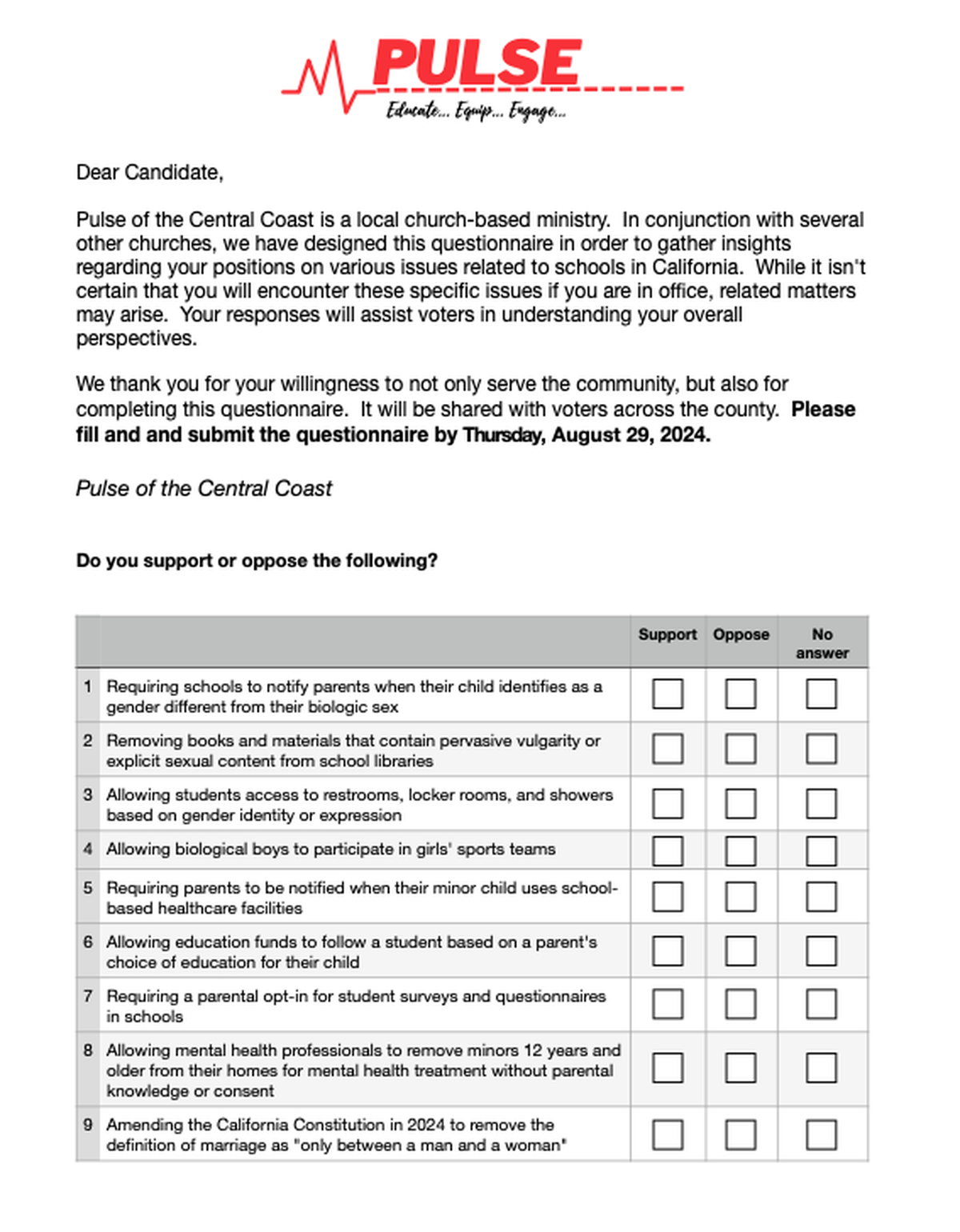
The short survey asked candidates their positions on series of hot-button policies, including “allowing students access to restrooms, locker rooms, and showers based on gender identity or expression,” “requiring schools to notify parents when their child identifies as a gender different from their biologic sex,” “removing books and materials that contain pervasive vulgarity or explicit sexual content from school libraries” and “allowing biological boys to participate in girls’ sports teams.”
His responses were expected the following week and would be shared with voters across the county, the form said.
Half of the questions considered issues of LGBTQ+ rights, and two of them were not related to schools at all, asking candidates their stances on abortion and the definition of marriage as being “only between a man and a woman.”
The rest of the questions had to do with parents’ knowledge of and choice over their children’s education, use of school-based healthcare facilities and the forced removal of minors over 12 years old from their homes by mental health professionals.
Stewart did not complete the survey.
“I’ve never seen a church come out so strong in a campaign,” he told The Tribune. “I’m a big proponent of the separation of church and state.”
Stewart self-identifies as one of the only openly gay elected officials in the South County.
In response to the question about defining marriage as exclusively heterosexual in the California Constitution, he said that “it’s my history and my Constitution that they are looking to erase.”

The questionnaire is one of at least two that church-based groups have sent via email to candidates for local races across the South County, raising questions about whether this kind of political activity is permitted by religious nonprofits.
A similar survey using nearly verbatim language in its introduction was sent to Arroyo Grande City Council candidates by a group called Culture Impact, which described itself as a “local church-based ministry” tied to Harvest Church.
Internal Revenue Service tax law prohibits charities and churches from engaging in political campaign activity, defining a tax-exempt nonprofit as an organization “which does not participate in, or intervene in (including the publishing or distributing of statements), any political campaign on behalf of (or in opposition to) any candidate for public office.”
But are these local churches breaking the law?
The Tribune looked into the recent activity of Pulse of the Central Coast and Culture Impact as a part of its Reality Check series.
Surveys ask candidates to ‘defy state law’
When the surveys started circling in late August, they immediately raised red flags for some of the candidates who received them.
Stewart called the questions on the Pulse survey “alarming” and said they even suggested that trustees “should break the law in their approach to governance and education.”
This includes a question about “requiring schools to notify parents when their child identifies as a gender different from their biologic sex,” which California’s Attorney General Rob Bonta cautioned is a violation of the state’s Constitution. Bonta has also challenged legislation that prohibits students from using restrooms and other school facilities that correspond with their gender identity, another issue that was raised on the Pulse survey.
“We’re seeing this up and down the coast … this push to defy state law,” Stewart said. “Anyone answering yes to those questions is violating their oath of office.”
Pulse of the Central Coast and Culture Impact are both low-profile groups that seem to have minimal digital footprint.
Culture Impact does not appear to have any online presence but said it was affiliated with Harvest Church in Arroyo Grande in its questionnaire sent out on Sept. 6.
While Pulse does not list a connection to any specific church in its survey, the only online information about the group is a short section at the bottom of a page about other ministries on the website of Grace Bible Church in Arroyo Grande — not to be mistaken with Grace Central Coast, which has campuses across the county.
In an email to The Tribune, Grace Bible Church Executive Pastor Ben Youngkin described Pulse as “a resource ministry to inform those with a Scriptural viewpoint about local, state and federal issues which may be of concern to them.”
“Pulse researches and educates about ethical and moral issues impacting our culture, equips citizens with information on how to voice their personal opinion to their local, state and national representatives, and encourages them to impact their culture,” Youngkin wrote. “Pulse is nonpartisan and does not endorse or oppose candidates.”
Youngkin declined to comment further after his initial response.
Harvest Church responded over email saying that they “kindly refuse to comment.”
When a Tribune reporter called the number listed on the Pulse questionnaire and identified themselves as a journalist, they were told they had the wrong number. It is unclear why the number is listed on the Pulse questionnaire.
Both churches are tax-exempt 501(c)(3) nonprofits under IRS tax code. The Tribune could not identify tax filings for either Pulse of the Central Coast or Culture Impact, suggesting they are affiliated groups under the respective churches’ tax exemption statuses.
The Tribune was able to confirm that at least four of the six candidates for the Lucia Mar School Board received the Pulse questionnaire, and only one completed and returned it. One candidate who is a member of Grace Bible Church, according to Stewart, did not receive the questionnaire. Another candidate did not respond to The Tribune’s inquiries.
When Stewart didn’t respond to the first survey sent over email, Pulse sent him a physical copy in the mail with a new due date of Sept. 20, including a self-addressed stamped envelope “to encourage me to return it,” he said.
The Tribune confirmed that at least one of the five candidates for Arroyo Grande City Council did not receive the Culture Impact survey. Two of the four candidates that The Tribune is aware received questionnaires completed and returned it, including Arroyo Grande mayoral candidate Gaea Powell.
Caren Russom, the other candidate for mayor, received the survey and did not return it, finding it unfair and irrelevant, she said.
“It is clearly biased and about issues that have nothing to do with local municipalities,” Russom told The Tribune in an email. “I have no intention of entering myself into perceived culture wars that exist in others’ minds.”
The Tribune attempted to reach the candidates who said they completed the surveys but did not receive responses to requests for comment. Some of the other candidates who did not respond to the surveys asked to remain anonymous.
Church candidate questionnaires toe the line of legality
Some of the candidates who received the political questionnaires found them alarming, offensive and even harmful to their communities — but are they illegal?
Professor Lloyd Hitoshi Mayer at the University of Notre Dame Law School said maybe, but that it would be up to the IRS to decide.
“They push the envelope on the campaign intervention prohibition — it’s not clear to me that either one obviously breaks the envelope, and that is, breaks the law,” he said. “If the IRS had unlimited resources and no political vulnerability, yes, I would think these questions would be enough, if the IRS received copies of them, for them to open up an examination.”
Mayer’s expertise is in the regulation of political activity by nonprofits including churches and other religious organizations.
These groups are strictly prohibited from explicitly or financially endorsing or opposing candidates, but there are certain political actions that do not constitute campaign intervention, he said.
This goes back to a 1978 IRS ruling that detailed certain voter education activities that nonprofits are allowed to engage in — which includes distributing nonpartisan candidate questionnaires that follow a strict set of rules.
Other organizations following these guidelines have been approved to distribute their surveys in the past, like the Christian Coalition of America, which has been creating voter guides since 1990. The Christian Coalition is a 501(c)(4) — another kind of tax-exempt organization that focuses on social welfare and is given more political freedom to lobby. After briefly losing nonprofit status in the late 90s, it reorganized into two entities was given the green light by the IRS to continue with the questionnaires and guides in 2005.
Most notably, questionnaires must consider a broad range of issues, ask unbiased questions, allow respondents the opportunity to provide additional comment and be sent to all candidates in a given race.
Mayer analyzed both of the surveys obtained by The Tribune. He said while neither survey appears to clearly break any of the rules, they also do not appear to clearly follow them.
For example, at least one of the questionnaires does not cover a broad range of issues, he said.
“Between the two surveys ... the Pulse one seems to me to be much narrower, because it focuses almost exclusively on sexuality and gender issues in an educational setting,” Mayer said. “On the other hand, the Culture Impact survey seems to be much broader. It covers a range of issues.”
Culture Impact’s survey asked eight questions probing candidates stances’ on policy issues such as requiring voter photo identification at the polls, allowing cannabis dispensaries in city limits, allowing prayers at public meetings, deciding what flags should be displayed on city property, asking how to address the budget deficit and “securing the right of citizens to keep and bear arms.”
Similar to the Pulse questionnaire, it also asked two questions about the definition of marriage and all-gender bathrooms.
Meanwhile, six out of the 10 questions on Pulse’s survey pertained to sexuality and gender rights.
Another issue was the framing of the questions and format of the responses, Mayer said.
Neither survey struck Mayer as particularly biased in the wording of the questions, he said, noting that the Culture Impact survey was especially neutrally worded. But the context in which some of the questions were asked was of greater concern to him.
“It seems a little bit of a stretch, some of these questions,” he said. “Why are you asking school board candidates about amending the California Constitution to remove (that) the definition of marriage is only between a man and a woman? That has nothing to do with being a school board candidate.”
The questionnaires seem to acknowledge this, both stating that “while it isn’t certain that you will encounter these specific issues if you are in office, related matters may arise. Your responses will assist voters in understanding your overall perspectives.”
Mayer said that when a group is asking about things that might be of particular interest to the group and that it might have its own positions on — rather than issues that are of interest to voters in general — it starts to look more like illegal campaign intervention.
“It becomes more troubling when the questions aren’t really relevant to the office,” he said. “In an examination, the IRS would ask that. You know, how did you select these questions? And the answer would make a difference.”
As for the responses, Mayer found them to be limiting.
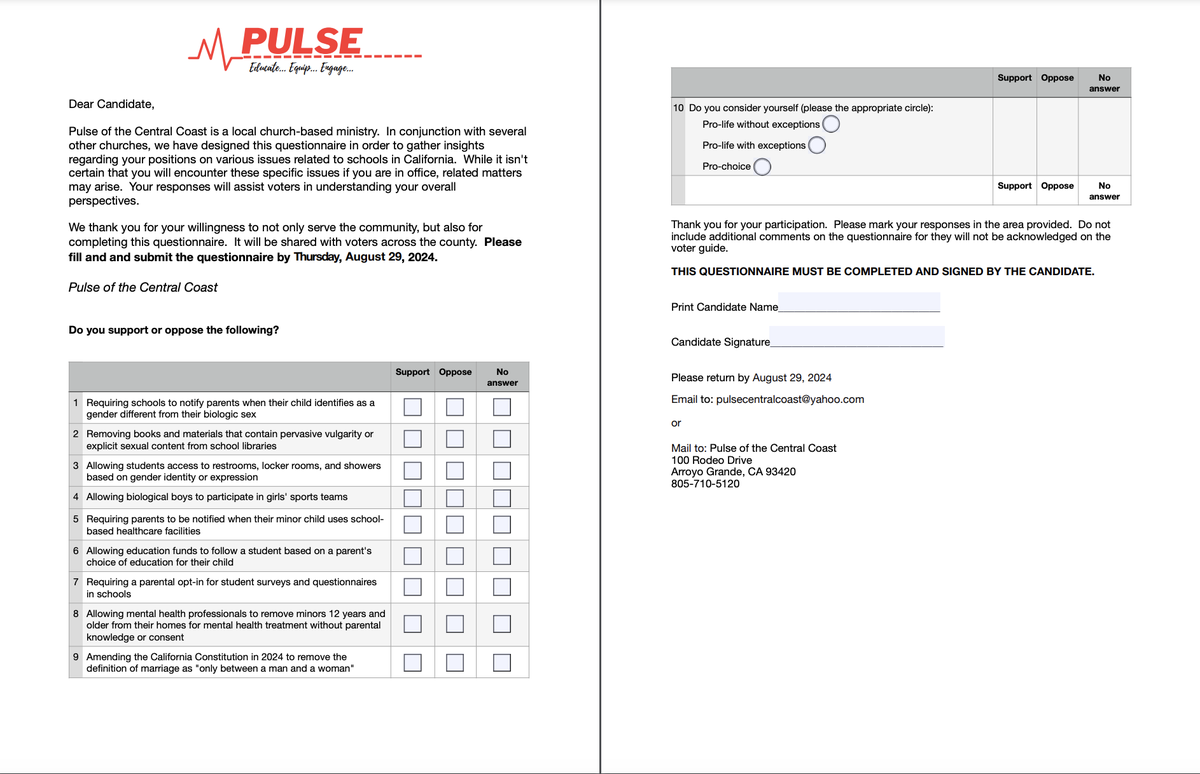
The questionnaires — sent to candidates by email as PDF files or Google forms — asked respondents to mark either “support” or “oppose” in check boxes next to each statement. They were not given the opportunity to elaborate on their responses.
The Pulse questionnaire stated that “additional comments will not be acknowledged on the voter guide.”
While this is not explicitly against the IRS code guidelines — which only recommend and do not require that candidates be allowed to leave additional comments — it does raise suspicion of the groups’ intentions, Mayer said.
“Having simply ‘support, oppose’, or ‘yes, no’ with a no-answer option doesn’t allow any nuance,” he said. “That would again suggest that, you know, you’re trying to make the the candidate appear black or white on an issue where maybe there’s some gray.”
Mayer also said that IRS guidance requires candidate questionnaires to be distributed to all the candidates for the given office, but at least one candidate from each of the races Pulse and Culture Impact sent surveys to did not receive one.
This could be explained if there was no easy way to contact a candidate and the group made reasonable efforts to reach them, Mayer said. But the email address of every Arroyo Grande City Council candidate are listed on the county’s public candidate list, and one of them still did not receive a questionnaire from Culture Impact.
“If Pulse or Culture Impact only sent the survey to a selected set of the candidates, that would be problematic. That would indicate campaign intervention,” Mayer said. “Any selectivity is, again, not quite determinative, but that’s a pretty red flag there.”
What will be the most telling, though, is how the groups go about distributing the voter guides they produce, Mayer said.
“If the plan to distribute the results of the candidate questionnaire is pushed on the website or distributed broadly to the electorate, that looks less like campaign intervention,” he said. “But if you’re distributing primarily, let’s say, oh, I don’t know, to relatively conservative church congregations, you probably have a sense of which way that suggests they should vote.”
He pointed to how the Christian Coalition used to distribute their guides as the classic example.
“They distributed the voter guides not to the public generally,” Mayer said. “They put them on people’s cars in church parking lots.”
He continued: “If the audience they’re distributing the results to is primarily, or even exclusively, one that tends to be on one side of the other of the issues they’re asking about, that indicates it’s a campaign intervention, because you’re basically telling them, these are the candidates that support the things you like and these are the candidates that oppose the things that you like.”
For all these reasons, Mayer said these uncertainties about Pulse of the Central Coast and Culture Impacts’ surveys warrant a deeper look by the IRS.
Realistically, though, that probably won’t happen, he said.
“The IRS does not have unlimited resources, and it does have political vulnerability, especially when it comes to political activities,” Mayer said. “It would seem that it’d be extremely unlikely that this is something that the IRS would choose to do an examination on both because they have limited resources and this is not an obviously across-the-line situation.”
He said opening an examination on these groups would puts the IRS at risk of political blow-back from Republican members of Congress for targeting conservative groups — which is not a position the IRS is likely to put itself into.
Surveys offend voters and candidates’ identities
Whether the questionnaires are legal or not, Stewart said that Pulse’s survey was “politicizing education” and was personally offensive to him.
“My focus has always been on making sure our campus feels safe for all students and all staff,” he said. “We don’t want to politicize education. That was my issue with this questionnaire.”
The Pulse survey questioned whether candidates are in support of “removing books and materials that contain pervasive vulgarity or explicit sexual content from school libraries,” which Stewart qualified as book banning.
“Book banning is alarming to me,” he said. “We give families choice in the materials they want for their students and families.”
Tom Fulks, chairman of the SLO County Democratic Party, told The Tribune that both Grace Bible and Harvest Church have publicly stood against LGBTQAI+ rights.
“This comes from the same group that continually protests Pride Month,” Fulks said of Pulse of the Central Coast and Grace Bible Church. “This is the church in Arroyo Grande that has organized this hate campaign targeted at the LBGTQ+ community.”
He shared similar sentiments about Harvest Church and said it opposed the Pride Month declaration by the Arroyo Grande City Council. The pastor of Harvest Church was also a participant in an anti-transgender protest in front of Arroyo Grande High School last year.
“These are the kind of people who focus their ire and their wrath on the politically weakest among us, the families and the kids who are least able to defend themselves,” Fulks said. “They scapegoat them, and they use them, and they persecute these families for their own political benefit.”
Similarly to Mayer and some of the candidates, Fulks found the questions on Pulse’s survey to be unrelated to the school board race.
“I don’t see anything in there about test scores, I don’t see anything in there about graduation rates or capital improvements for the buildings of the district, the nuts and bolts of running an education system,” he said “This is all about ideology and wedge issues and all of these sort of hot button things they want to focus on.”
“It has nothing to do with policy. It has everything to do with power,” Fulks said. “I find it reprehensible. To be honest with you, it’s the antithesis of inclusion in democracy.”
This story was originally published September 20, 2024 at 5:00 AM.