Should one supervisor represent both Paso Robles and Cambria? A guide to redistricting
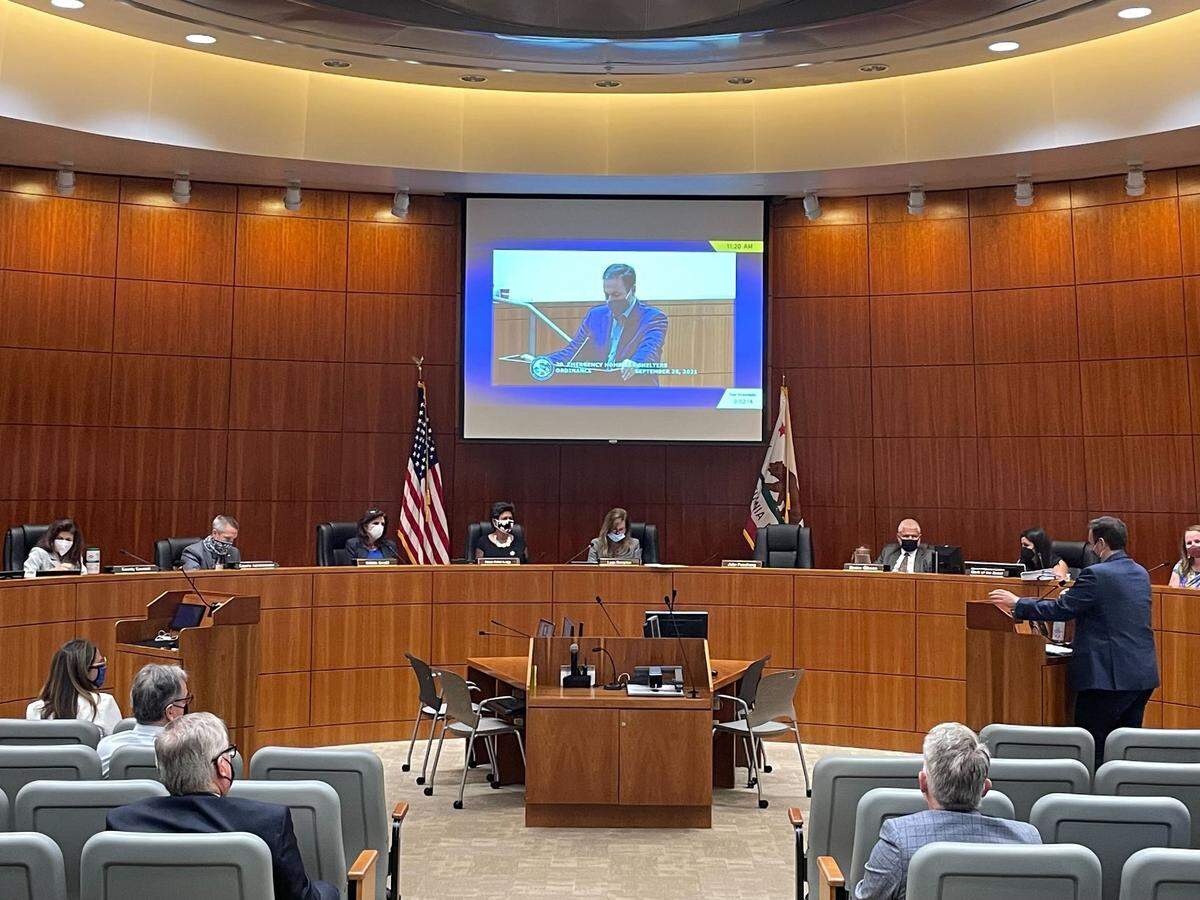
San Luis Obispo County is in the midst of a process that happens at the beginning of every new decade — redistricting, or redrawing the boundaries of each of the five supervisors’ districts.
November is a big month for redistricting.
The Board of Supervisors will hold a third hearing on Friday at 9 a.m. to review maps submitted by staff, consultants and local residents. On Nov. 30, they’ll pick a district map that they’ll adopt in December and use for the next 10 years of elections.
So what is redistricting? Why does it happen, why does it matter and who’s involved in the map-drawing process? And how can residents become involved?
Here’s your guide to the county’s redistricting process.
What is redistricting and why does it happen?
Redistricting refers to all the different steps that go into drawing new boundaries for the five geographical districts represented by members of the Board of Supervisors.
This process divides the county based on population. Each district must contain roughly the same number of people. A supervisor’s district may look big physically, but that’s because it may contain mostly rural areas where people are spread out.
The county must redraw the district maps every 10 years in conjunction with the Census, which recalculates the United States’ entire population at the beginning of each decade.
Population shifts may make some districts substantially bigger than others over time, thus the need to adjust the maps to re-balance the distribution.
None of the districts in SLO County grew enough to necessitate substantial boundary changes, so the supervisors could legally leave the map as it is, according to Redistricting Partners, the county’s consultant.

Why should redistricting matter to me?
Every person in the county lives in one of the supervisors’ districts, even if your home is in a city. However, city residents are also represented by their city councils, which make decisions on behalf of people living within their governing area.
The Board of Supervisors is especially important for people who live in communities that are unincorporated, as it’s one of the only forms of representation for those residents. Those living in unincorporated areas usually end up appealing to their supervisors if they’re facing problems in their communities.
SLO County has only seven cities and large chunks of unincorporated areas, so supervisors can be very influential.
The redistricting process can also become political, as district boundaries can determine which interest groups dominate certain areas. The Board of Supervisors is technically a nonpartisan body, but that doesn’t mean members don’t express political views.
Currently, three of the five supervisors — John Peschong, Debbie Arnold and Lynn Compton — tend to lean more conservative and vote as a block. Supervisors Bruce Gibson and Dawn Ortiz-Legg lean more liberal and also vote together.
Depending on how districts boundaries are drawn, they can lean more heavily to one political party or another. When districts are drawn in extreme shapes to specifically give one party an advantage, it’s called gerrymandering.
How are district maps created? Who draws them?
District maps must follow a set of legal criteria that govern the shapes of the boundaries and how different groups of people can be divided.
The five districts must be contiguous, meaning the boundaries must form one connected shape. The boundaries can’t jump over those of other districts or have islands of population outside the connected area.
The districts also must be of approximately equal population size, and they should follow city and Census boundaries to keep districts compact as much as possible.
The new map should also respect “communities of interest,” groups that share common interests and characteristics, to the extent it can.
So who draws the maps? Redistricting Partners drew four maps for the supervisors to consider, and county residents can also submit their own.
What do old maps look like?
The current district map is set up so there are two supervisors representing the North County, one supervisor representing the North Coast, one supervisor representing the Avila Beach and Pismo Beach area and one supervisor representing the area from Arroyo Grande down to Nipomo.
The city of San Luis Obispo is the biggest population center in the county, so it’s traditionally been divided among two or three supervisors to make sure each district has the right number of people, said Chris Chaffee, Redistricting Partners chief business officer, at an Oct. 26 Board of Supervisors meeting.
The previous two maps, drawn in 2000 and 1990, both have similar basic regional structures to the one adopted in 2010, with a few differences.
For example, District 5 is much smaller geographically in the 1990 map — in the 2000 and 2010 maps, it includes more of the North County.
What kinds of maps are supervisors reviewing right now?
The supervisors are reviewing four maps produced by Redistricting Partners. One map drawn by Arroyo Grande resident Richard Patten also attracted a great deal of interest from residents who spoke at the Oct. 26 redistricting hearing.
Patten also recently presented his map at a pair of redistricting trainings held by the SLO County Republican Party.
Supervisor Peschong in late October told The Tribune he’s leaning toward a map that keeps San Luis Obispo whole, the main feature many people tout about Patten’s map.
“I’d like to see all seven cities whole,” he said.
However, San Luis Obispo has not been represented by a single supervisor in any of the maps from the last three decades because its population is typically too large to place in one district without causing cascading effects elsewhere in the county.
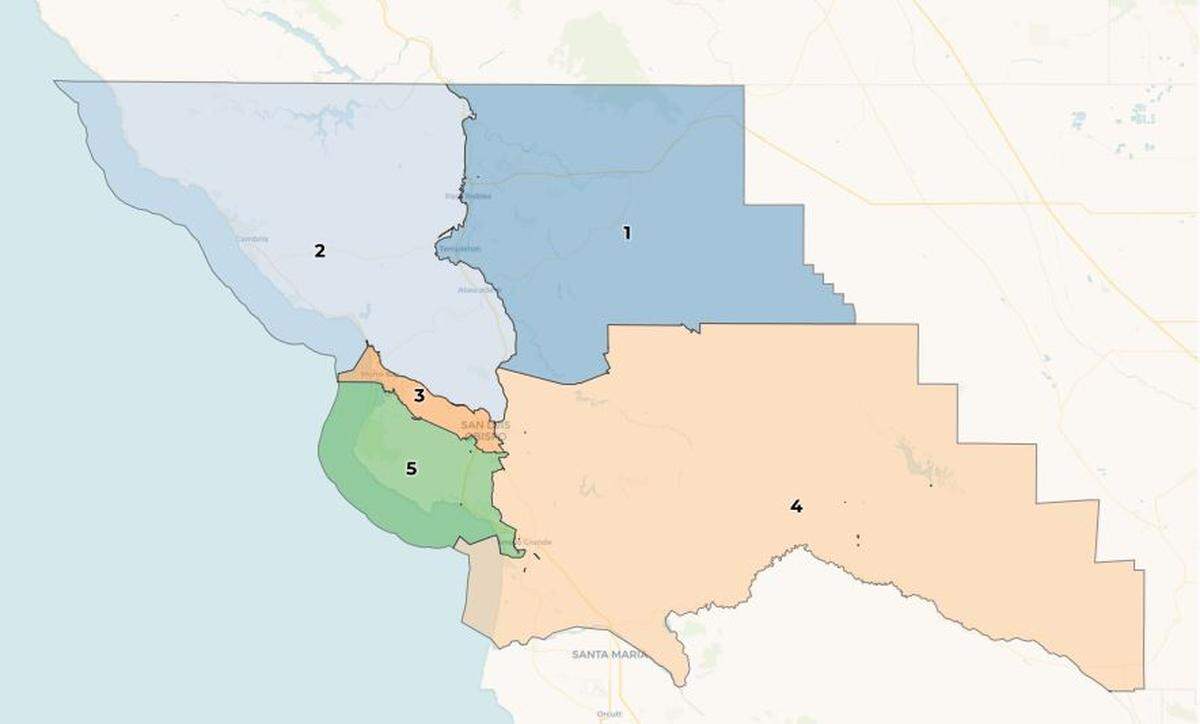
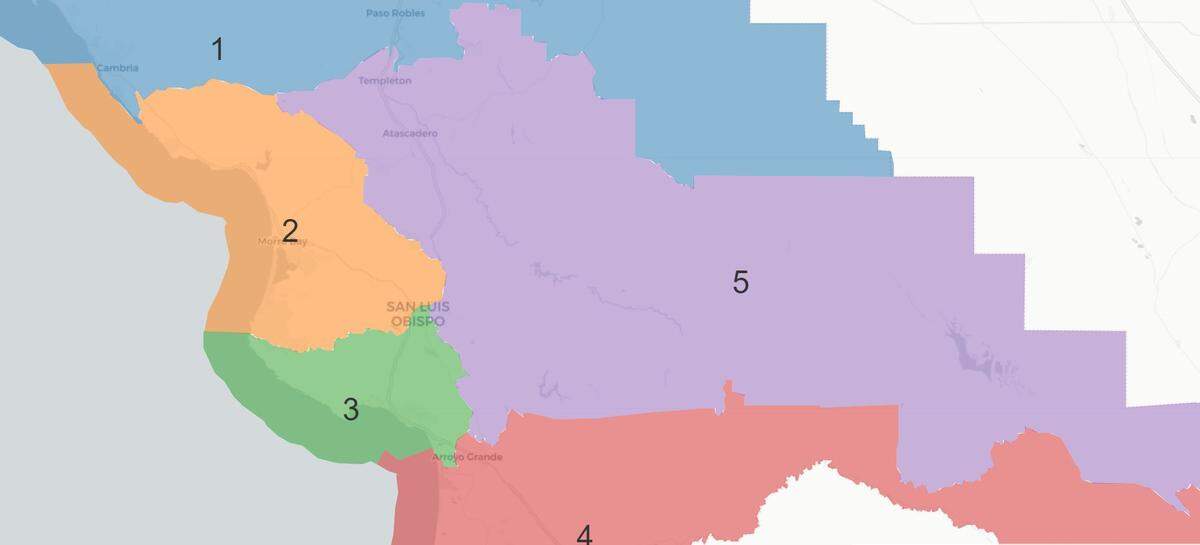
Three of the four Redistricting Partners maps — Plans A, B and D — are very similar to the current map. Plan C would remove San Luis Obispo from District 5, setting off a string of changes that would break up the North Coast and put Cambria in a district with Paso Robles and other inland communities.
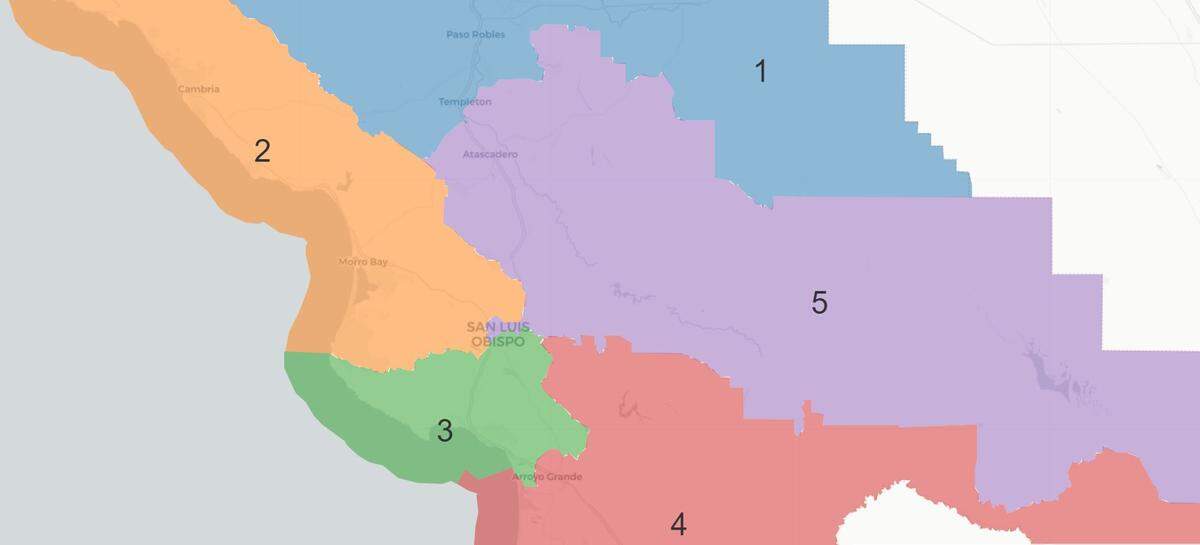
Patten’s map also involves putting coastal communities in the same district as some North County areas. This development has alarmed North Coast residents, who fear their voice would be diluted by those of inland communities.
“We are a community of interests as a group of coastal towns with unique issues of our own, issues that inland residents don’t really know or understand,” said Sue Morgen Thaler, a Los Osos resident, on Oct. 26. “We’re also a community of interests of mostly unincorporated towns, and we need representation together. Incorporated cities have city councils made up of people who are dedicated to helping their residents. Unincorporated towns don’t have that.”
How can I get involved in the redistricting process?
The Board of Supervisors is holding a third hearing on Friday at 9 a.m. to discuss the latest maps. You can attend the meeting in person or stream it online at slo-span.org. SLO-SPAN’s broadcast is also available live on cable channel 121.
If you can’t attend the meeting, you can also submit written comments to redistricting@co.slo.ca.us.
You can even draw and submit your own map online at districtr.org/tag/slo_county. The submission period for the Friday meeting ended on Nov. 5, and Nov. 21 is the deadline to submit maps for the fourth and final redistricting hearing on Nov. 30.
To learn more about the redistricting process and to view all submitted maps and public comments, visit the county’s redistricting page at bit.ly/2ZroWt3.
This story was originally published November 15, 2021 at 5:00 AM.
CORRECTION: This story has been updated to clarify how boundary changes impacted Templeton in the current San Luis Obispo County Board of Supervisors district map. The Templeton Community Services District (CSD) is entirely in District 1 in the map that’s in use today.