
Will supervisors respect SLO County’s regions – or carve them up for political gain?

Even in the best of times, redistricting is contentious.
This time around — with San Luis Obispo County more politically divided than ever — the redrawing of supervisor district lines is sure to get downright incendiary.
We saw a preview at Tuesday’s public hearing, when a few speakers accused county staff of deliberately “hiding” maps to influence the outcome. (They did no such thing.)
Making matters even more complicated, the board faces an unusually tight deadline to adopt a map due to the delay in release of census figures, attributed both to the COVID pandemic and “anomalies” in processing the data.
And here’s the kicker: For the first time, officials must consider “communities of interest” as one of the criteria when they redraw boundaries to reflect population changes.
What are ‘communities of interest’?
Here’s how the California Constitution defines that term:
“A community of interest is a contiguous population which shares common social and economic interests that should be included within a single district for purposes of its effective and fair representation.
“Examples of such shared interests are those common to an urban area, a rural area, an industrial area, or an agricultural area, and those common to areas in which the people share similar living standards, use the same transportation facilities, have similar work opportunities, or have access to the same media of communication relevant to the election process.”
That’s an awfully squishy definition.
No wonder it’s being manipulated for political gain — including here in SLO County, where “community of interest” has become a rallying cry for conservatives pressing for radical changes in district boundaries.
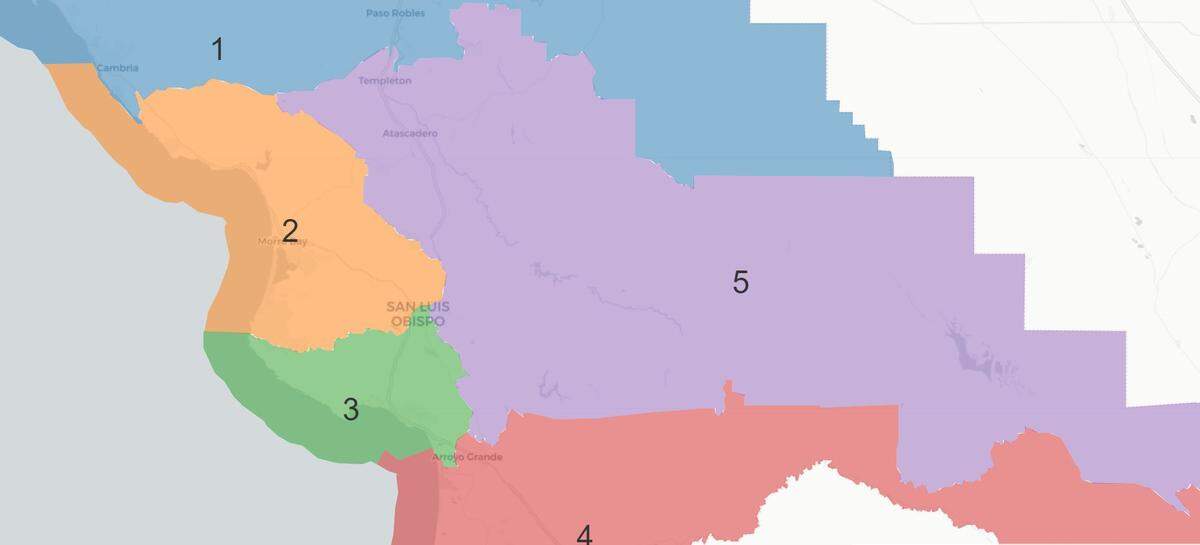
They maintain the city of San Luis Obispo is one community and, as such, should be represented by a single supervisor, rather than three as it is now.
For that to happen, District 5 — represented by Supervisor Debbie Arnold — would no longer extend into San Luis Obispo. To make up for that loss in population, 5 would pick up territory from District 1.
To balance out District 1 — represented by John Peschong — its lines would be adjusted to reach all the way to the coast, picking up Cambria and breaking up the North Coast district represented by Bruce Gibson.
The net result: There would be only one “safe” district for liberals — District 3, represented by Dawn Ortiz-Legg.
Yes, it’s politically motivated
Most advocates of the plan aren’t admitting it, but this is a highly political move.
One of the county’s leading conservative voices — Mike Brown, the executive director of COLAB — acknowledged as much in the organization’s recent newsletter.
“The crucial issue at hand is that both the left progressives and the conservatives will struggle to seek the best voter advantage based on how their respective voters are distributed geographically,” the newsletter says.
“The biggest threat to conservative and rational values comes from some city of SLO precincts, Cal Poly precincts, Oceano and some of the large planned golf communities in Nipomo,” it goes on to say.
Liberals also have an agenda, which is to prevent the current conservative majority from solidifying its power.
They want to keep Oceano’s large population of Democrats in District 4 to increase their chances of defeating conservative Supervisor Lynn Compton in 2022. And they very much oppose breaking up the North Coast, which has long been a liberal stronghold.
What do supervisors say?
Gibson strongly favors a proposed map that makes only minor changes to existing lines. Ortiz-Legg, the other liberal on the board, opposes putting the city of SLO in a single district.
“I don’t think you really want to have one supervisor holding the city of San Luis Obispo. It has a diversity to it,” she said at Tuesday’s hearing.
From the three conservative supervisors — Arnold, Compton and Peschong — we heard crickets.
All three declined to comment on any of the proposed maps, saying they preferred to wait until all maps are in. (The public still has the opportunity to submit proposals.)
Nor did they give any clue as to whether they’re inclined to keep things more or less the same or make major changes.
But in a telephone interview on Thursday, Supervisor Peschong said he’s leaning toward keeping the city of San Luis Obispo in one district.
“I am,” he said, “but I want to see other possibilities.”
“I’d like to see all seven cities whole,” he added.
North Coast communities should stay together
Some boundary changes may be in order, but putting top priority on keeping San Luis Obispo in a single district would come at too steep a cost.
The major shakeup in boundaries would be confusing for voters, it would generate even more distrust among moderates and liberals, and would come at the expense of breaking up the North Coast.
That truly is an area with common interests — communities are linked by Highway 1, they are hugely dependent on tourism, they come under the purview of the Coastal Commission, they care strongly about the conserving the coastal environment and they have historically been in the same district.
What’s more, judging by comments submitted by residents of the North Coast, they very much oppose the breakup of their region.
The majority of residents of San Luis Obispo, on the other hand, don’t appear too concerned about being divided among three districts.
There was no large contingent of SLO residents at the hearing, clamoring to be in a single district.
No Cal Poly students agitating to be let out of District 5.
Yet we did hear plenty from residents of Cambria who don’t want to be lumped into the same district as Paso Robles.
Would the board majority ignore their wishes — and break up their “community of interest” — in order to keep the city of SLO in one district?
Would they disregard the many Oceano residents who want to remain in District 4 — listening instead to a specious argument that Oceano has more in common with Grover Beach than Arroyo Grande?
Would they actually fall for the ridiculous idea that it would be good to have four supervisors represent the coast, rather than three, because it would give the county more clout with the Coastal Commission?
Would they buy into the notion that District 5 is “rural” and should therefore be completely separate from the city of San Luis Obispo, overlooking the fact that District 5 includes the third largest city in the county and serves as a bedroom community for residents who commute to San Luis Obispo for work?
These arguments are nothing more than weak talking points aimed at keeping conservatives in control — to neutralize, in the words of COLAB, “some city of SLO precincts, Cal Poly precincts, Oceano and some of the large planned golf communities in Nipomo.”
The majority of San Luis Obispo County residents do not share that cynical, hyper-partisan view, and it’s time for them to join the discussion.
Given the uneven distribution of our county’s population and its large size — in area, we’re 16th out of the 58 counties — it’s a huge challenge to meet all redistricting goals, which include keeping district populations relatively even; making districts compact; and keeping communities of interest intact.
There is never going to a perfect map that meets every single requirement with flying colors.
And that’s OK. What we should strive for is a map that conforms to legal criteria and has the most buy-in from the most people.
So don’t sit back while a map is rammed through the approval process by a board majority that’s repeatedly placed priority on catering to its conservative base, rather than listening to all the residents of San Luis Obispo County.
Let the Board of Supervisors know our county deserves a final redistricting map that respects true communities of interest and serves all residents — not just narrow partisan interests.
This story was originally published October 29, 2021 at 5:15 AM.