SLO County board talks election maps — 2 would drastically change supervisor districts
San Luis Obispo County voters are re-envisioning the boundaries of their five supervisor districts, with some lobbying to maintain the status quo and others saying the political map needs a complete shakeup.
The county Board of Supervisors on Oct. 26 considered the first slate of draft maps in the redistricting process, which takes place every 10 years and uses new U.S. Census data to redraw the boundaries around the areas supervisors represent.
A committee of county staff is in charge of redistricting, with help from a consulting firm, Redistricting Partners. The maps supervisors will consider throughout the process — which will continue through December — can come from staff or residents, who can draw and submit their own boundaries.
Some of the maps supervisors considered on Oct. 26 hewed closely to the current district layout. Others totally changed the geographic makeup of the districts, breaking up some long-contiguous regions, like the North Coast.
On Oct. 26, Supervisors John Peschong, Debbie Arnold and Lynn Compton declined to share their opinions about the draft maps until the next meeting on Nov. 19. But Supervisors Bruce Gibson and Dawn Ortiz-Legg pushed back against some substantial changes residents suggested.
Gibson said he’s against breaking up the North Coast region, which he represents as the District 2 supervisor. And Ortiz-Legg suggested it would be better to continue splitting the city of San Luis Obispo between districts, instead of having just one supervisor represent it, as some residents proposed.
“I will oppose any redistricting that breaks up the communities on the North Coast, certainly from Los Osos to the county line, which have traditionally been held together, which have a long history, which have the obvious economic shared interests and the interest in Highway 1,” Gibson said.
Maps range from maintaining status quo to making significant changes
County staff on Oct. 26 presented four draft maps, as well as several drawn by residents.
All maps must follow a series of legal criteria. The five districts must contain roughly the same number of people, and they must be contiguous, meaning one area’s boundaries can’t jump over those of another area.
The districts should also maintain “communities of interest” with common characteristics, they should follow city and Census boundaries and they should remain as compact as possible in shape.
The county doesn’t technically need to change its supervisor district boundaries, as the populations haven’t shifted beyond legally allowable limits, Chris Chaffee, Redistricting Partners chief business officer, told supervisors at the meeting.
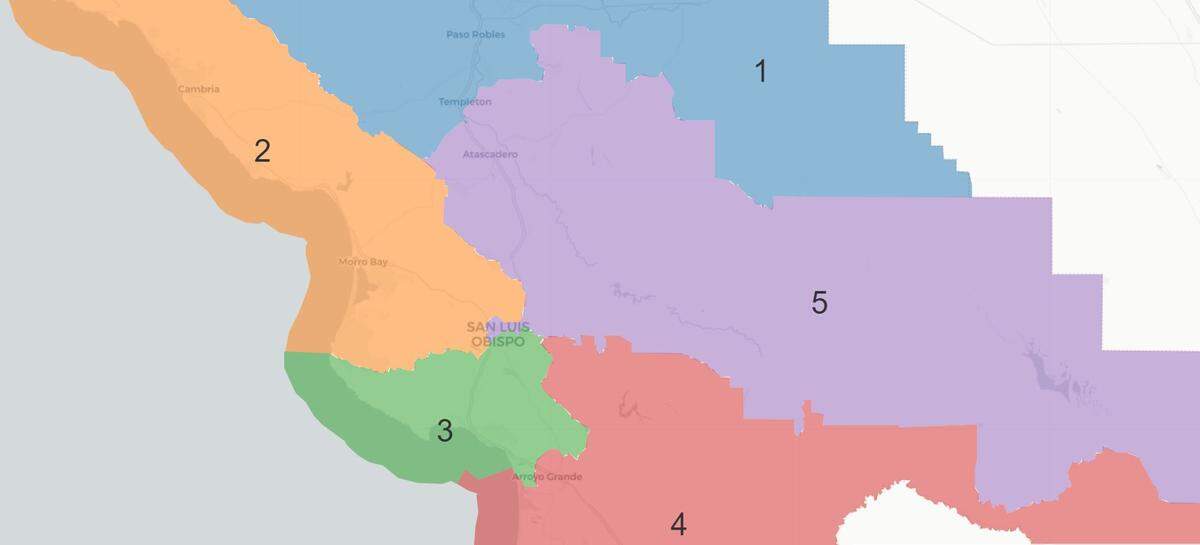
Of the maps created by staff, Plan A kept the districts closest to the current boundaries, with minor adjustments to account for Census updates.
Plan C would change things the most by removing the city of San Luis Obispo from District 5 and breaking up the North Coast, placing Cambria and San Simeon in District 1 with Paso Robles.
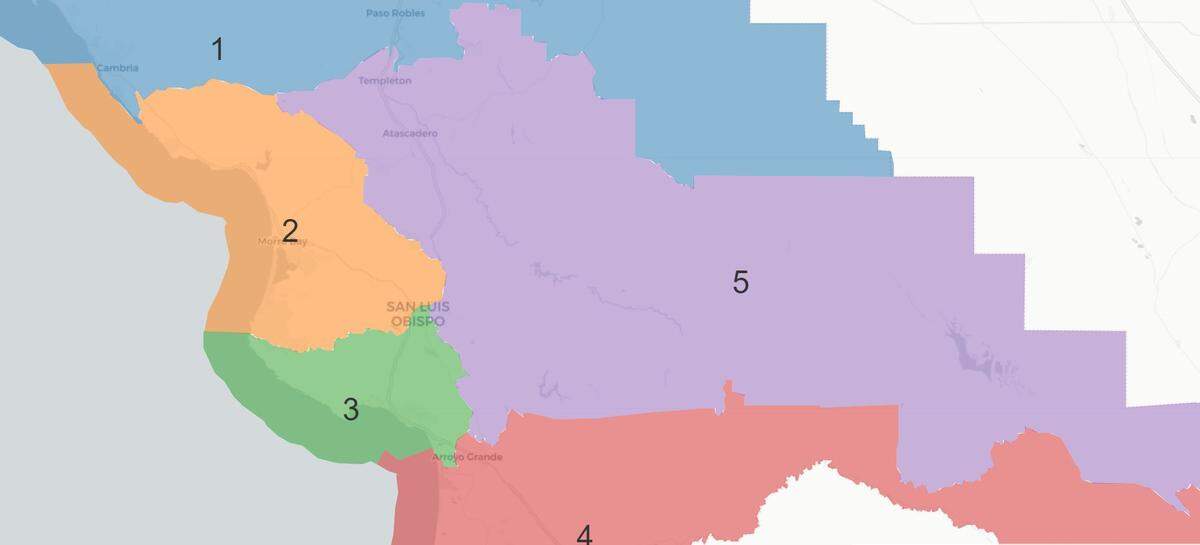
San Luis Obispo has traditionally been split between districts because it’s the county’s largest population center, and it’s challenging to allocate the correct number of people to the other areas without including at least part of the city, Chaffee said.
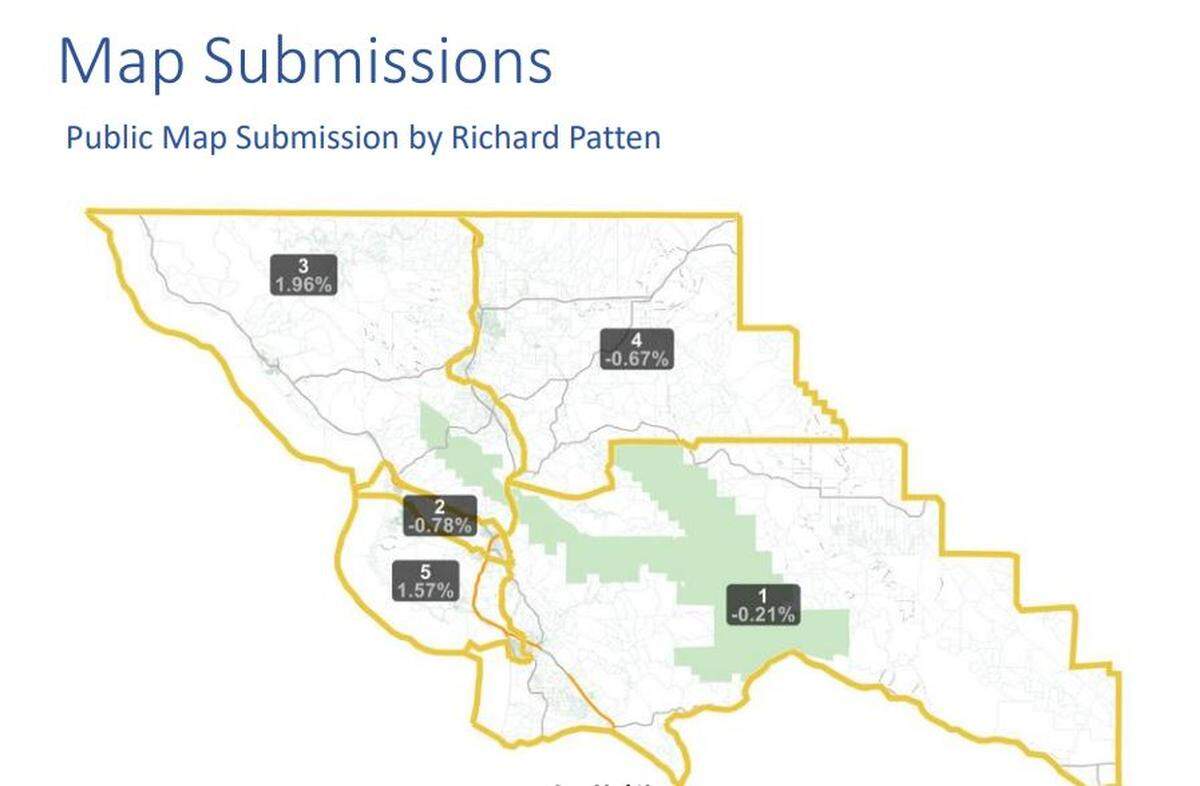
A map drawn by resident Richard Patten would alter district boundaries even more. Patten’s map moves the cities of San Luis Obispo and Morro Bay into one district. It also creates one North Coast-North County district and another district that encompasses the eastern half of the North County.
Another district includes the South County and the southeastern half of the county, and a final district contains Avila Beach and other unincorporated areas south of San Luis Obispo.
SLO County residents provide feedback on redistricting maps
Nearly 30 residents attended the Oct. 26 meeting and provided comments on the maps. Some lobbied to maintain the North Coast region, some pushed to keep Oceano in District 4 and some urged supervisors to avoid Plan C and keep the status quo.
“We are a community of interests as a group of coastal towns with unique issues of our own, issues that inland residents don’t really know or understand,” said Sue Morgen Thaler of Los Osos. “We’re also a community of interests of mostly unincorporated towns, and we need representation together. Incorporated cities have city councils made up of people who are dedicated to helping their residents. Unincorporated towns don’t have that.”
A contingent of speakers also supported Patten’s map, saying San Luis Obispo needs its own district and the county needs to change up the district map it’s maintained for more than 20 years.
“The Richard Patten map, which is my map, respects communities of interest by leaving them intact,” Patten said. “They do not divide SLO city, but leaves it intact. (It) enables four supervisors to manage the Coastal Commission. It keeps geographic areas with common social and economic interests, intact, benefits many other citizens without dividing it for the purpose of political gainsmanship.”
The Board of Supervisors will hold another hearing to discuss redistricting maps on Nov. 19.
This story was originally published October 27, 2021 at 2:11 PM.