San Luis Obispo groundwater pumped beyond sustainable levels, new report shows
Drought conditions and overpumping have caused the San Luis Obispo Valley groundwater basin’s water levels to plummet in the past year, according to a new report.
The report, released in mid-March, outlines how much water was estimated to be pumped from the basin — comprised of the San Luis and Edna Valley subarea basins — in 2021 compared to previous years.
Overall, 6,280 acre-feet of water were extracted from the basin last year, above the basin’s estimated sustainable yield of 5,800 acre-feet per year, according to the report and the basin’s groundwater sustainability plan.
An acre foot of water is about 326,000 gallons, or enough to cover an entire football field in a foot of water.
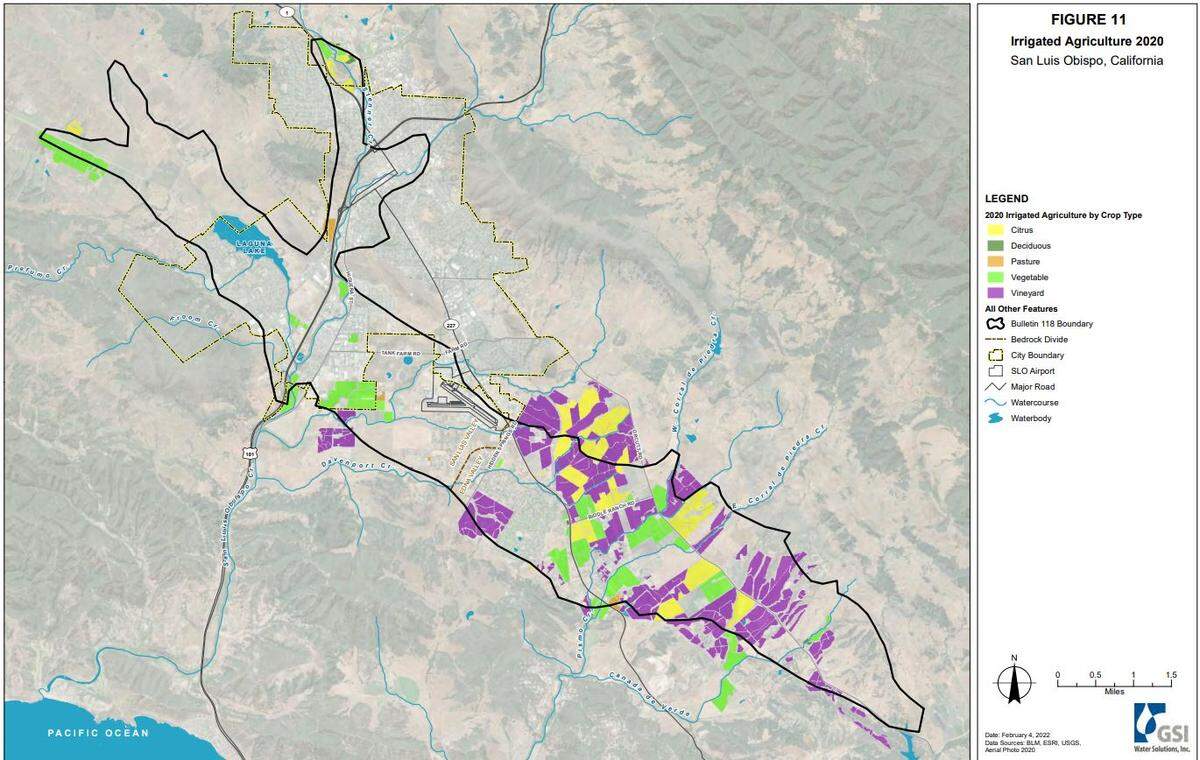
Agriculture used the majority of that water: 5,030 acre-feet, up from 4,960 acre-feet the year before.
“It was another dry year, the crops didn’t get the water they needed from the rain,” said Blaine Reely, San Luis Obispo County’s groundwater sustainability director.
Public water systems and rural domestic users pumped 1,250 acre-feet of water from the basin in 2021, the same amount as the year before, the report says. The city of San Luis Obispo did not use any of the groundwater.
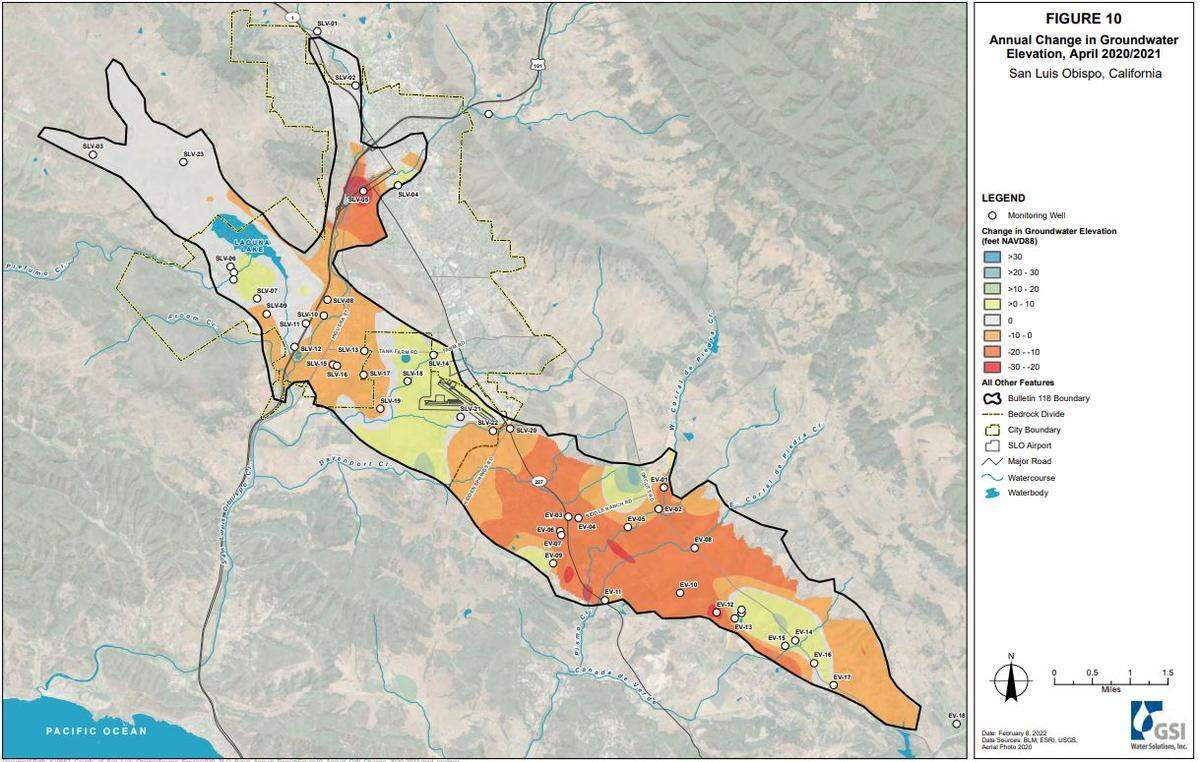
The unsustainable pumping coupled with a year with little rainfall to replenish the basin meant that the amount of groundwater in storage plummeted by 5,530 acre-feet, according to the report.
San Luis Obispo has received about 9.43 inches of rain, or around 59% of the normal rainfall seen in the rainy season by this time of year, according to the National Oceanic and Atmospheric Administration.
Since 1986, the San Luis Obispo Valley groundwater basin has seen a net loss of 28,580 acre-feet of water, according to data compiled in the groundwater sustainability plan and the annual report for the basin.
The basin now holds roughly 140,000 acre-feet of water, according to the sustainability plan.
The basin is considered to be in overdraft by about 400 acre-feet per year, according to its sustainability plan.
How do parts of SLO Valley water basin differ?
Reely noted that the San Luis portion of the basin — everything to the northwest of Hidden Springs Road — is relatively stable and has a surplus of about 700 acre-feet per year of groundwater.
The Edna Valley portion, on the other side of Hidden Spring Road, is in an overdraft of about 1,100 acre-feet per year of groundwater, and that’s largely due to the great amount of agriculture irrigation pumping occurring in that area, Reely said.
The two sides of the basin are hydrogeographically distinct, Reely noted, meaning the overdraft in the Edna Valley side likely has little-to-no impact on the San Luis side.
Even so, the two halves of the basin are considered together when looking at the sustainability of the groundwater pumping in the area.
“It is clear that historical groundwater pumping in excess of the sustainable yield has created challenging conditions for sustainable management,” the annual report says. “However, actions are already underway to collect data, improve the monitoring and data-collection networks and coordinate with affected agencies and entities throughout the basin to develop solutions that address the shared mutual interest in the Basin’s overall sustainability goal.”
The county and city of San Luis Obispo developed a groundwater sustainability plan for the San Luis Obispo Valley basin because it is considered a high priority basin under the California Sustainable Groundwater Management Act (SGMA, pronounced “sigma”).
The basin’s characterization is largely due to its heavy pumping and declining groundwater levels over the past several decades.
To help potentially reduce the groundwater pumping on the basin, the sustainability plan — which has yet to be approved by the state Department of Water Resources — has proposed several projects including bringing in state water and recycled water from San Luis Obispo and the Sentinel Peak oil field operation near Arroyo Grande to offset the basin’s use.
Additionally, the county and city have expanded the number of groundwater wells that monitor the water levels in the basin.
“We have a big toolbox filled with possibilities to get this basin to sustainability,” Reely said.
Agriculture looking at more water-smart farming methods
Beyond finding ways to increase the amount of water supplied to the San Luis Obispo Valley basin, Bob Schiebelhut, chair of the basin’s groundwater sustainability commission and longtime resident of Edna Valley, said he and many other local farmers are working on ways to decrease the amount of water their crops demand.
Partnering with Cal Poly, farmers in the area are studying whether there is a more ideal time to irrigate their crops depending on when the most evaporation occurs. And many of the local vineyard owners are working to plant less thirsty vines, Schiebelhut said.
“Twenty-five to 30 years ago, we weren’t as cognizant of our water issues and we planted a rootstock that wasn’t as water smart,” he said. “Now, because vineyards are typically planted in 25- to 30-year cycles, everyone is replanting with a rootstock that’s much more water-efficient.”
However, water-smart vineyard owners play only a partial role in working toward a sustainable groundwater basin.
The annual report noted that in 2020, about 400 acres of vineyards in Edna Valley were replanted with citrus — which can use more than twice the amount of water per acre than vineyards.
Schiebelhut said hoping for more rain is not the plan — especially as the average annual amount of rainfall in San Luis Obispo has fallen over recent decades — but rather focusing on measurable objectives and projects that will provide for conserving water from being pumped and finding reliable sources of outside water to recharge the basin.
“You’ve got to embrace the problem to solve it,” he said. “I really believe we’re going to achieve sustainability. And no one wants sustainability more than the farmers.”
This story was originally published April 11, 2022 at 8:00 AM.