Is this SLO County community running out of water? A plan wants to bring in more homes
In Los Osos, it’s hard to go anywhere without seeing water.
The Morro Bay estuary and the Pacific Ocean border the backyards for many homes in the unincorporated community of about 16,000 people in coastal San Luis Obispo County.
But it’s another source of water — one you can’t see without turning on your tap — that is causing concern.
Seawater intrusion and nitrate pollution is impacting the Los Osos water basin, the community’s only drinkable water source, an issue worsened by the extreme drought conditions facing San Luis Obispo County.
The crisis has impacted Los Osos since the 1970s and ‘80s when development of the community 12 miles from San Luis Obispo exploded. That caused drinking water levels to plummet and the water basin to become polluted due to seawater intrusion and nitrates leaking from septic systems in densely populated areas.
“We have an infinite amount of water in Los Osos,” said Charlie Cote of S&T Mutual Water Co., a small water purveyor in the community. “It’s just that a lot of it’s not drinkable.”
The California Department of Water Resources classifies the Los Osos water basin as “critically overdrafted,” under the Sustainable Groundwater Management Act. However, the basin was adjudicated in 2015 so the act does not technically apply to it.
Seawater intrusion and nitrate contamination have caused much of the town’s water to be contaminated.
Possible solutions to the pollution — such as bringing in state water through a pipeline or building a local desalination plant — are too expensive for the community, according to San Luis Obispo County Supervisor Bruce Gibson and the local water purveyors. And conservation programs have yet to turn around the water crisis.
Los Osos is now at a turning point. The San Luis Obispo County Board of Supervisors has adopted a plan that would allow for the town to grow 29.1% by 2040, if the water basin is proven to be sustainable.
Currently, most development is prohibited within the town’s urban limits because of the town’s water issues.
The Los Osos Community Plan, the county’s wide-ranging blueprint for how the community will grow and develop over the next 20 years, is now in the hands of the California Coastal Commission, which will decide whether it adheres to the California Coastal Act by protecting coastal resources — such as groundwater and sensitive habitats for plants and animals.
“This is obviously a huge priority for us because quite literally an entire community’s future is hinging on this plan,” said Kevin Kahn, Central Coast District supervisor for the Coastal Commission. “So we don’t take that lightly at all.”
Meanwhile, the Santa Lucia chapter of the Sierra Club has expressed doubts that the plan is feasible.
“As written, the proposed Los Osos Community Plan (LOCP) would only exacerbate the various stressors on the basin and contribute to its instability,” Gianna Patchen wrote in the club’s January and February newsletter. “This plan heavily assumes that the water basin is reliable, which has not been confirmed, and that if the development turns out to be unsustainable, it can be scaled back before triggering unrecoverable seawater intrusion. This misplaced confidence leaves the entire Los Osos community at risk, from current residents to anyone who would move there as a result of the LOCP.”
The need for affordable housing in San Luis Obispo County must be balanced with the ability to supply that growth with water Patchen wrote.
Can drinking water supply meet demand?
Three local water purveyors — Golden State Water Co., S&T Mutual Water Co. and the Los Osos Community Services District — provide drinking water to a total of roughly 5,600 customers in Los Osos. They say increasing water demand in the town doesn’t appear to be feasible at this point.
“Because of the inconclusive results of our monitoring that would truly indicate we’re moving forward towards that sustainability, we’re reluctant as water purveyors to take on new customers at this point,” said Ron Munds, general manager of the Los Osos Community Services District, which currently provides water for about 2,780 customers.
The Los Osos Community Services District and S&T Mutual Water Co. both have enacted water shortage emergencies, meaning they will no longer issue “will serve” letters to new customers due to drought conditions and the status of the water basin.
Golden State Water Co., on the other hand, is a state-regulated water purveyor, so it would ultimately need to get approval from the California Public Utilities Commission in order to stop issuing “will serve” letters.
“That’s a complicated, long process,” said Mark Zimmer, general manager of Golden State Water Co.’s Los Osos service area. “What we’ve done, instead of going down that pathway, is we’ve put all of our resources into the basin plan, the Basin Management Committee and in creating a sustainable basin for the community of Los Osos.”
On the county Board of Supervisors, Gibson represents District 2, which encompasses Los Osos.
He’s also a member of the Basin Management Committee, which was formed as part of a 2015 court-issued stipulated judgment. It consists of representatives from the three water purveyors and the county.
“Based on the studies that have been done, it appears that there is a quantity of water available both to provide a reliable water source for existing residents and provide for some amount of future growth — if that resource is developed appropriately,” Gibson said, referencing annual water basin monitoring reports authored by Cleath-Harris Geologists, Inc.
Those reports give an overview of the status of the basin — noting the levels of nitrate contamination and seawater intrusion, as well as how drought and conservation programs are impacting Los Osos’ drinking water source.
Los Osos water basin reports show deteriorating conditions
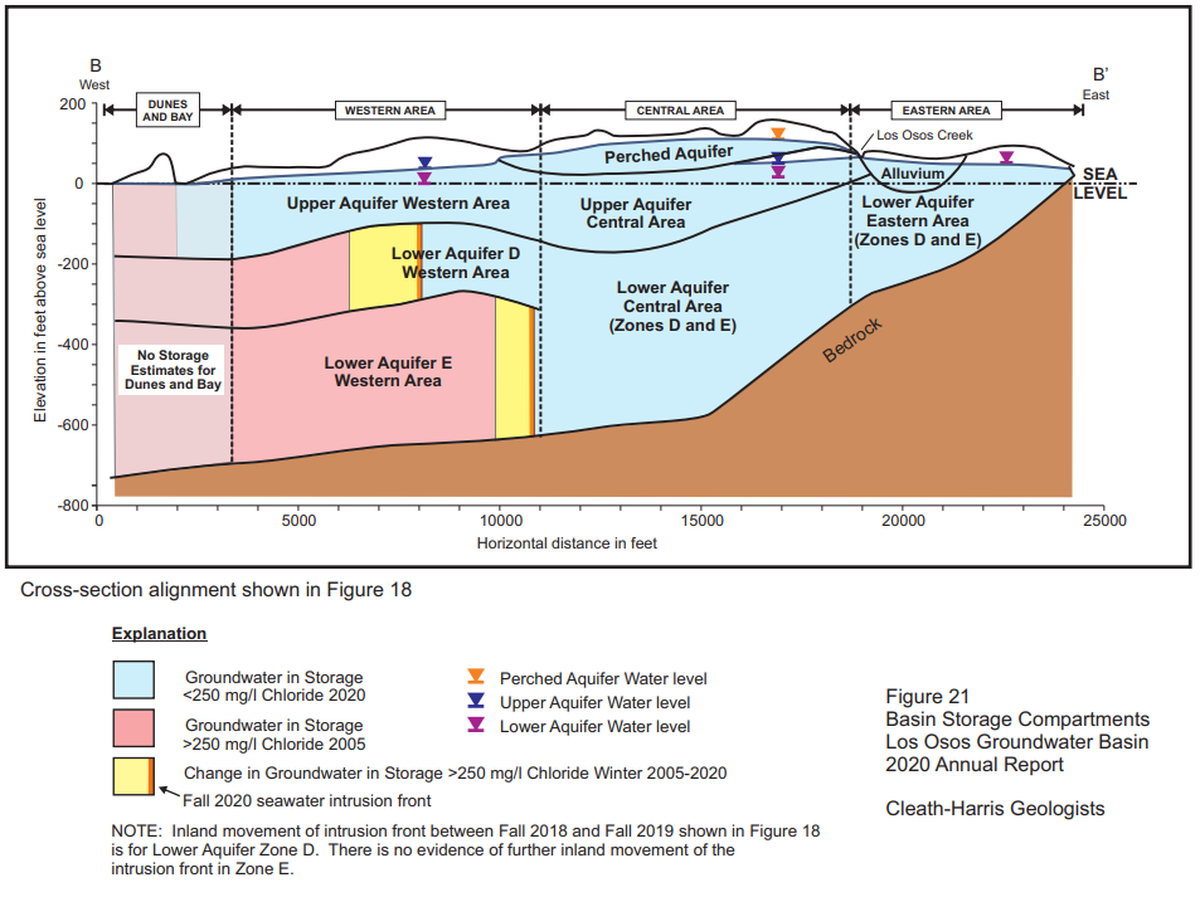
In its most recent report on the Los Osos water basin, which looked at conditions in 2020, Cleath-Harris Geologists notes that the water basin has not substantially improved in recent years.
In fact, the San Luis Obispo-based company noted, some metrics show a deterioration of water quality.
Seawater intrusion has moved “several hundred feet inland between fall 2019 and fall 2020,” which is reflected in the amount of chloride measured in wells that tap into the basin, according to the report.
This indicates “that seawater intrusion has not yet been mitigated,” and has worsened, the report said.
Worsening seawater intrusion is largely due to the water level of the western lower aquifer wells, the wells closest to the Morro Bay estuary, which Cleath-Harris reports are at an average of 1.8 feet above sea level, down from 2018 levels.
The target water level is 8 feet above sea level, an elevation that would prevent any seawater intrusion by effectively using the fresh water to push the seawater away from the water basin, according to Cleath-Harris.
The level of nitrate contamination in the Los Osos water basin — caused by runoff from nearby farms and historical pollution seepage from septic systems — hasn’t met targets either, although it has improved over the last year.
The overall concentration of nitrate-nitrogen in the water basin is at about 20 milligrams per liter, twice the U.S. Environmental Protection Agency’s healthy drinking water standard, the Cleath-Harris report says.
That’s down from 22 milligrams per liter in 2019, according to the report.
A septic system moratorium imposed by the California Central Coast Regional Water Quality Control Board in 1988 encompassing the urban areas of Los Osos was supposed to stop or at least manage nitrate contamination in the groundwater basin. Although it appears to have worked in part as nitrate contamination levels on average slowly decrease, ongoing nitrate contamination has caused S&T Mutual Water Co. to shut down three of its four public water wells.
“There’s no question right now that the current state of the S&T water supply is not sustainable,” said Cote, chief operator at the company. “Our S&T well number 5, which is our only remaining water source, is likely to exceed the maximum contaminant limit for nitrate within 10 years. And so we’re still searching for a new water source.”
Cote noted that a new water source could cost from $500,000 to $1.5 million — a bill that the company’s 179 customers would have to foot.
There are five other public water wells in Los Osos owned by Golden State Water or the community services district that are also either threatened by nitrate pollution or have already shut down because nitrate levels exceed safe drinking water levels.
“The water supply in Los Osos is not in a sustainable condition today for its present population,” Cote said.
Overall, groundwater storage in the Los Osos water basin increased from spring 2019 to spring 2020, according to Cleath-Harris’ report. However, that’s mostly due to the addition of a groundwater well to the monitoring data, the report says.
Groundwater production — how much water the purveyors, private well owners and agricultural well owners pulled from the basin — increased 6% from 2019 to 2020, the report says.
“Agriculture and other rural residential areas that are on their own wells, not many of those wells are metered and none of those extractions are actually reported,” Gibson said. “But we have basically a good idea of how much water’s being drawn out of the basin.”
According to the Cleath-Harris report, agricultural withdrawals from the Los Osos water basin account for an estimated third of the basin’s total production.
Meanwhile, water purveyors supplying water to most of the residents of Los Osos accounted for about 53% of the basin’s total withdrawals in 2020, the report says.
The 2020 report determines that groundwater extractions from the basin are at 73% of safe yield. But water purveyors debate that number, after approving the annual report, because they say they’re concerned about how the sustainable yield of the basin was calculated.
Measures taken to address sustainability of water basin
Over the past few decades, several measures have been taken to increase the yield and sustainability of the Los Osos water basin so that at least the current population can have a healthy drinking supply.
In 1988, the regional Water Quality Control Board prohibited septic systems in the most densely populated areas of Los Osos, commonly referred to as the prohibition zone.
That prohibition is still in effect today and essentially bans anyone from building a new home in Los Osos. The ban remains in place even though nearly all properties are now hooked up to the new sewer system beginning in mid-2016.
In 2015, a Basin Plan for the Los Osos Groundwater Basin was prepared and adopted by the three local water purveyors and the county as part of the adjudication of the groundwater resources in the basin.
“The most important goals are to halt seawater intrusion into the basin and to provide sustainable water supplies for existing and future residential, commercial, institutional, recreational and agricultural development within Los Osos,” the basin plan states.
As a result, new wells have been drilled or will be drilled soon in the upper aquifer away from the seawater-contaminated water. And water treatment facilities were recently installed to effectively sanitize water being withdrawn from wells contaminated with nitrate.
The county-initiated Los Osos water recycling facility opened in 2016 and has been pumping highly treated wastewater to be used for irrigation at locations such as the Sea Pines Golf Resort.
In addition, treated wastewater will be recharged into the water basin within the next several years through leach fields at the Broderson site located off Highland Drive and Broderson Avenue in Los Osos.
Meanwhile, any new water-using development in Los Osos is required by the county to offset their water use 2:1 — saving twice as much water as they consume.
Mandated water conservation has decreased the per capita amount of water withdrawn from the basin, and the amount of water estimated to be withdrawn by area farms has decreased, according to the Cleath-Harris 2020 monitoring report.
Despite all of those efforts, water purveyors are still urging caution before building more homes.
“You can’t conserve your way to sustainability at this point,” said Chris Gardner, a member of S&T Mutual Water Co.’s board of directors. “I think we’re optimistic that the (Basin) Plan they have in place is going to work. I mean, it better. But we kind of feel that it hasn’t gotten there yet. And it just hasn’t been given enough time to prove itself.”
Community plan calls for population growth of Los Osos
If approved by the Coastal Commission, the Los Osos Community Plan would allow about 1,844 new homes to be built in Los Osos by 2040, an overall increase of 29.1%, or 1.3% annually.
Over the last several months, the Los Osos Sustainability Group — a group of community homeowners that advocates for the sustainability of the water basin — has appealed any new development projects using water approved by the county to the Coastal Commission.
Patrick McGibney, chair of the Los Osos Sustainability Group, said the appeals are necessary.
“We need to stop any new water demand in Los Osos until there is a sustainable water supply,” he said. “Once we have a sustainable water supply, welcome, come all. We’d love to have more people come experience Los Osos.”
He said the group appeals any new developments that demand water use to the Coastal Commission because the commission requires as part of its coastal development permit for the Los Osos wastewater project that the county must have “conclusive evidence” that an adequate water supply exists to serve any new demand.
That evidence just doesn’t exist yet, McGibney said, evidenced by the Cleath-Harris reports that show continuing deterioration of the water basin in recent years.
San Luis Obispo County’s Los Osos Community Plan allows for flexibility in the annual growth rate of Los Osos with the sustainability of the water basin by using an “adaptive management approach,” according to Trevor Keith, county Department of Planning and Building director.
“Adaptive management involves analyzing both program implementation and data gathered as part of ongoing basin monitoring in order to assure the basin resource is being used sustainably,” Keith told The Tribune via email. “The objective is to set growth rates so that adaptive basin management will be effective in assuring the water supply is sustainable.”
In essence, the growth rate of Los Osos over the next 20 years will be determined on whether the water conservation programs implemented are successful by monitoring the water basin data, Keith explained.
“I’m optimistic that we can solve these problems,” Gibson said. “I’m optimistic that there is a resource there that can be developed in a way that is sustainable and does provide for some reasonable amount of growth.”
Whether Los Osos will see 29.1% growth by 2040 is yet to be determined.
The Coastal Commission is reviewing the Los Osos Community Plan and gathering data needed to ensure it can either approve the plan or recommend changes.
The Coastal Commission is mandated to uphold the Coastal Act, which requires that new development be served by adequate public services, including water.
However, a new state law says local governments must not “unreasonably restrict the ability of homeowners to create accessory dwelling units in zones in which they are authorized by local ordinance” due to California’s housing crisis.
Accessory dwelling units, commonly referred to as ADUs, are “an essential component of California’s housing supply,” according to the state. The state law effectively streamlines the process to create ADUs and incentivizes local governments to allow ADUs.
“In Los Osos, the key is to understand what level of growth the underlying resources can accommodate,” Kahn said. “If the data and the science suggests that there’s still not enough water to supply ADUs, for example, it would be within both the ADU law and the Coastal Act to not allow it.”
The Coastal Commission will also be looking at how future development in Los Osos may be possible because essentially the entire area is considered an environmentally sensitive habitat area, or ESHA, and therefore receives utmost protection under the Coastal Act from any damaging development or activity.
Therefore, Kahn said any development likely allowed by the Coastal Commission in Los Osos will be infill and within the community’s urban reserve line, which aligns with the county’s Los Osos Community Plan.
“For such a small little town, this is one of the more complicated planning exercises that we’ve done,” Kahn said.
Kahn said he hopes to have a staff report regarding the feasibility of the Los Osos Community Plan to the Coastal Commission by the end of this year. The commissioners would then vote on whether to approve the community plan or make changes accordingly.
This story was originally published July 22, 2021 at 5:00 AM.
CORRECTION: This article was updated to more accurately reflect that, although the California Department of Water Resources has categorized the Los Osos water basin as critically overdrafted, the basin was adjudicated so the Sustainable Groundwater Management Act does not apply to it. Additionally, the article was updated to correct various inaccuracies.