Why has SLO County not leaned harder into desal? It’s trickier than you think
In many San Luis Obispo County communities, water is the single biggest limiting factor on development.
Social media commenters with a shallow understanding of water economics frequently suggest that water districts are weak willed.
The argument is, “You got all the water you need, the biggest ocean in the world is right there. Go get it.”
The Diablo Canyon desalting facility was the biggest in the nation in 1990 — so PG&E has “been there, done that, got the T-shirt.”
The county is studying desalination as a resilient source of drinking water, and there are certainly communities that need water — Nipomo, Los Osos and Cambria spring to mind.
But when wells and reservoirs are full of relatively cheap water, it is hard to sell expensive desal.
It has been a long evolution of finding the easiest cheapest water sources.
Most communities were located near streams and springs. Ditches, pipe and wells were the next option. The wealthiest and most fortunately located communities have been able to tap reservoirs, or the State Water Project pipeline.
But the communities that haven’t got a dam with a pipeline are in a difficult spot. Especially if the wells go dry or salt water or other minerals are starting to leach into overtaxed wells.
Lopez dam was funded by voters when wells in Shell Beach began to have a salty taste.
Two significant desal plants have been built in the county, Morro Bay and at Diablo Canyon Nuclear Power Plant.
Diablo’s is still in operation, they need a lot of clean water that won’t corrode and plug the pipes used to generate steam.
And conveniently they own an electricity source for the power-hungry process.
Morro Bay’s was built when drought-related mineral contamination closed more than one well in the city.
About the same time, San Luis Obispo was also facing a shortage and considering sharing costs and output of the $3.1 million plant, but the 1991 “March Miracle” rains came and delivered San Luis Obispo enough water to get to the other side of the drought.
Morro Bay kept the plant and operated it briefly, but it was dismantled in 2020.
Damaris Hanson, utilities division manager explained it in an email to Tribune reporter Stephanie Zappelli: Iron fouling limited the effectiveness of the reverse osmosis plant when it operated briefly in the 1990s.
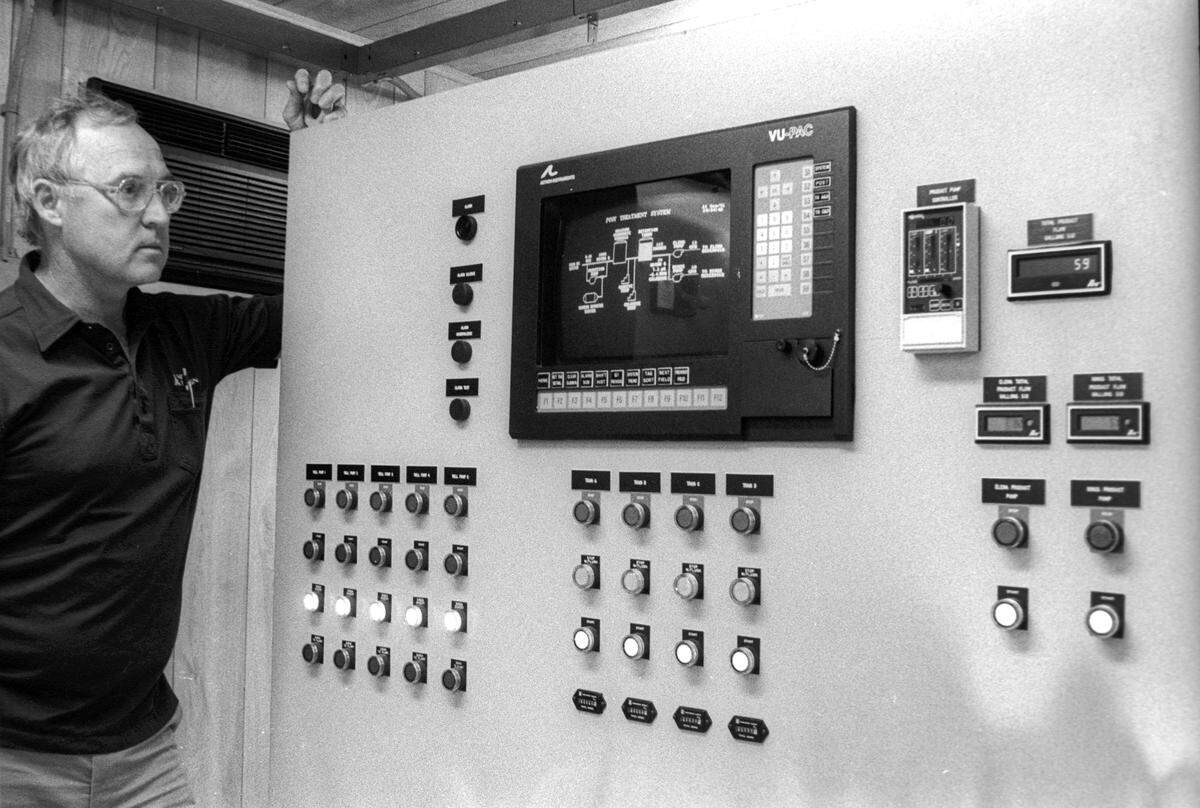
The Coastal Branch of the State Water Project was completed and soon delivered cheaper water so the RO plant no longer made economic sense.
And now waste water is cleaned to a high standard at the recently built advanced treatment facility. It is then injected into the ground to be tapped again later.
San Luis Obispo also upgraded its wastewater treatment and used it to irrigate parks, replenishing the water table. They also started a low-flow replacement policy for toilets and fixtures.
The skeptics are right that the political will to spend on infrastructure always seems to lag several years behind a crisis.
But no elected official wants to face a room full of angry ratepayers, if there is any alternative.
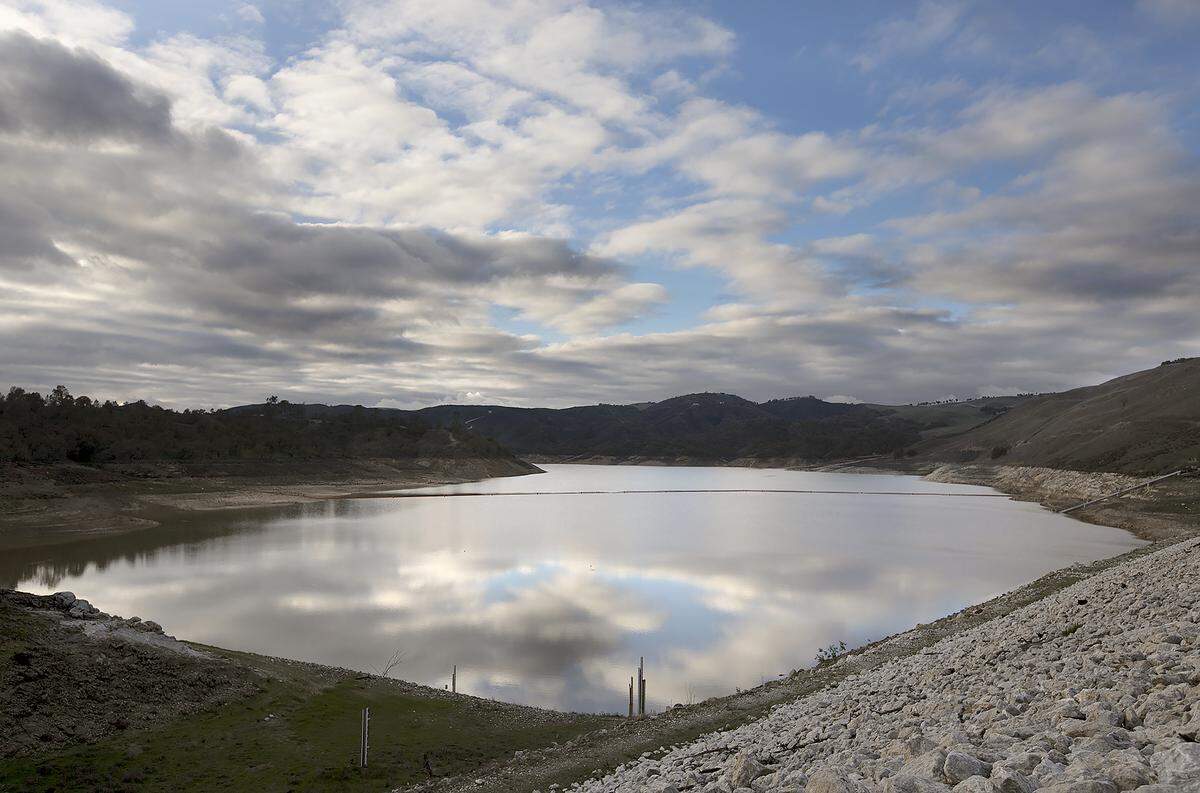
Nacimiento Dam was completed in 1956 by Monterey County and some water rights were negotiated for San Luis Obispo County in 1959. But funding to build a pipeline to deliver the water to taps and toilets would take over five decades.
Pipeline operations began in 2011.
At the time, the pipeline was the largest construction project the county had ever undertaken. So the county earned a T-shirt too.
Anyone who says the problem is easy to solve, haven’t solved it yet.
Here with a deep dive into the economics of desalting water, Phil Dirkx wrote this story for the then Telegram-Tribune during a previous drought era.
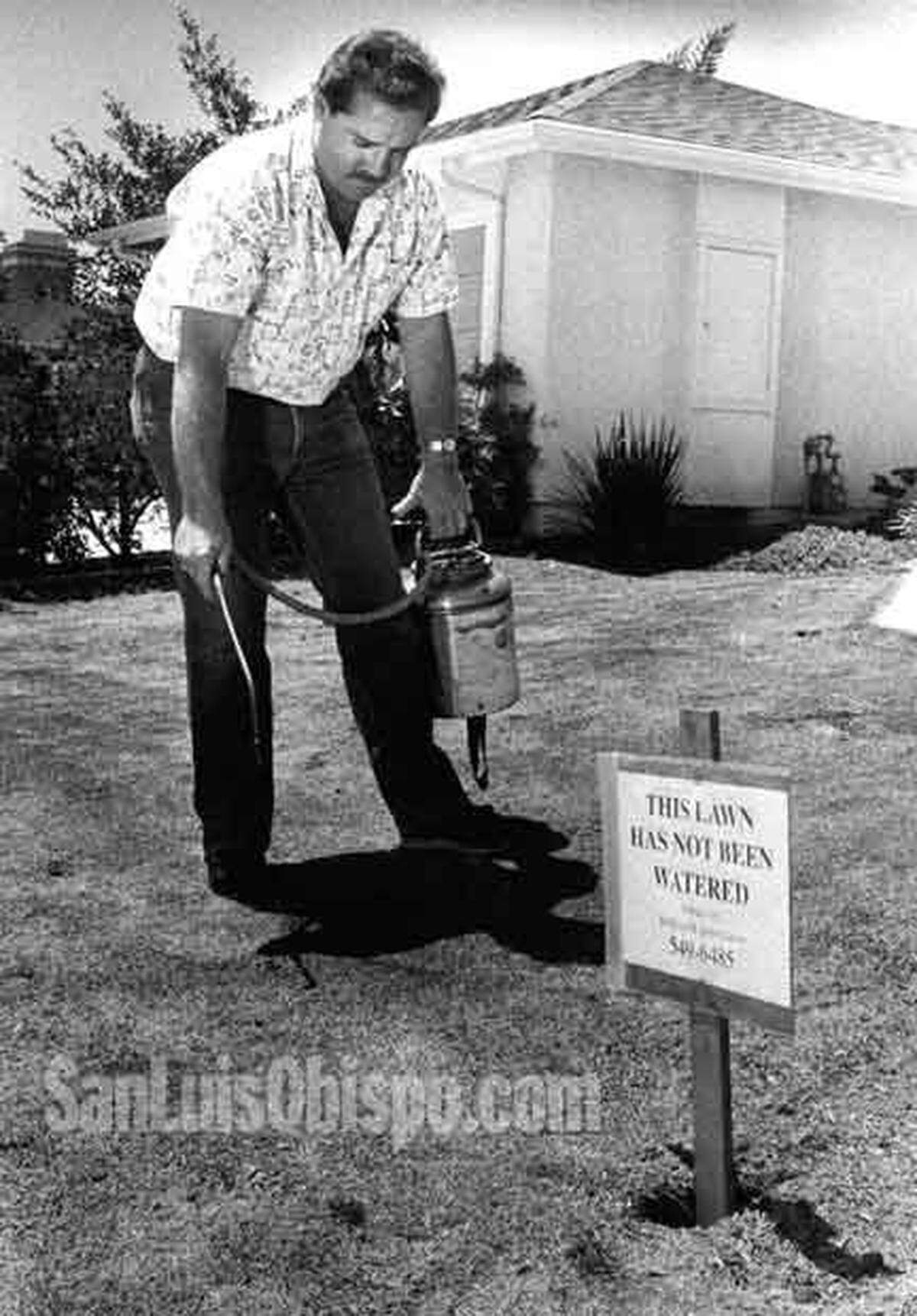
How dry was it? One local business was founded to paint dry lawns green with food coloring.
This was one of a six-day series on drought and water, published March 29, 1990:
Desalting sea water is trendy but expensive
People in this area can get all the water they want if they’re willing to pay the price.
All they have to do is desalt some of the ocean.
Engineers already know how to do it. Seawater is now being desalted into drinking water on ships and in such places as Saudi Arabia and Malta.
It’s already being desalted in this county — at the Diablo Canyon nuclear power plant.
Diablo Canyon has the largest operating ocean-water desalting plant in the United States, said Mike Peterson. He ought to know; he’s the Pacific Gas and Electric Co. engineer in charge of the desalting plant.
Of course, there’s only one other seawater desalting plant operating in this country right now — at the Chevron refinery at Gaviota.
Key West island off Florida has a bigger plant, but it was mothballed after a pipeline hooked it to mainland water.
The Diablo Canyon desalting plant produces 700 acre-feet of water per year.
So, using the most common formula, the Diablo Canyon desalting plant could serve 3,500 people. But it doesn’t. Most of its water gets turned into steam to drive the turbines that generate electricity. Fresh water is as essential to the power plant as uranium.
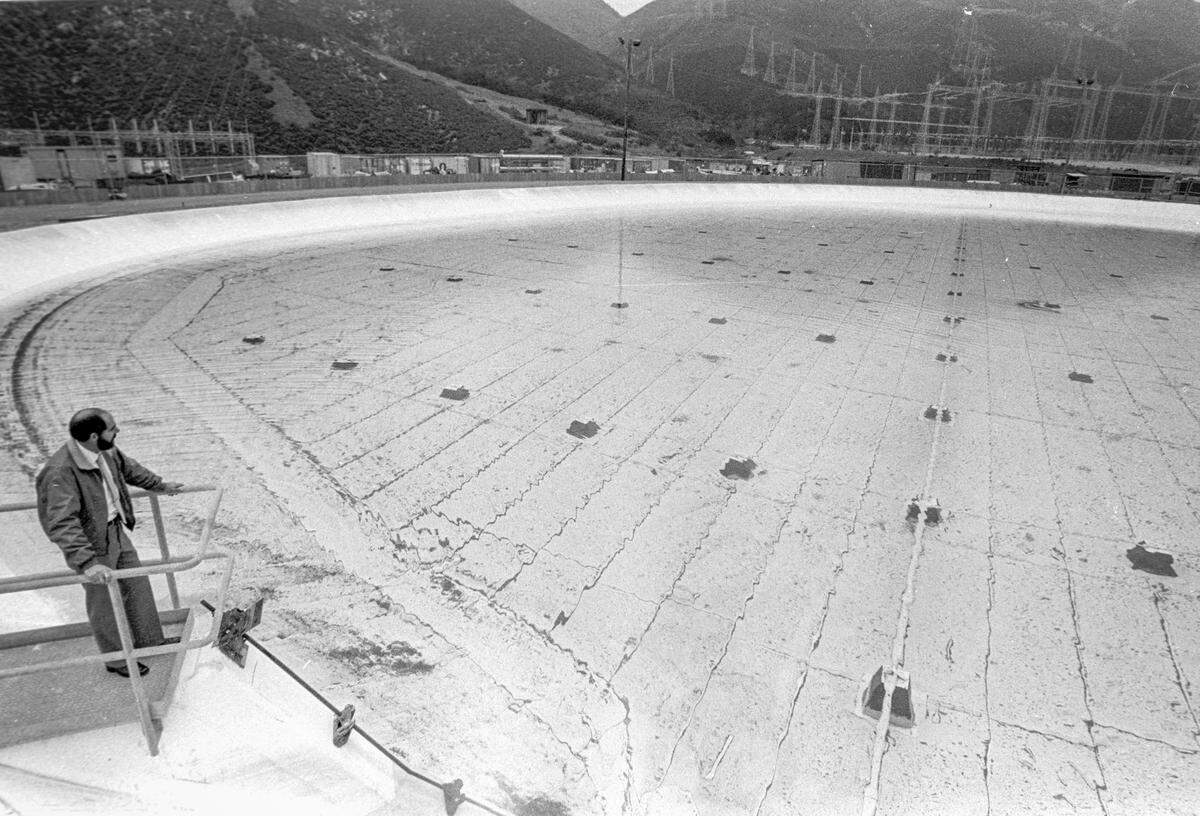
The power plant originally relied on water from wells and creeks, but they seemed to be running low in 1985, Peterson said, so PG&E ordered a desalting plant.
It was completed in September 1985, he said, having been designed and built in a little more than six months.
When people hear the word “plant,” they often think of a large building containing a lot of machinery. But this desalting plant is a collection of pipes, tubes, pumps and filters sitting out in the open on a concrete slab that measures 80 feet by 100 feet.
It was built and is operated by Hydranautics Inc. of San Diego on a contract with PG&E.
This plant produces good water for about $1,200 per acre-foot — including the cost of building the plant. But Peterson expects that cost to drop as low as $675 in 1992 when a more efficient replacement plant is to be built.
The desalting plant converts seawater — containing 35,000 parts per million of salt and other minerals — into freshwater with a mineral content of just 350 parts per million.
That’s better quality water than many people now drink in this county.
The plant does its job by reverse osmosis. Water is forced at very high pressure through 3-foot-long rolls of a special, thin plastic film called a membrane.
The water is forced through these 6-inch-diameter rolls lengthwise at a pressure of 1,000 pounds per square inch. This actually squeezes the water through the minute pores in the membrane.
The microscopic particles of salt and other minerals are so small they could pass through the pores, but they don’t. They can’t because they carry a natural charge of energy that is repelled by the membrane, Peterson said.
The membrane also stops other things that are too large to pass through its pores. These include bacteria and pesticide molecules, Peterson said.
The big cost in getting the salt out of seawater is for the electricity that runs the pumps that push the water at 1,000 pounds per square inch.
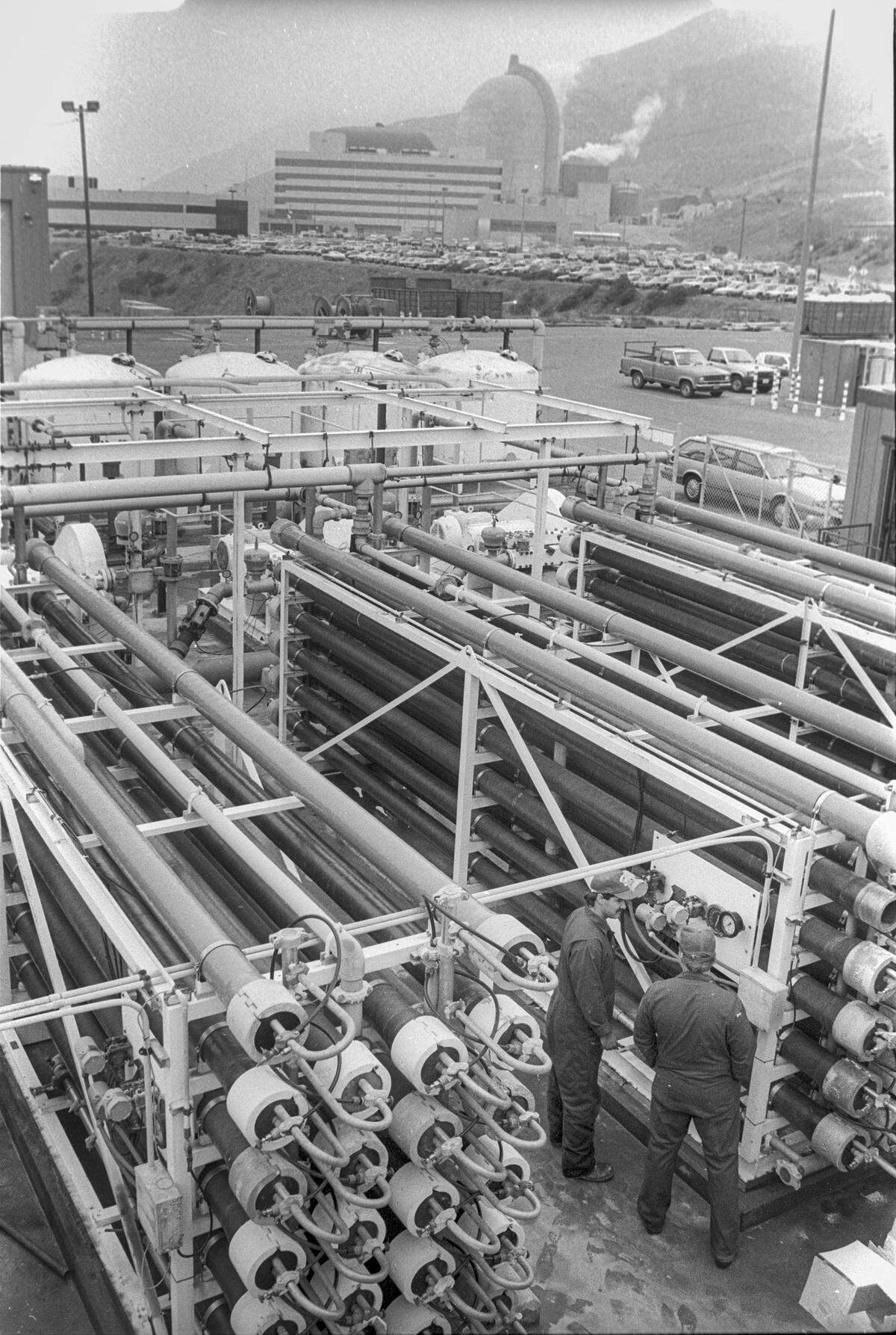
The power cost is about $450 per acre-foot of water, Peterson estimated. He figured the overhead for such things as labor, equipment and chemicals adds $200. That brings the total production cost to about $650 per acre-foot.
But that doesn’t include the cost of building the plant, he said, which was about $2.5 million. That construction cost works out to about $550 per acre-foot if it’s spread over the period from when the plant was built in 1985 until is to be replaced by a new plant in 1992.
This brings the total up to $1,200 per acre-foot. The new plant will be more efficient and will last longer, Peterson said, so he expects it to produce water for about $675 per acre-foot, including the building cost.
And if someone built a larger plant, it could probably do the job even more cheaply — about $575 per acre-foot.
The water shortage on the Central Coast is making desalting a hot topic among government officials and builders.
Developers of proposed housing projects in Morro Bay and Cayucos have talked about pulling drinking water from the ocean.
The Santa Barbara City Council jumped on the bandwagon this month when it ordered its staff to study the possibility of building a desalting plant.
But Central Coast cities interested in this alternative or supplement to the State Water Project quickly find there are hidden costs.
For one thing, they would have pay to pump the treated water uphill from sea level.
There’s also the cost of returning the brine that the desalted water leaves behind.
That was no problem at Diablo Canyon because the power plant already had an ocean inlet and outlet, Peterson said. Their primary job is to handle the 1.6 million gallons of seawater per minute that circulates through the generating plant for cooling.
Peterson thinks municipal desalting plants could get seawater fairly easily by pumping it from beach wells.
But even if cities could get desalted water for $800 per acre-foot, that’s much more than they pay for water now and nearly double the cost of tapping the State Water Project.
But if water gets scarce enough, people may be willing to pay that much.
After all, some people now pay 35 cents a gallon for drinking water from those vending machines in front of supermarkets. That works out to $114,047 per acre-foot.