When Chinese man was shot, ‘hasty’ SLO County inquest said he shouldn’t have run
“Terrible things are happening outside. At any time of night and day, poor helpless people are being dragged out of their homes.” ― Anne Frank, “Anne Frank: The Diary of a Young Girl”
Events of the last few days have been disturbing.
Sora Vigorito shared her life story at Cal Poly.
The holocaust survivor is the youngest twin to have been liberated from sadistic tortures inflicted on twins at the Auschwitz death camp. Mute obedience was given to an autocrat and the German government became instrument of fear and horrific genocide.

This week in America, Department of Homeland Security Secretary, Kristi Noem, stood at a podium with a slogan linked to a Nazi massacre. It was the day after an ICE agent fatally shot a Minneapolis woman.
“One of ours, all of yours,” was the justification for murdering all the men and boys in a Czech Republic village after an SS officer was killed.
Meanwhile, the Guardian reports that 32 people died in Immigration and Customs Enforcement custody in 2025, the most since 2004.
There have been hopeful moments.
Sora Vigorito spoke of finding solace in religion after her experiences in the death camp and losing her sister and mother.
A peaceful protest in Mission Plaza following the shooting death of Renee Good at the hands of an ICE agent showed a community coming together to mourn and respond to the death that even Noem called “preventable.”
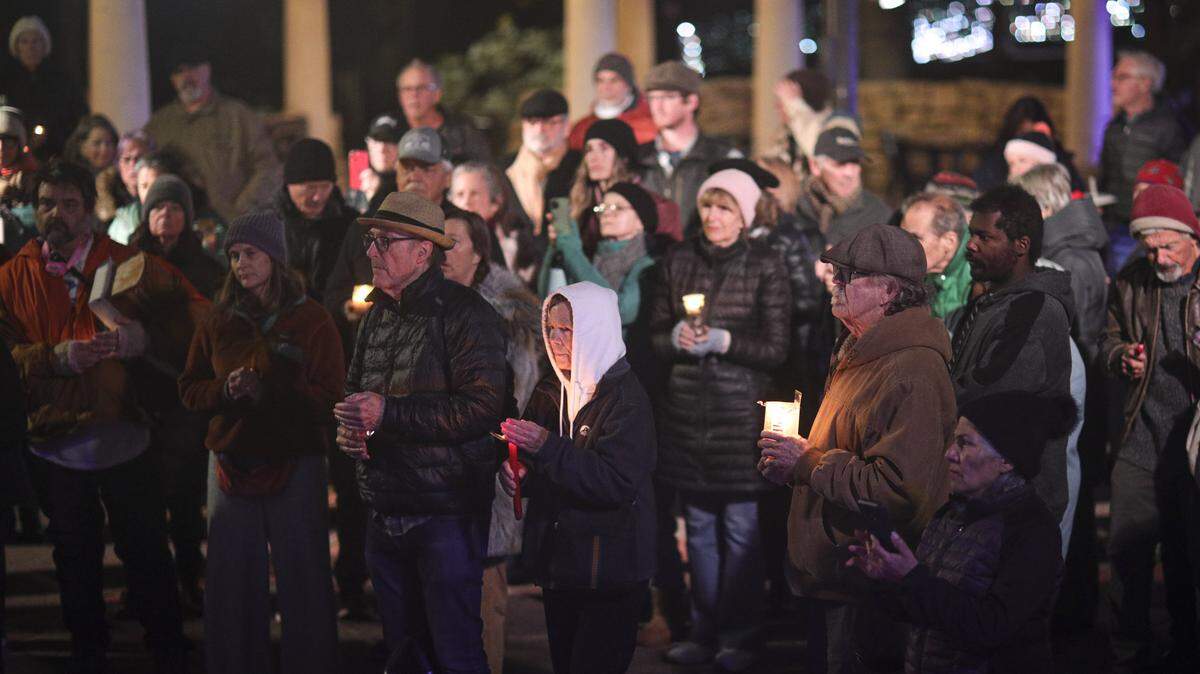
Federal officials appear to be uninterested in investigating the fatal shooting and more interested in blaming the victim.
An eerie repetition of that incident happened in San Luis Obispo County from the 1870s, told below.
Immigration policy is complex and often exploited for emotional political gamesmanship. But viral moments on social media do not craft thoughtful law and policy.
Treating immigration like a game of memes and online viral moments have had deadly consequences.
The breakdown of trust causes deep harm to relationships that police and legal systems rely on to function. Fear is a powerful tool that demagogues use to consolidate power.
Blame the other, demonize them and bring violence to bear. It is an old story.
In the late 1870s-80s the “Chinese question” was the dog whistle language used by the Workingman’s Party to galvanize a violent response.
And to be honest at the time, Democrats and Republicans did not rush to the defense the Chinese immigrants either.
The good old days weren’t in the 1870s.
The Chinese community had suffered violence and discrimination before, but then it got worse.
The financial panic of 1873 and following recession brought hard times.
Up stepped populist politicians like Dennis Kearney who boiled it all down to a simple scapegoat proposition, “The Chinese must go!”
San Luis Obispo County was not immune.
The Dec. 13, 1879, edition of the weekly San Luis Obispo Tribune carried three articles about events in San Miguel.
A correspondent from San Miguel said that Chin Kee was accused of committing “an inhuman crime” against the 5-year-old daughter of Capt. J.C. Currier.
J.S. Carter and Frank Camp waited at the Chinese wash house and captured Kee between 3 and 4 a.m. Another account said he was dragged from his home. (A later article has the spelling Frank Kamp, alias Billy Douglas.)
They immediately brought him to Justice of the Peace, Walter M. Jeffreys, who told them to wait for morning when a proper hearing could be held.
The three walked around the streets waiting for sunrise when, according to the two surviving witnesses, the prisoner attempted to run away.
Camp ordered him to stop and drew his pistol. The prisoner turned to face his captors, but Carter hit Camp’s arm and Kee was killed with a shot to the brain.
A brief inquest in San Miguel was convened, Camp was not charged, and the victim was blamed for trying to escape.
In another column, the editors of The Tribune at the time questioned the account.
They called the killing “unnecessary if not willful.”
“The circumstances attending the shooting give the affair an ugly look,” they wrote.
The men who grabbed Chin Kee were not law officers and had no warrant. No evidence of the crime was presented. Kee was well known and had a good reputation. The parent of the child alleged to be a victim did not testify at the initial coroner’s inquest.
They also questioned the story that the gunman had been bumped, and then the gun went off.
“The shot was too well directed,” the column said. “The examination or ‘inquest,’ conducted by friends of the shootist, was too hasty and the verdict of ‘accidental killing’ a little too lenient.”
The Tribune on Jan. 17, 1880, had the story of a later inquest held in San Luis Obispo Superior Court.
A man named Chin Poo came down from San Francisco to settle the deceased man’s affairs and swore out a complaint that the shooting was deliberate and malicious, even if there was little sympathy in the community for the victim.
New details emerged.
Capt. Currier testified at this hearing confirming the assault on his daughter.
Two Chinese witnesses, Ah Kim and Ah Pauk, testified that they had heard two shots fired near the Mission grounds.
The white defendants were so confident of a verdict in their favor they offered no testimony, and this court returned the same decision, not finding sufficient cause for a murder charge.
The Jan. 24, 1880, Tribune later reported: “San Miguel has solved the Chinese problem. Since the recent ‘accident’ to one of their number in that locality, the Chinamen have all pulled up stakes and left.”
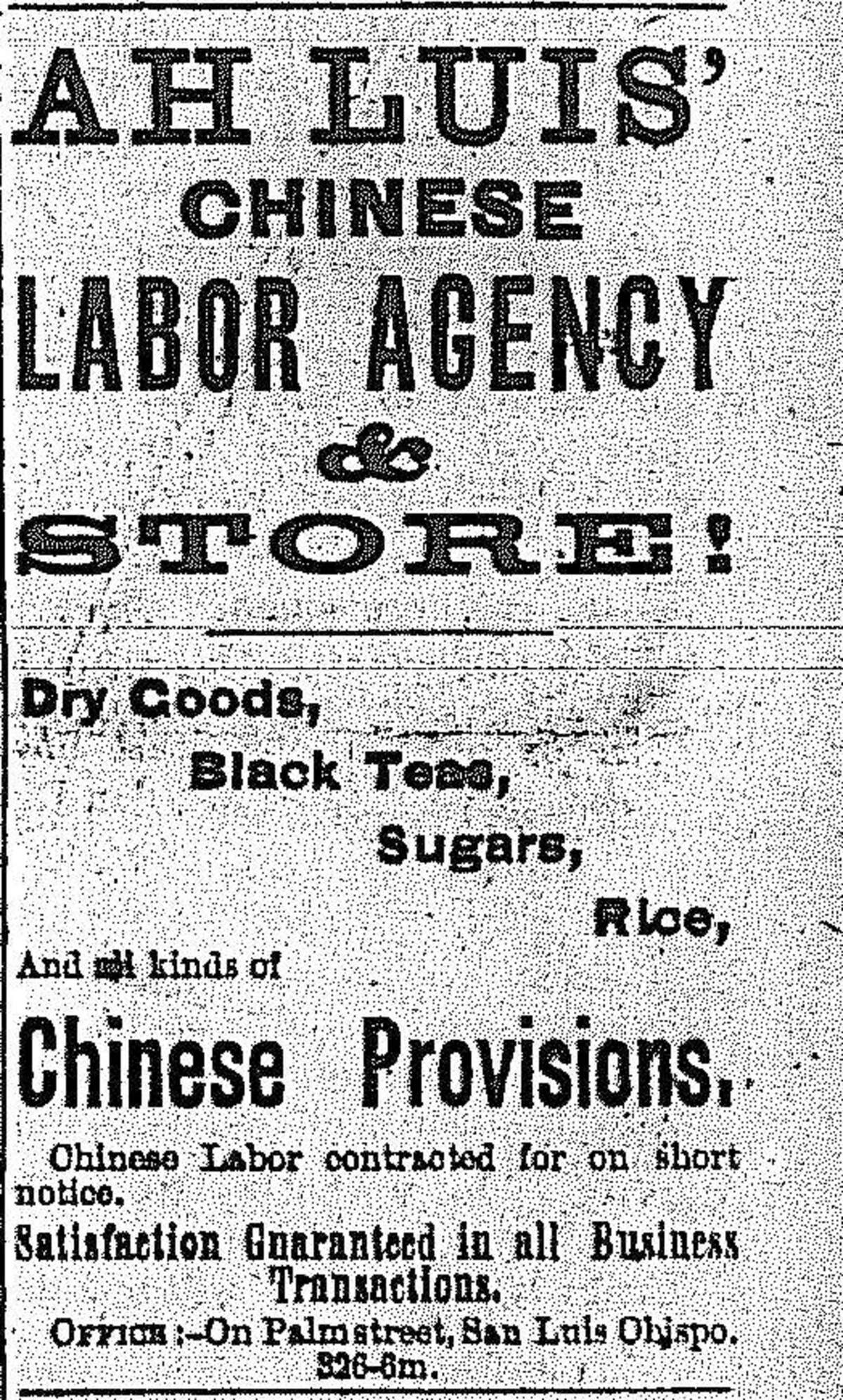
Anti-Chinese advertisements were placed in The San Luis Obispo Tribune even though Chinese businessmen Ah Louis and Leong Yek Lee had previously been dependable advertisers.
And South County historian Jim Gregory has found two instances of the Chinese being driven from the Arroyo Grande area.
The 1870 census listed about 25 Chinese out of the 300 residents.
Ten years later, there was only one Chinese surname in Arroyo Grande. They had been driven from town.
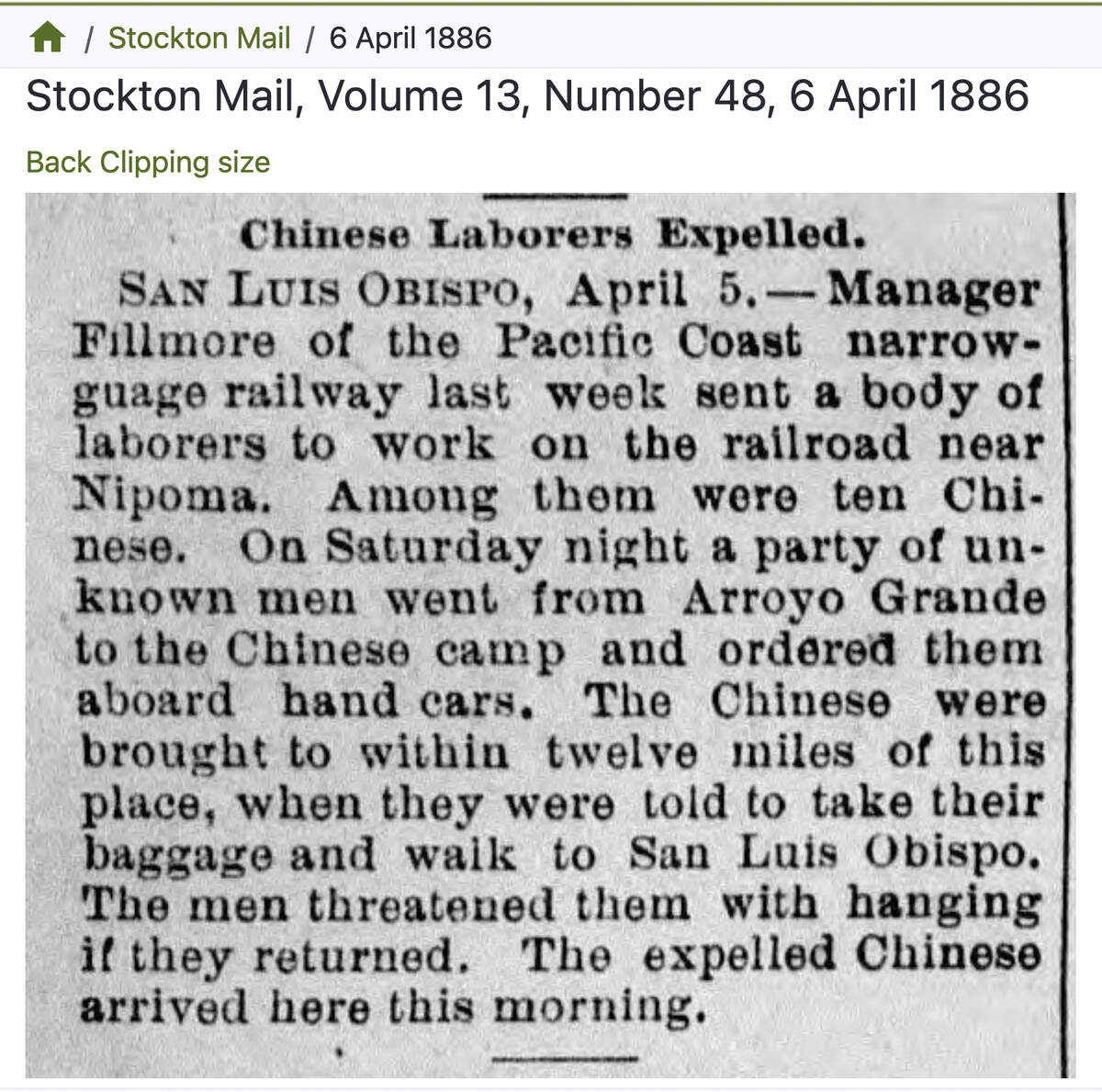
In April 1886, a Chinese work party was part of a larger group building Pacific Coast Railway tracks south of Arroyo Grande. The Chinese were threatened with hanging and removed from the job site.
In February 1886, the Anti-Chinese club, an estimated 300 members marched in Arroyo Grande’s reconstituted Chinatown.
An article in the San Francisco Examiner said, “The procession was quiet and orderly, but meant business. The Chinese must go.”
In other California towns, the Chinese neighborhoods were attacked and burned.
The most deadly of several was in Los Angeles on Oct. 24, 1871, when 19 Chinese men were killed by a mob looting the community.
The Chinese Exclusion Act passed Congress in 1882, making legal immigration almost impossible.
But anti-Asian violence continues to be reported even in modern times.
And in different eras other communities have been targeted.
Next week in Photos from the Vault, expect the story of the time that pioneer San Luis Obispo businessman Ah Louis ran afoul of immigration authorities.