
Holocaust survivor tells story of trauma, faith at Cal Poly. ‘Renewal is possible’
Holocaust survivor Sora Vigorito spoke to a sizable crowd at Cal Poly on Wednesday night, recounting her experience as a young child enduring painful medical experiments at Auschwitz, while sharing a powerful story of how she persisted through intense grief and trauma to become who she is today.
The speech, which was put on by Chabad of SLO and Cal Poly, precedes International Holocaust Remembrance Day, which will occur on Jan. 27.
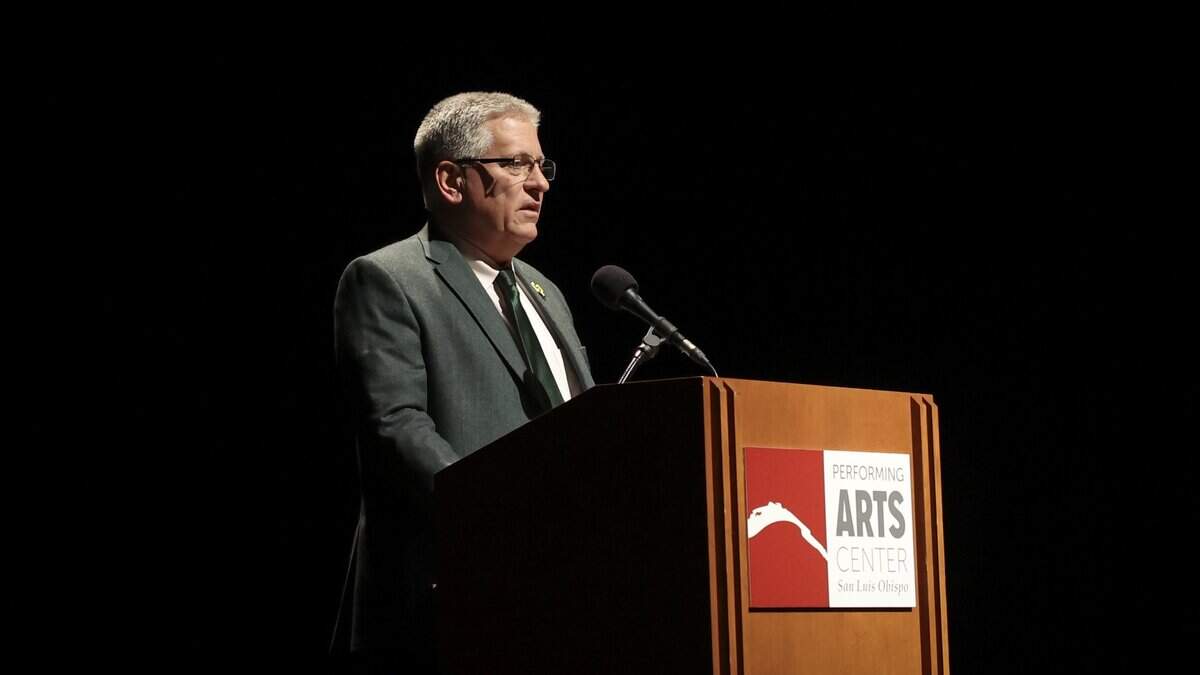
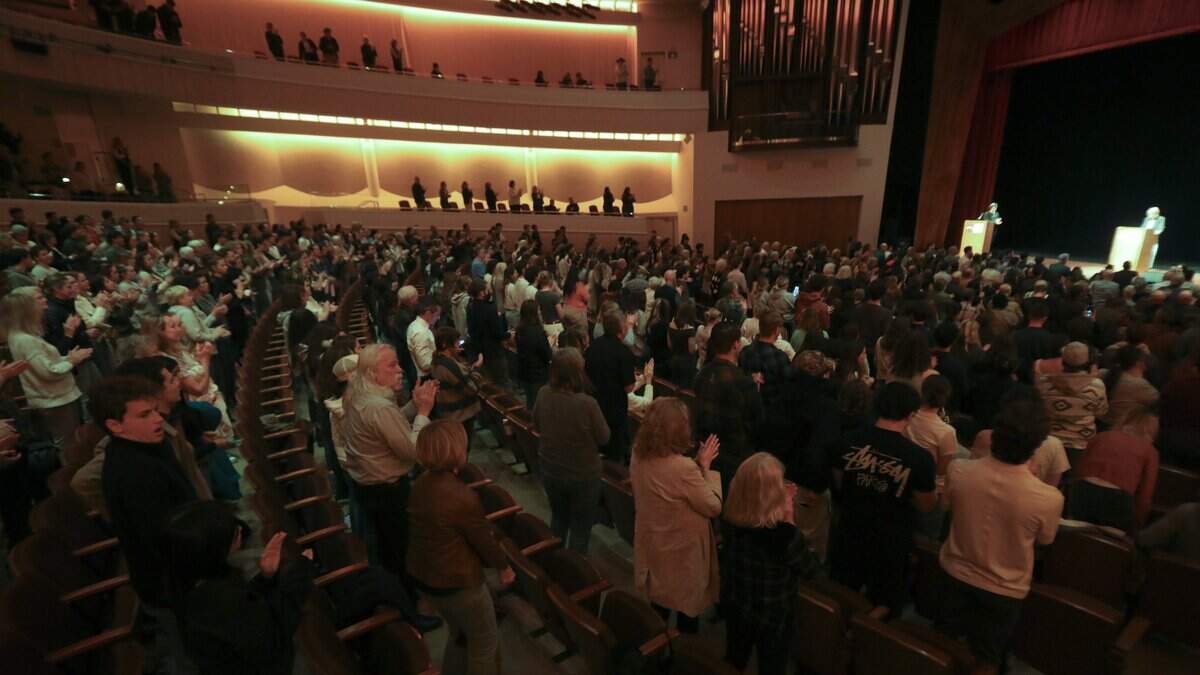
Close to 1,000 people showed up for the event, according to Rabbi Chaim Hilel. Attendees included students, faculty and local residents, as well as Cal Poly President Jeffrey Armstrong, who spoke at the event just before Vigorito.
In May, Armstrong was called to testify before a congressional committee about the university’s efforts to combat antisemitism on campus, where he denied that Cal Poly was a “hotbed” for antisemitism.
“As we gather tonight, I want to express unwavering support for the Jewish community here on campus, in our region and around the world,” Armstrong said Wednesday night. “In times when antisemitism still exists, it’s more important that we all stand together against hate of any type, and that we foster a culture where Jewish identity is respected, valued and protected.”
He continued: “It’s incumbent upon us to listen carefully tonight to Sora, no matter how difficult it is to hear her stories, and to ensure that every new generation knows the history of the Holocaust so it is never repeated.”
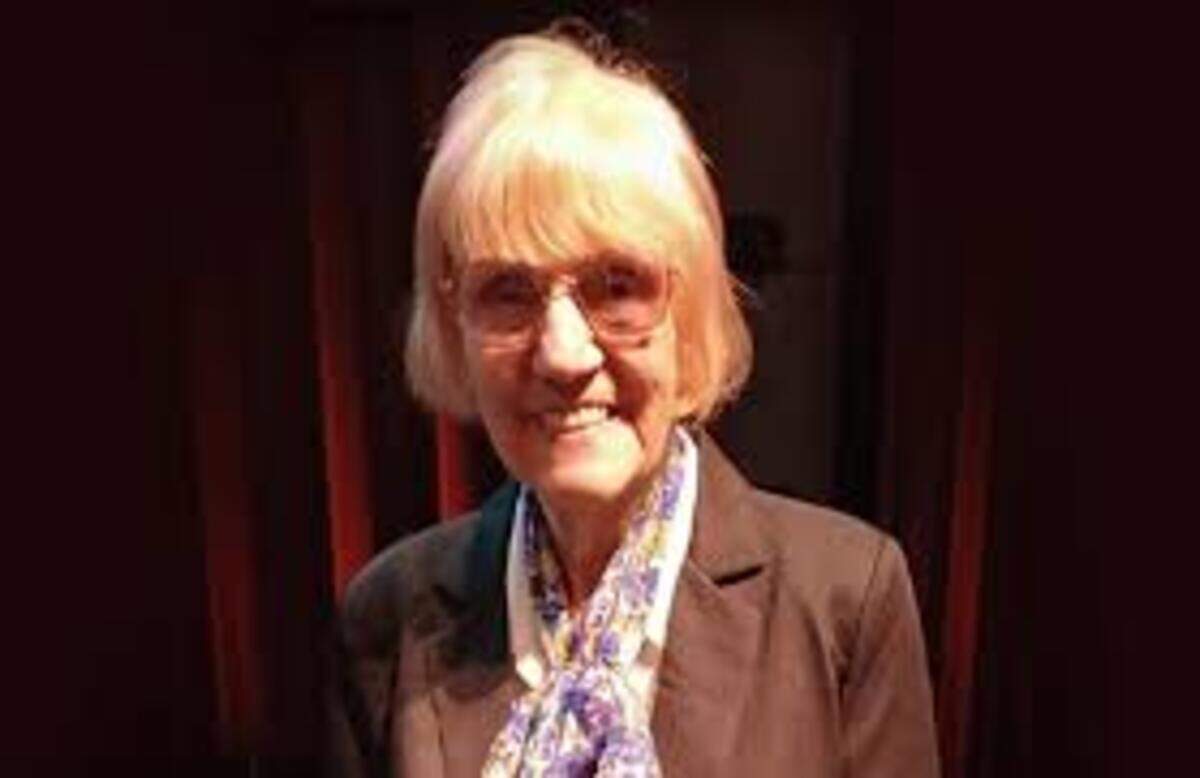
Holocaust survivor shares story at Cal Poly
Vigorito was born an identical twin in Berlin in 1942 — though the exact date is unknown because her birth was never recorded. Her mother was in hiding at the time and her father was imprisoned in Dessau, she said.
Soon after she and her twin sister Hanna were born, their mother was captured by the Gestapo and the two young girls were taken by strangers to their grandparents.
“Our births were never registered to protect us,” Vigorito told the crowd Wednesday night. “Bubbe didn’t know the date, but she always said that we arrived on Yom Kippur.”
During that time, the twins ate mostly gruel and potato peelings, she said. Vigorito reflected on the feelings of hunger and fear they felt.
“We scratched drawings on the southern wall and attached our fears to the drawings,” she said. “Even in those conditions, we didn’t know life could be different. We only knew fear.”
One day in early 1944, uniformed Gestapo officers arrived.
“Our grandmother had taught us that if we see men with black boots in uniforms, that we had to hide,” Vigorito recounted. “She said we, as Jews, were rats and they were cats. We understood that cats hunt rats, and so that’s ... how she protected us.”
The family was forced into a vehicle and transported to a field near a train, where they waited in the elements for days before being packed into the train and sent to Auschwitz.
“There were no bathrooms, no water, no food. People were sick and panicked. Children cried,” she said.
She further reflected on her memories from inside the train, where the stench of sweat, urine and feces permeated the senses. She and Hanna clung to each other and hid under the skirts of women on the train.
“Some people wrote that the Jews act like pigs,” she said. “We acted as any human beings would act under such conditions. Our rights were stripped away. We were made to look like foul animals. That was the Nazi way.”
Twins endure torturous experiments after arrival at Auschwitz
When the train stopped, the twins were carried off by their grandmother — one in each arm — before being transported to the gates of Auschwitz, Vigorito said.
At the entrance, their grandmother attempted to shield them from view under her clothing, but Hanna stumbled, and the girls were scooped up. Vigorito ended up directly in the arms of Josef Mengele — the Nazi doctor now commonly monikered the “Angel of Death” for his torturous medical experiments.
“He turned towards Hanna and then a brief smile, before he handed me over to his assistant,” she said. “We screamed in vain as we were taken away from our Bubbe, who stood pleading with tears in her eyes.”
The twins were transported to the hospital where Mengele conducted his experiments, Vigorito said. There, they were placed in a wooden cage and readied for doctor’s brutality.
“We received injections, mostly spinal blood draws, bone scrapings and skin samples were taken, some that caused third-degree burns,” she said of the torture. “Pain often lasted for many days.”
Vigorito continued: “I was held down for injections without ever receiving any anesthetic. Cuts were made in my legs, bone samples taken. I still have scars.”
At times, Mengele would speak gently to the children, Vigorito said. He once sat her in his lap, which she said was confusing for a child starved for affection.
“But he always returned to torture,” she said.
It was during this time at Mengele’s lab that Vigorito said she experienced her worst day.
It began when, after a round of injections, her sister began to shake. She convulsed through the night, shaking and quivering before eventually becoming still.
“In spite of my young age, I knew she was gone,” she said. “I clung to her body, crying hysterically, refusing to let her go.”
When Mengele came to retrieve her sister’s body, Vigorito slapped him in the face, she said. He took a hammer to the hand that slapped him, crushing her fingers.
Hanna’s death marked the first time in her life that Vigorito was without her twin sister.
“After Hanna’s death, my soul, my Neshama, felt numb, as if it no longer existed within me,” Vigorito told the crowd Wednesday.
She continued: “In her memory, I give this talk. I sometimes feel like she’s standing right next to me with her hand on my shoulder, helping me through this.”
After Auschwitz, Vigorito recounts struggles with faith, trauma
A day came when Vigorito saw other children start to leave the facility.
“As a small child, I didn’t understand liberation,” she told the crowd.
One day, a woman reached into her cage and scooped her out, she said. She had tuberculosis and was taken to a hospital for treatment.
“Our identities were eventually known,” she said. Vigorito’s grandmother was still alive after a year at Auschwitz, and they were reunited before returning to East Germany.
Eventually, Vigorito also met her father for the first time. After four years together in Germany, they immigrated first to Canada and later to the United States, she said.
In the years following the Holocaust, Vigorito said she struggled with her faith and an “internal emptiness.”
“The biggest damage from the Holocaust was the damage to the human spirit, damage to the psychology of ourselves,” she said.
That started to change after she met Rabbi Menachem Mendel Schneerson, whom she credited with helping her find her soul again.
She continued to struggle with mental turmoil, including flashbacks and confusion, but she leaned on her faith to help her through.
“Leaving the Rebbe, I felt a deep wholeness,” she said. “The numbness began to melt, but the pain, emotional pain, remained. It didn’t erase the loss of my sister, but it reminded me that my soul was still alive. From that moment on, my life became more about surviving, it became about living and rebuilding and sharing my story so that others could know that even after the worst losses — the worst — renewal is possible.”
Vigorito responds to crowd questions
After her prepared remarks, which earned her a standing ovation, members of the crowd had the opportunity to text questions for a Chabad leader to ask Vigorito.
During this question-and-answer period, Vigorito shared additional details — including the fact that she covered up the number tattooed on her arm and hid her identity as a Holocaust survivor growing up at school. Her traumatic childhood, in addition to the language barrier, made her an introvert in her youth.
Vigorito eventually met her husband and had children of her own — an experience she said helped her find joy.
“I enjoyed being a mom,” she said. “I define it as, I lived my childhood through my kids.”
One crowd member asked about Vigorito’s decision to write a book, and why she continues to share her story.
“People say it didn’t happen — the Holocaust didn’t happen — but it did,” she responded.
Another member of the crowd asked what Vigorito would say today to Mengele, the perpetrator of her torture, if she could.
She responded that she would first reflect on her own religious beliefs, before saying anything.
“I‘m not to judge, I’m not to condemn,” she said. “I would tell him: Good luck with God.”
This story was originally published January 16, 2026 at 5:00 AM.
.JPG)