As population disappeared, Pismo clam baffled scientists. ‘A mind of their own’
Some critters have more star power than others.
It helps to be cute like sea otters or monarch butterflies.
Or gracefully dangerous like great white sharks and mountain lions.
Or edible like abalone and Pismo clams.
Pismo clam shells have been used as currency and even have a festival named after them.
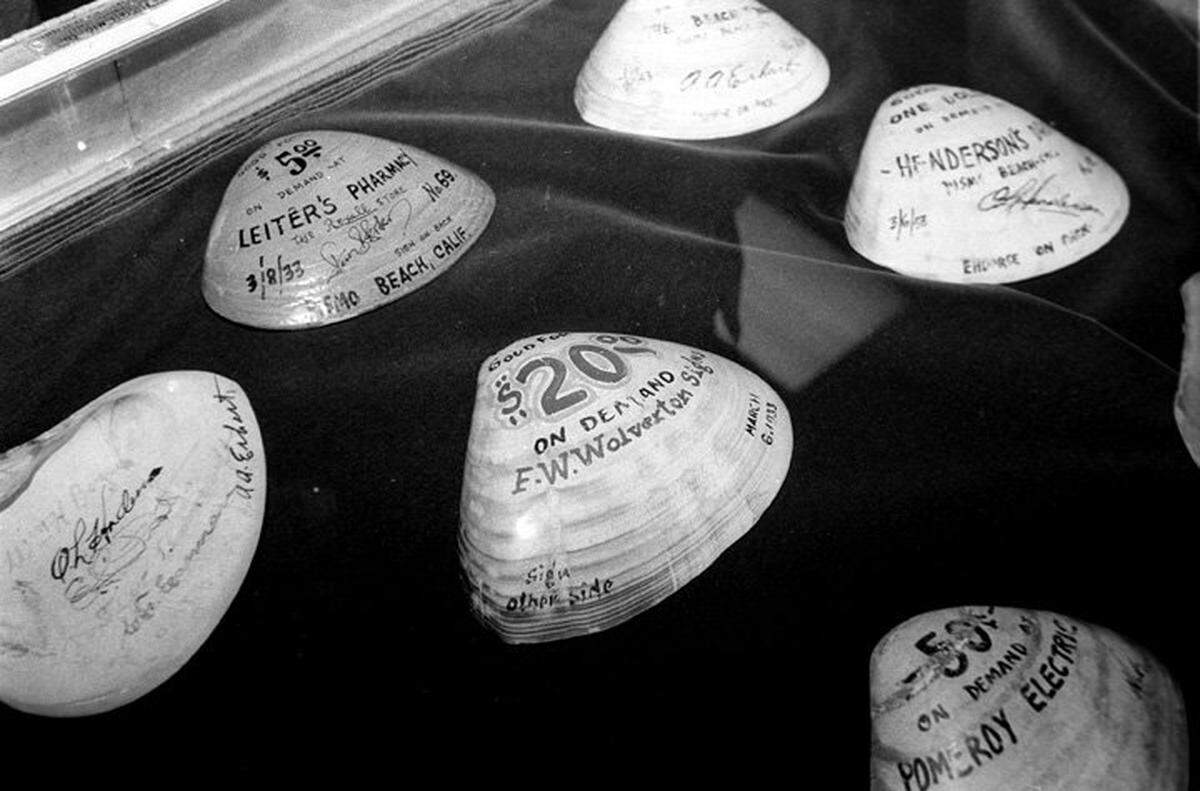
Shells have been found in middens, or refuse heaps, dating back over 2,000 years — a staple food of the coastal Chumash.
At one time, the clams were so plentiful along the Pismo shore that they were harvested in bulk and fed to hogs or chickens.
The greatest commercial harvest was in 1918 with 666,000 pounds gathered by commercial clammers.
Restrictions began in 1911 and falling clam populations have been the subject of study.
After decades of smaller-than- legal-harvest-sized clams, there has been some recent encouraging signs that the population might be in a better place.
But the explanation of why remains elusive.
Four decades ago, a researcher was trying to jumpstart the recovery by operating a clam nursery.
Though there has been a separate successful abalone farm established for many years in Cayucos, I’m unaware of a successful program of clam husbandry though it was not for lack of effort.
Arthur Haseltine spent over five years studying how to propagate the Pismo clam.
After a career with State Fish and Game he retired and pursued other interests like photography. He died March 3, 2018, at the age of 77.
Judith Walthers von Alten wrote this story for the Telegram-Tribune on June 24, 1981.
The Pismo clam may thrive again
Single-handedly, marine biologist Art Haseltine may bring back the clam that made Pismo Beach famous.
Haseltine has dedicated the past five years of his life to creating Pismo clams in the test tube.
If he can discover what makes the sensitive bivalve spawn and thrive, some day soon Pismo clams may again crowd beaches as they did 30 years ago before man and sea otter helped decimate them from as far as Half Moon Bay in the north to Pismo Beach in the south.
Haseltine is making progress. A year ago he discovered the crucial secret that Pismos must have sand at age 20 days. Otherwise, their shells become mortally “cruddy.”
Proudly he shows off “the largest Pismo clam in captivity,” about 1 1/2 inches across and sole survivor of the last batch of clams spawned before the sand discovery.
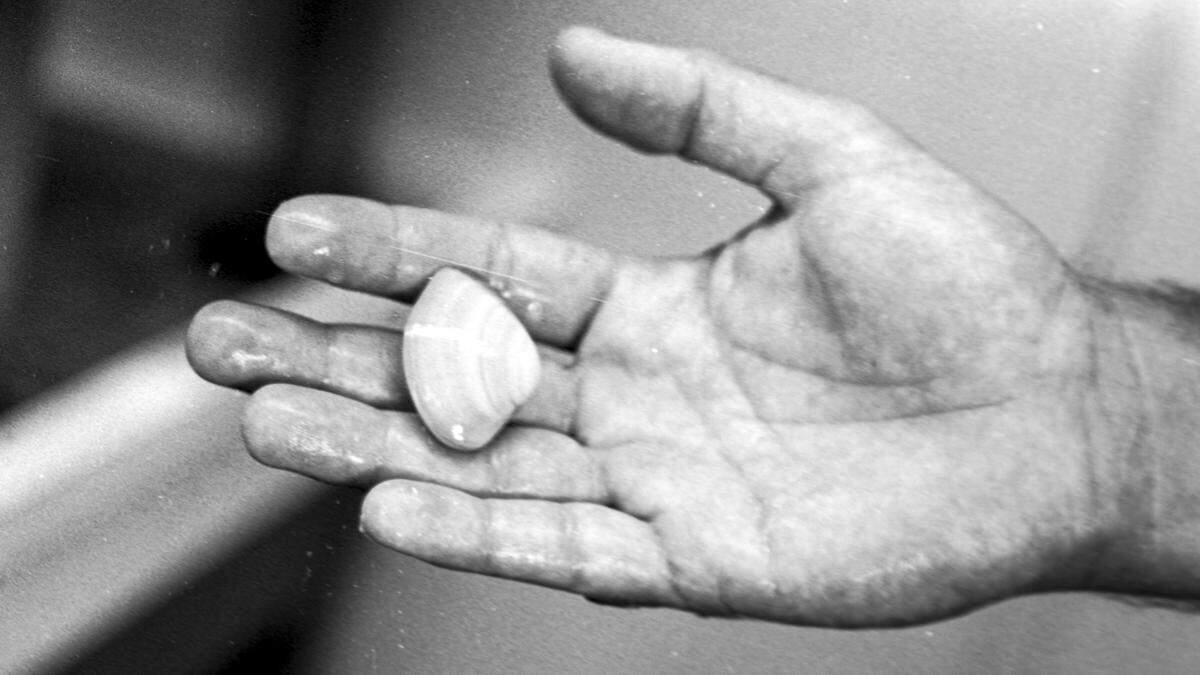
“I wouldn’t want to lose that guy for anything,” he said affectionately. —
Feeling is necessary to successfully grow sea life in the laboratory, he said.
“Mariculture is more than an art than a science right now,” said Haseltine. “You have to have feeling for the animals. It’s not a mechanical thing. You have to get involved with your animals.”
By 1982, Haseltine hopes to begin seeding beaches not frequented by sea otters with year-old clams. About 3,000 of the laboratory’s clams are seeding size, he said.
If the experiment works, it could mean a future for commercial clam breeding.
Haseltine doesn’t get ribbed too much about his solitary work 123 miles north of San Luis Obispo at the state Fish and Game’s Granite Canyon laboratory, although he acknowledged that friends and acquaintances “never hesitate to ask how the clams are doing.”
It took the Humboldt State University invertebrate zoologist four years to discover that Pismo clams need sand at age 20 days. Before that, he experimented unsuccessfully with different antibiotics and food, thinking the phytoplankton diet or bacteria were making the shells dirty. Equally challenging has ben figuring out when and how the cantankerous clam spawns.
“Other shellfish you can fool into spawning,” Haseltine explained. “The Pismos, they have a mind of their own.”
Although Pismos respond somewhat to “thermal shock” or temperature changes in the water, in the fall, male and females shoot sperm and eggs into the water for chance fertilization only if they are “ready” and in the mood.
Haseltine said this year he will probably travel to Zuma Beach in Southern California to find adult clams for spawning because his usual Pismo Beach hunting grounds have become so depleted.
Unlike other bivalves that use their cilia to swim around and eat almost immediately after fertilization, the new-born Pismo gametes or fertilized cells, settle to the bottom by the second day of their lives.
Pismos grow slowly, reaching adulthood in five years, and constantly eat single-celled, rust-colored phytoplankton. Most of the bivalves energy goes into building a heavy, calcium shell, Haseltine said.
Before the larvae are even visible to the naked eye, Haseltine places them in a beaker of fine sand and water. By day 50, when they’ve grown to about the size of the sand grains, Haseltine will know whether they made it.
By age six months, Pismos the size of 1/4-carat diamond chips are robust creatures. Haseltine held up a beaker of “juveniles” who conquered traumatic Clam Puberty, the larvae stage; some of the miniature adults sucked in food via transparent siphons while others used their “filter feeders” as feet, tracking fine trails across the sand.
Haseltine’s two colleagues devote their energies to growing abalone at the state’s only running seawater laboratory. Whether the abalone venture pays off commercially is yet to be seen, but the more abalone costs in the markets, the more feasible the work will become, Haseltine said.
Pacific Gas and Electric Co. is paying for most of that research, he said, as part of its out-of-court settlement when experiments with copper cooling towers at Diablo Canyon’s Nuclear Power Plant killed shellfish in the surrounding waters.
To Haseltine, it only makes sense that sealife is farmed to replace what is hunted. But mariculture, as it’s called, is a sensitive political issue because many fishermen fear for their livelihood.

Almost as sensitive is the controversy over sea otters, accused of decimating the abalone, Pismo clam and their shellfish populations.
Because otters have no blubber, they rely on air trapped in dense fur and energy from food to keep warm, said Earl Ebert, director of the Granite Canyon laboratory who studied the otters for four years.
Daily, otters eat up to 25 percent of their body weight, he said. For a 50 pound mammal, that means the adult can consume as much as two tons of sea urchins, abalone, Pismo clams and other shellfish in a year, he said.
As many as 16,000 otters probably roamed the California coast before hunting reduced that number to about 50 in the early 1900s, Evert said. Now about 1,800 to 2,000 otters roam the coast as far north as Soquel Point above Monterey Bay and south as far as Oceano, he said.
Otters have been spotted as far south as Point Conception, and Ebert estimated they would be calling the spot home in five to severn years.
From a Point Conception toehold, otters can swim to forage at the Channel Islands, the site of most of the state’s commercial fisheries, Haseltine said.
Between preservationists wanting the otters protected and the fishermen wanting them trapped wholesale, Ebert said “compromise is in order.”
Haseltine doesn’t know how much it would cost to commercially grow Pismos to restock beaches. The technical aspects of spawning are what interest him, and some Mexican researchers are watching his work closely in hopes of repeating his success at Mexico’s Magdalena Bay, the clam’s southernmost habitat.
After 6 1/2 years with spot prawns Pacific oysters and the “nuisance” of Dungeness crabs — that molted, ate each other or left their dinner of squid for the marine biologist to fish out — Pismos are a pleasure to Haseltine.
“They don’t talk back. They don’t snap back. They feed on (cheap) phytoplankton.”