
In Pismo Beach, clams were once as good as gold
When the economy falters, speculators often clamor that the nation needs to return to the gold standard.
In March 1933, in the midst of the Great Depression, Pismo Beach turned to its own form of gold — Pismo Clams.
Eleven of the town’s merchants got together to issue the clam currency. Among them: K.L. Phillips service station, Henderson’s Drug Store, Hi-Way Cigar Store, Leiter’s Rexall Pharmacy and Restwell Cabins. Even the Pismo Beach Post Office accepted clam currency then.
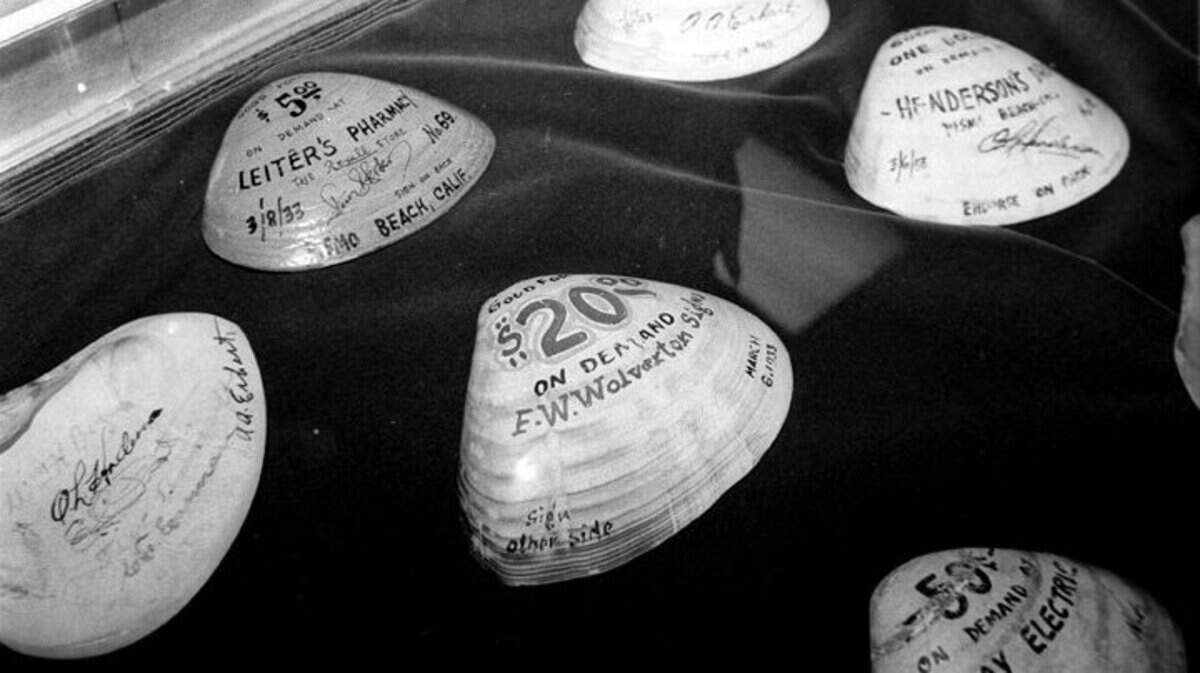
The shells were marked with India ink in denominations ranging from 25 cents to $20.
One shell reads “Good for $20.00 on demand F.W. Wolverton Signs, Sign other side, March 6, 1933.” Another carries a $5 value at Leiter’s Rexall Pharmacy. Many of the clams were signed inside when they were redeemed.
In creating the currency, the Pismo Beach business owners turned back the clock to the era before the Civil War when it was common to find locally produced scrip.
Some libertarians and business advocates say local scrip is a good way to keep goods and services trading in a local community without watching some of the money leave town for taxes or corporate profits.
But the flexibility of folding money always seems to win out. Moreover, those who use scrip tend to view its value in terms of dollars.
When someone asks, “How many clams did that cost?” they are asking for a value in dollars, not bivalves.
In 1985, the Pismo Beach City Council considered buying back the clam scrip from an Arcadia coin and stamp collector for $3,000. The clams are now on display at City Hall in the lobby by the city clerk’s office.
Not a bad investment, especially considering how rare it is to find a legal-sized clam in Pismo Beach these days.
This story was originally published July 17, 2013 at 3:26 PM with the headline "In Pismo Beach, clams were once as good as gold."