PG&E wanted to build artificial reef from Diablo Canyon ‘junk.’ Here’s why
When flying over something from the air, or photographing from a distance, it is easy to lose track of the scale.
Diablo Canyon nuclear power plant is that kind of big.
Large protests, payroll, property tax contributions, everything about the big scale is something that is hard to wrap the mind around.
In a Feb. 15, 1973, story, Elliot Curry wrote: “It is the third largest construction project ever built in California and PG&E now estimates the cost at $665 million.”
Curry doesn’t elaborate, but it would be a fair guess that water projects in California would be the only construction on a larger scale. The California State Water Project cost was estimated in news articles at $2 billion when it got underway.
Diablo construction costs soared far above the 1973 estimate, into the billions of dollars, with the Hosgri fault discovery, Three Mile Island accident and a blueprint error and other factors adding to the bill.
Today, the plant generates nearly 9% of California’s electric supply and 17% of the state’s zero-carbon electricity according to PG&E.
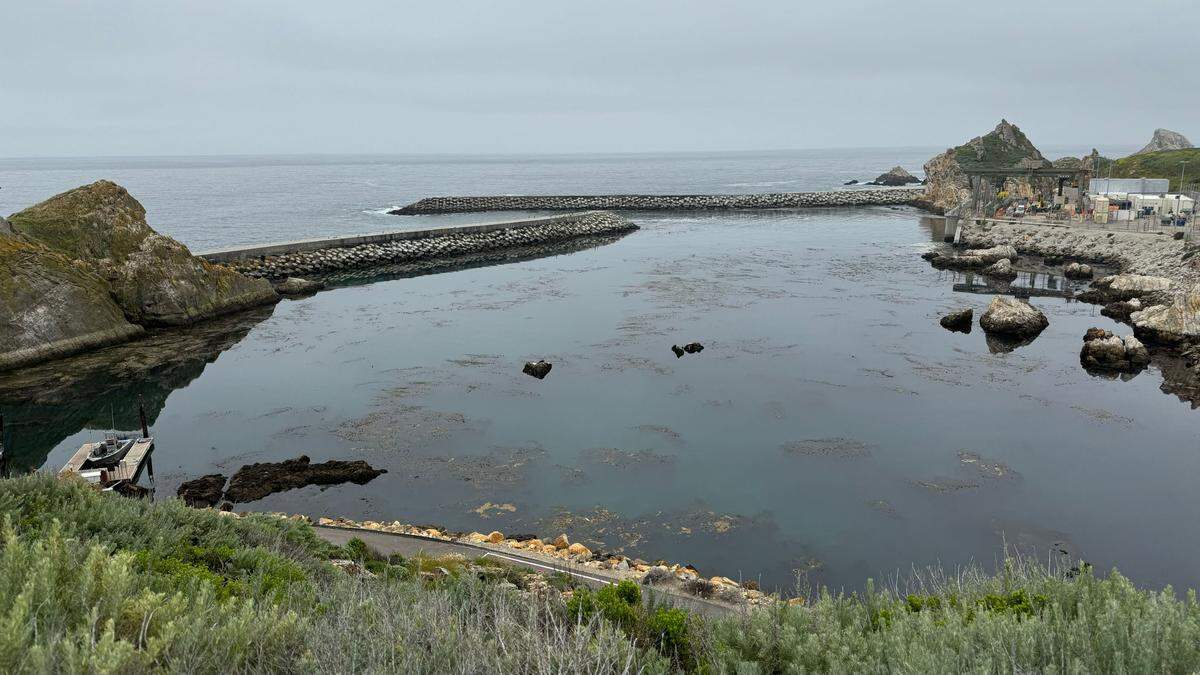
Building the plant required solving a number of engineering problems.
One was building breakwaters protecting the cooling water intake structure. The original design did not include a breakwater but in response to studies the structure was added to the scope of the work.
Giant concrete tri-bars were used that lock together like Legos on top of a base of quarried rock.
A 1970 photo shows a crane lifting and placing the concrete structures, and a 1971 photo shows more rocks waiting to be placed.
But even those massive tri-bars could be damaged by an angry ocean.
Over the years, parts of the outer breakwater were broken by storm-driven waves.
In 1984, there was a proposal to dispose of the broken concrete, but I’ve been unable to find if the proposal was ever carried out.
Brooks Townes wrote this story March 16, 1984:
PG&E wants to make ‘junk’ reef
Pacific Gas & Electric Co. has tons of refuse at Diablo Canyon it needs to dispose of and one idea is to create an artificial reef with it just north of Port San Luis.
The plan is to create a breeding ground for kelp and rockfish — an idea endorsed by fishermen and marine biologists.
The question is: Can the plan receive all the required agency endorsements by July, the time Diablo engineers say the material has to be out of their way?
Biologist Thomas C. Wilson, a PG&E employee, explained that the refuse consists of reinforced concrete tri-bars — huge things resembling a child’s toy jacks — that were part of the nuclear power plant’s breakwalls in Diablo Cove. They broke up during last winter’s storms.
The cement junk is inert, free of contaminants, Wilson said. “They have been used successfully for construction of artificial reefs in the past.”
In an effort to grease the project along with the California Department of Fish and Game and other agencies, Wilson appealed for support from fishermen’s groups and the Port San Luis Harbor Commission.
The plan got the Harbor Commission’s endorsement this week and Wayne Moody, president of the Port San Luis commercial fishermen’s association, said he was not opposed.
“From what I understand, it is not planned where it would impact commercial fishermen at all,” he said.
Jodi Giannini, a leading Morro Bay commercial fisherman, agreed and noted that commercial draggers cannot by law work that close to shore so there’s no chance the reef will snag commercial fishing nets.
Thomas Wilson has worked on the plan with Kenneth C. Wilson, marine habitat development coordinator for the Department of Fish and Game, and Laurence “Bud” Laurent, area Fish and Game manager.
It tentatively calls for up to 15,000 tons of stone and concrete to be dumped in four 60-foot by 200-foot piles set in pairs 200 feet apart, with 1,000 feet between pairs.
The exact location has yet to be determined, but it will be roughly four miles north of Point San Luis and about a half-mile offshore in about 40 feet of water.
Laurent said he would dive in the area to find the right kind of hard packed sand bottom between natural pinnacles.
Artificial reef design and placement has become an esoteric science, Thomas Wilson said. The primary aim with this reef is to provide a nursery for kelp and rockfish with its fairly remote location making it less of a “fishing reef.”
Fishing reefs are those placed handy to fishermen and have not proved all that beneficial since the fish are caught right away. Dropping a line around them is a bit like fishing in a rain barrel — the fish have less of a chance to grow up and spawn more fish.
This reef, which would be built by PG&E but managed by the state, would provide a good habitat for several varieties of rockfish and lingcod, kelp and possibly abalone, biologists reason, and its location should give them a chance to grow to adulthood.
Building the reef, its proponents say, would be a better use of the power plant refuse than simply dumping it way out at sea or disposing of it ashore.
Some of the refuse could be barged to Estero Bay where Laurent has urged construction of the two fishing reefs atop two surplus Texaco oil pipes about 1 1/4 mile north of Morro Rock. The pipes end there, creating a minor hazard for some commercial fishing operations.
Laurent’s solution to the problem would not reduce the hazard — it would increase it — but it could create a handy attraction for hook-and-line fishermen.
Giannini said the reef idea was a little bothersome to commercial fishermen but not enough to raise a fuss over. Building reefs over the pipes would also save Texaco money, and it would be less damaging to the environment than removing the pipes, Laurent said.