New SLO County election machines were touted as foolproof in 1962 — they weren’t
Elections are the foundation of how we govern in the United States.
Trust in the process relies on transparency and accuracy.
As tabulation continues in San Luis Obispo County, we are reminded elections are not a simple process. What human enterprise involving power and money is?
Each state and local election official weighs decisions based on the law, budget, access, technology, time and other local considerations.
All of these rules are given different weights in different states, with accuracy being the outcome.
One example of different decisions between two large states: Florida closes voter registration 29 days before elections with no provision for Election Day registration. California’s deadline is 15 days before election with conditional registration and provisional ballots available on Election Day.
California argues enfranchising voters makes for a more representative result, but it also complicates and slows the process of counting.
Elaina Cano, San Luis Obispo County’s Clerk-Recorder and registrar of voters, explained the process in a recent opinion piece.
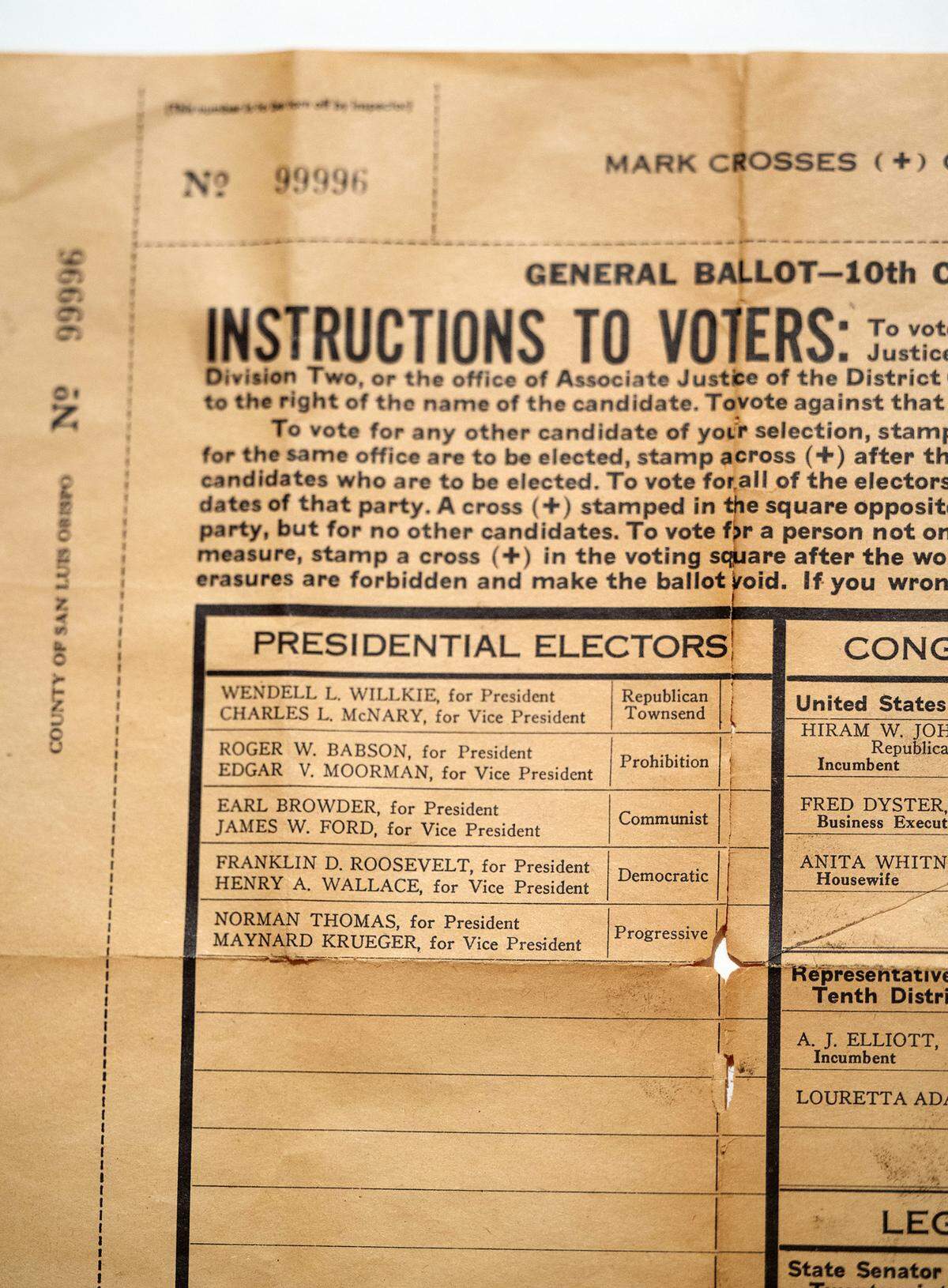
It was a simpler time in 1957 when San Luis Obispo County decided voting machines would improve tabulation speed and lower printing costs. The county began using them a year later.
The machines were touted as foolproof and fast.
But when they failed, they failed big.
The equipment crash in the primary election had been so bad that Shoup voting machine company vice-president, Ransom F. Shoup, had personally directed the overhaul of balky machines.
The county would use the machines for less than two decades and eventually scrap the huge mechanical machines and replace them in 1975 with punch card ballots.
Barney Barnett wrote this story Nov. 2, 1962, just before the general election.
$250,000 GAMBLE
Paper Ballot Vs. Machine
Although San Luis Obispo County has almost $250,000 invested in voting machines, taxpayers will still have to pay $6,000 for a supply of paper ballots for Tuesday’s election.
This extra expense is the result of the machines failing to function properly during the June primary and an ensuing order from the board of supervisors to make paper ballots available at all polling places in the county.
At their Oct. 1 meeting, the supervisors voted to instruct county clerk A.E. (Mike) Mallagh to have old style paper ballots available for use in conjunction with the machines if he felt it were necessary and in the public interest.
As a result of this order, Mallagh said voters can take their choice of voting by machine or by paper ballots when they go to the polls Tuesday. Mallagh’s directions have resulted in the backers of one candidate, Sam Borradori, urging the use of paper ballots.
Borradori is running against incumbent Jesse Drake for the second district supervisorial post, representing the north coast area.
Drake has advocated a program of voter instruction in the use of the machines and a recent demonstration in Morro Bay resulted in some 600 persons checking out the mechanical ballot.
Voting machines were introduced to San Luis Obispo County on a trial basis during the 1958 election. As a result, some of the machines were purchased and functioned properly during the 1960 elections, although there was some grumbling among the electorate about the long wait at the polls
In this June’s primary, many of the machines either broke down completely or only allowed ballots to be cast for certain combinations of candidates. This malfunctioning caused a storm of protest from aroused citizens who were unable to vote for the candidates of their choice.
“I was disenfranchised by a machine,” M.G. Stephanovich of Paso Robles charged at a meeting of the board of supervisors. Other county residents vowed they would fight against machine voting to the end.
It was at this meeting the subject of giving voters their choice of ballots was first brought up. Mallagh pointed out if this was done it would result in a terrific expense to the county.
Supervisor Roland Gates, first district, Paso Robles, pointed out the expense would be far greater if the county was hit by a taxpayers suit of if a complete new election would have to be held.
“I have been opposed to voting machines from the start,” gated declared, “they are expensive cumbersome and inadequate.”
Drake said the voting machines had been purchased in an effort to same the county money and reduce the costs of printing paper ballots. He urged giving the machines another trial and setting up instruction sessions for voters unfamiliar with their operation.
Ransom F. Shoup took full blame for the machine break down, claiming an improperly constructed small part had caused the trouble. However, the voting machine company official also blasted the California election laws and implied voters were not using the machines intelligently.
The supervisors also decided to delay purchase of more machines pending the result of the November general election.
As a result of the board’s order voters in 74 of the county’s 86 polling places can take their choice between using machines or paper ballots.
In the other 12 voting places only paper ballots will be available.
The county’s 169 precincts are combined into the 86 polling places.
If nothing else, the election should give county officials some idea of what type of ballot casting method voters prefer.